
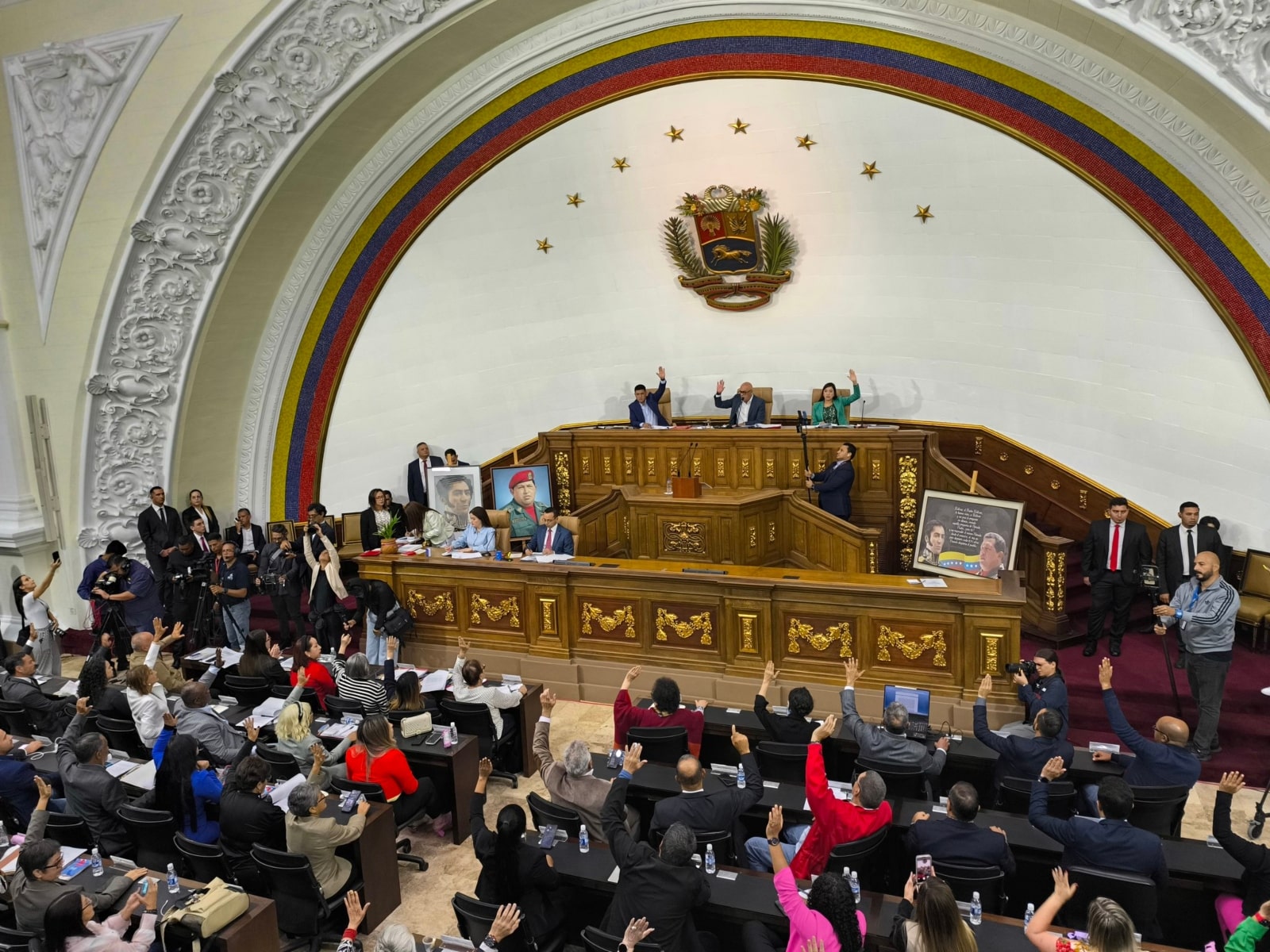
The 2025 National Assembly (AN 2025), made up mostly of the United Socialist Party of Venezuela (PSUV), gave first-round approval to the reform of the Anti-Hate Law on November 3, now renamed the “Law for Democratic Coexistence, Peace and Tolerance” (LCDPT), despite complaints from Venezuelan civil society that the law still violates the human rights of Venezuelans.
“Hate, unfortunately, cannot be repealed. Hate cannot be repealed, and it cannot be contained, because it starts with tweets and ends with people being burned alive. It starts with heated opinions and then ends with denying the human condition of the adversary,” said Jorge Rodríguez, president of AN 2025, during the debate held on November 3.
Rodríguez referred to the case of Orlando Figuera, a Venezuelan who was killed in April 2017 during protests against the government of Nicolás Maduro (PSUV). Although chavismo says the killing was motivated by his political leanings, the Public Ministry later confirmed that the homicide was not linked to any political movement, to the protests taking place at the same time, or to any act of discrimination.
The reform of the Anti-Hate Law sets fines calculated in bolívares that could exceed 10,000 dollars. In addition, the Ministry of Internal Relations, Justice and Peace would be responsible for setting the amount of the fines according to the severity of the offence, its reach, the medium used, intent, economic benefit obtained and repeat offences.
NGOs such as Espacio Público have denounced that the reform keeps “ambiguous” terms that could harm the population, and that the state could apply charges under the LCDPT without discretion. In addition, the law contains no mechanisms to repair the fundamental rights of more than 900 people, including more than 118 adolescents, who were arbitrarily detained under the Anti-Hate Law.
“Reforming fear”
The Freedom Parliamentary Group (GPL), a group of lawmakers critical of chavismo, voted against the reform.
“Venezuela does not need to disguise intimidation to make it more sophisticated or dress it up in good intentions,” said deputy Amelia Belisario. “Venezuela needs to eliminate all the rules that violate constitutional guarantees.”
The GPL said it submitted a motion to repeal the Anti-Hate Law on October 6, but the ruling-party Parliament has not followed the legal process to include it in the commission in charge of the reform, nor held the public consultations or consultations with deputies.
“This law has been questioned since its creation [in 2017]: it was used to institutionalise persecution and fear,” Belisario added. “Switching prison for fines is not enough, because the project would keep its frightening and coercive essence [...]. Fear should not be reformed.”
The deputy said that if AN 2025 intends to carry out a democratic transition, as it has said it does since January 3, 2026, Parliament must repeal the law as a sign of respect for human dignity.
PSUV wants to continue with the reform
Pedro Infante, a PSUV deputy and member of the commission in charge of the reform, said that repealing the Anti-Hate Law “would mean denying the real problem of violence and hatred in politics, which today show signs and clear intentions to reappear from far-right political actors.”
The deputy stated that the reform seeks to eliminate the punitive approach and establish an educational one.
“This law must be a collective commitment that obliges us to guarantee peace,” Infante said. “It cannot and must not become an instrument of partisan struggle... This law cannot be tailored to politicians, whether chavistas or opposition, to resolve their irrational differences,” the chavista lawmaker said.
He said the law “was born from a moment of irrational confrontation,” but continued to defend its existence: “I could agree with the statement that this law should not have existed, because the outburst of violence should not have happened [...]. This law is a product of that context.”
Rodríguez said the law is necessary. In response to Belisario’s call for gestures of change, the president of the ruling-party AN said the PSUV had “unblocked all media outlets” that until three weeks earlier had been censored by the government. However, the NGOs VE Sin Filtro and Espacio Público say that more than 100 web domains remain blocked, including more than 20 media outlets.