
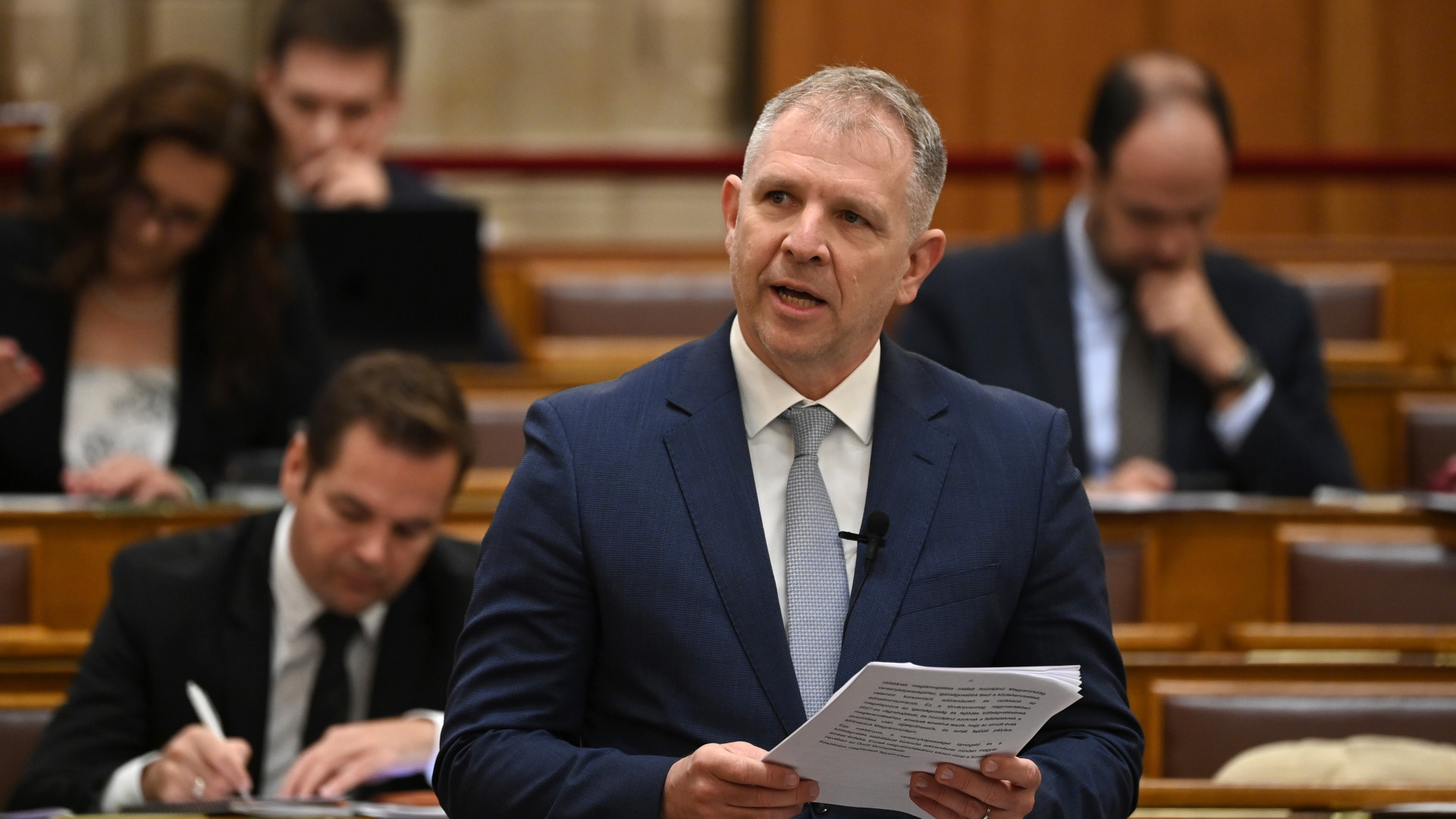
Deputy State Secretary for tax policy Attila Zoltán Kövesdy, presenting two bills on the taxation of companies and on amendments to various tax-related and other related laws, told Parliament that one of the proposals contains amendments concerning the taxation of large companies, particularly corporate tax, while the second proposes several changes affecting different areas of tax law.
He said that a tax system reflects a state's view of society, and that if the tax system is in line with government policy, that is evidence of credibility. The previous government spoke about competitiveness, while its tax system was inefficient, unjustifiably supported domestic and foreign big capital, and did not sufficiently help the development of the domestic economy, he argued. He added that while they spoke about supporting Hungarian people, "the tax rules they built and operated were full of loopholes enabling tax avoidance and rules that favoured companies close to the NER, and gave competitive advantages to politically embedded businesses."
He stressed that since the election campaign, the Tisza government has consistently represented the principle of creating a functioning and humane Hungary, and this is reflected in these bill proposals. Making the sharing of the tax burden fairer through simpler and more efficient rules, increasing competitiveness and closing the loopholes of tax avoidance is "nothing other than
the translation of the government's political ideas into the language of taxes," he said.
He said that for the government, a "fairer tax system" means that those who, thanks to their higher incomes and wealth, are able to do so should bear a larger share of the tax burden, and thereby indirectly reduce the burdens of those in more difficult situations. He said this is a principle regularly reflected in the Tisza government's decisions.
Summarising, the state secretary said the proposals introduce complex changes that, alongside supporting the revenue side of the budget, contribute to Hungary's competitiveness, make the tax burden fairer, modernise the tax system and reduce tax administration. He said this package contributes to creating the conditions that allow Hungary to be "rebuilt after the devastation of recent years and set back on a path of development."
State secretary's closing remarks: tax proposals contribute to stable budget and growing economy
Responding to points raised in the debate, Kövesdy stressed that the government would reduce this year's 7.5 percent deficit to 4.9 percent next year, but tax measures account for only 25 percent of the deficit reduction; the adjustment does not come from tax increases. In his assessment, the previous government carried out a much larger adjustment in 2022 focused on tax increases.
He emphasised that the tax bills submitted by the government will contribute to a stable budget and a growing economy.
Responding to Fidesz criticism on lump-sum taxation, the state secretary said the former governing party had 16 years to settle the increase of the cost ratio, but did not do so.
On the public health product tax (NETA), he promised the government would consider the direction of regulation, while recalling that the previous government abolished in 2025 the donation option similar to the TAO system for NETA.
Responding to criticism of abolishing the TAO system, he said the government did not decide this by accident: the system was a breeding ground for abuse and corruption, and the State Audit Office report also pointed to its disadvantages and harmful consequences.
In response to points raised in the debate, the state secretary confirmed that the review of casino concessions is under way, and the area is expected to move to the Ministry of Finance.
Cover image: Attila Zoltán Kövesdy, state secretary for tax policy at the Ministry of Finance, delivers his opening speech in the joint general debate on the bills concerning corporate taxation and amendments to tax-related and other related laws at the plenary session of the National Assembly on 4 November 2026. Source: MTI Photo/Attila Kovács