
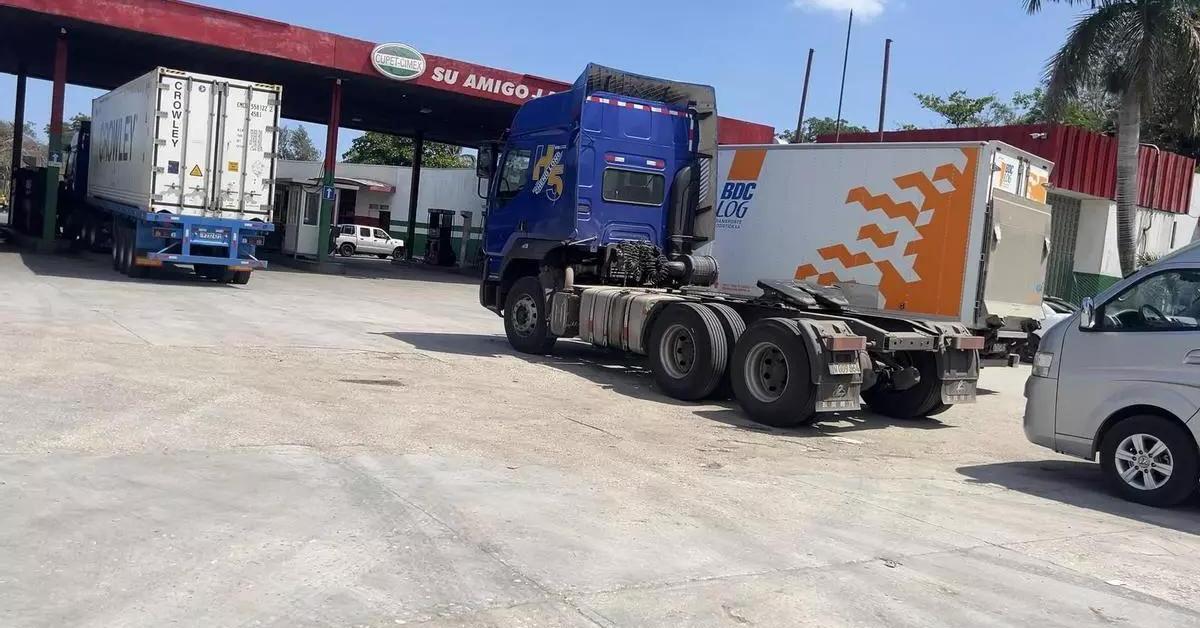
Madrid – U.S. gasoline shipments to Cuba rose in August compared with the previous month, although the drop from June is significant. According to data from the U.S. Energy Information Administration (EIA), 562,000 barrels were exported to the island during the month, more than the 467,000 in May and far fewer than the 778,000 in June. The figure could still be provisional, as it may undergo a correction similar to the one made the previous month.
In July, official data caused a major stir when it reported shipments of 3.2 million barrels, an amount far larger than Hugo Chávez's Venezuela ever sent at its peak. In mid-October, the Census Bureau and the EIA corrected the data, turning the record into the opposite: only 182,932 barrels were actually exported, the lowest figure since February. The error occurred when shipment forms at the ports of Miami and Tampa were filled in with quantities in liters or gallons instead of barrels. One barrel equals 158 liters or 48 gallons.
With the situation clarified, and given that the error affected only volume and not value, August's figures represent a strong recovery, as they triple the amount exported in July once the errors are removed. Although the corrections were published in an Excel document available on the Census Bureau website, the changes have not been entered on the EIA website, where the disproportionate peak from the previous month still appears.
Although the corrections were published in an Excel document available on the Census Bureau website, the changes have not been entered on the EIA website, where the disproportionate peak from the previous month still appears
The same Census Bureau spreadsheet also flagged a correction to an August shipment that arrived in Cuba from Miami. The initially recorded consignment was 310,753 barrels of gasoline, but it was corrected to 127,471. Since the EIA has not entered the July corrections, it is possible it has not done so for August either, which would reduce the total to 378,718 barrels, subtracting from 562,000 the 183,282-barrel difference identified by the Census Bureau.
Economic data also come from the Census Bureau. In August, private Cuban buyers spent $74.8 million importing fuel during that month. In the first eight months of the year, the United States exported these products to Cuba worth $231,744,309, mostly diesel, gasoline and lubricants.
The data were published at the same time as a report from the think tank Cuba Siglo 21, which paradoxically coincides with an analysis by a Cuban government minister in pointing out that the United States has become the main source of the island's energy supply. However, the two sides interpret the same fact differently. While the minister in charge of Foreign Investment, Carlos Luis Jorge Méndez, considers it “unacceptable” (“One cannot do anything but think that it is a way of subjecting us to dependence,” he argued), Emilio Morales sees it as an opportunity to “control” supply.
Morales's report points to an apparent contradiction: small and medium-sized private enterprises (mipymes) are allowed to import and sell fuel, yet the gas stations remain run by Cimex, the only entity that currently has the infrastructure to handle these products. In addition, payments are made through Fincimex cards, whose revenue ends up at the International Financial Bank (BFI), which is linked to the military conglomerate Gaesa and sanctioned by the United States.
Morales's report points to an apparent contradiction: small and medium-sized private enterprises (mipymes) are allowed to import and sell fuel, yet the gas stations remain run by Cimex
The Cuba Siglo 21 report emphasizes the number of entities placed on the blacklist by the Office of Foreign Assets Control (OFAC), including Cupet, Coreydan and Enetec. Enetec had 90 shipments confiscated, totaling about 600,000 gallons of fuel valued at $2.8 million, according to U.S. authorities. “These operations show that Washington is not limited to controlling energy supply, but seeks to identify the business networks used to evade sanctions and to control the final destinations of the shipments,” the document states.
The report argues that Gaesa no longer controls the rules of the energy game, and that Washington now contests both its control and its ability to decide who holds it and who benefits from its revenue. “Washington faces, however, a delicate balance: preventing fuel from strengthening the repressive apparatus without causing an even greater collapse of the essential services on which the Cuban population depends,” it concludes.