

The regime of Daniel Ortega and Rosario Murillo, through the Ministry of the Environment and Natural Resources (Marena), reported in June 2026 that 77 wildlife export permits were authorized between April and May, generating $3,661,603.7 in revenue for the country.
In its statement, the agency described this revenue as coming from “sustainable use and conservation,” and grouped “wildlife bred in authorized breeding facilities” in the same category as granadillo and the commercialization of queen conch (Strombus gigas). The queen conch does not reproduce in controlled ponds, as it is a wild marine species subject to regulation.
While Marena praises this supposed conservation, the National Production, Consumption, and Trade Plans of the Central Bank of Nicaragua (BCN) and official reports from the Nicaraguan Institute of Fisheries and Aquaculture (Inpesca) show that queen conch exports exceeded the quota Nicaragua reported to the Convention on International Trade in Endangered Species of Wild Fauna and Flora (CITES). In 2023, the volume exported already exceeded the most recent published quota, that of 2022.
According to the government’s plans, Nicaragua exported approximately 1.71 million pounds of queen conch (about 771,106 kilograms) in 2023 and 1.9 million pounds (861,824 kilograms) in 2024, for $8.4 million and $10.1 million, respectively. Both volumes exceed the latest meat quota that Nicaragua reported to CITES, which was 703,080 kilograms in 2022.
Inpesca, for its part, reported that revenues rose from 234 million córdobas in 2023 to 304 million córdobas in 2024. According to the institution, this nearly 30% increase in revenue confirms that this protected species is “one of the most important fishery resources for the national economy.”
At the official exchange rate, however, Inpesca’s figures amount to approximately $6.4 million and $8.3 million, about two million dollars less per year than the figures reported by the BCN.
That same year, Inpesca set the quota at 1.5 million pounds of 100% clean fillets, about 680,389 kilograms, in a report on fillet sampling. The BCN’s most recent plans do not specify which form of conch they account for, but the 2021–2022 plan recorded exports as fillets, the same unit in which the quota is set.
Nicaragua Stopped Using Security Stamps
A change in regulation adds to this picture. On May 13, 2025, the CITES Secretariat informed member countries, at Nicaragua’s request, that the Nicaraguan administrative authority would stop affixing security stamps to its export permits “until further notice.” These stamps are one of the mechanisms that make permits harder to forge. The notification does not explain the reason for the decision.
DIVERGENTES analyzed the CITES database on trade in CITES-listed species from 2020 to 2024 and compared what Nicaragua reported as exported, what purchasing countries reported as imported, and the export quotas the country reported to the Convention.
Furthermore, Nicaragua stopped reporting its trade to CITES. Indeed, the Convention’s database shows no queen conch exports in 2023 or 2024, even though the United States, Mexico, and countries in the Middle East recorded imports from Nicaragua in those years.
According to the regional report on Central America presented to the CITES Standing Committee in February 2025, Nicaragua had not submitted its 2023 annual report, which was due by October 31, 2024.
Nicaragua’s Figures Do Not Match the Records of Purchasing Countries
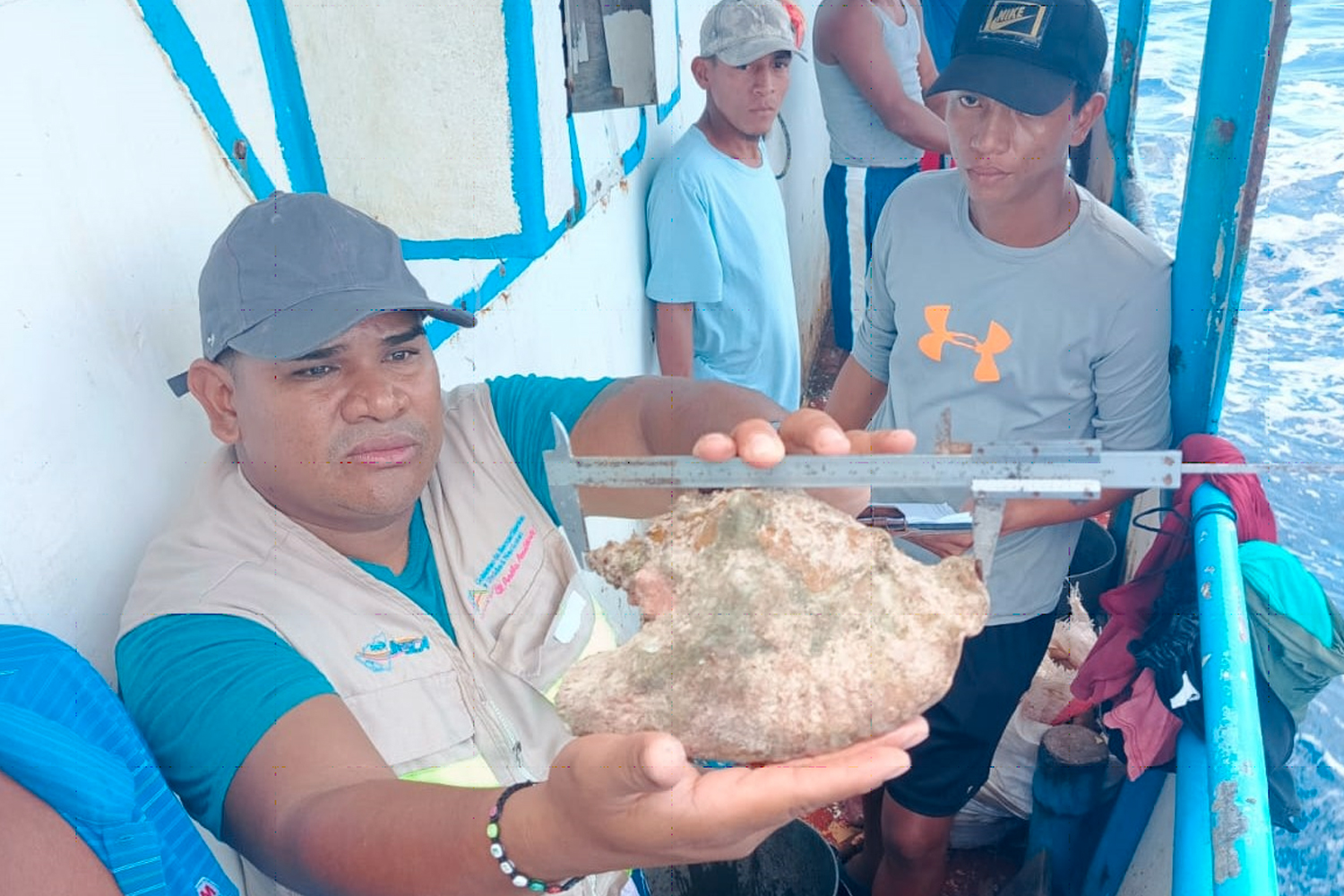
An Inpesca official weighs queen conch meat, a product for which export figures show discrepancies of hundreds of thousands of kilograms between the Central Bank’s data and the figures reported by purchasing countries. Photo: DIVERGENTES/Taken from Canal 8.
In 2021, Nicaragua reported exporting 692,773 kilograms of queen conch meat, 12,373 kilograms more than the quota of 680,400 kilograms it had reported to CITES. However, the importing countries reported receiving a larger amount: 752,437 kilograms of this species, bringing the excess to more than 72,000 kilograms.
In 2022, the difference between the two sources was reversed. Nicaragua reported exports of 762,636 kilograms against a quota of 703,080, an excess of 59,556 kilograms. Importers recorded 711,142 kilograms, although 11,340 kilograms of that amount originated in Honduras. The Nicaraguan queen conch meat they reported receiving, approximately 699,800 kilograms, remained within the quota.
Importing countries continued to record shipments of the product a year later. In 2023, they reported imports of 560,964 kilograms of Nicaraguan queen conch meat, and in 2024, 744,649 kilograms, a 32.7% increase over the previous year. This latter figure alone already exceeds the latest quota Nicaragua reported to CITES by more than 41,000 kilograms.
Even so, what buyers report is less than what the BCN attributes to domestic exports. Between 2023 and 2024, importers recorded 1.31 million kilograms of queen conch meat of Nicaraguan origin, while the BCN’s figures total about 1.63 million. The difference, more than 300,000 kilograms, is greatest in 2023, the first year Nicaragua stopped reporting to the Convention.
The U.S. Is the Leading Destination for Queen Conch Meat
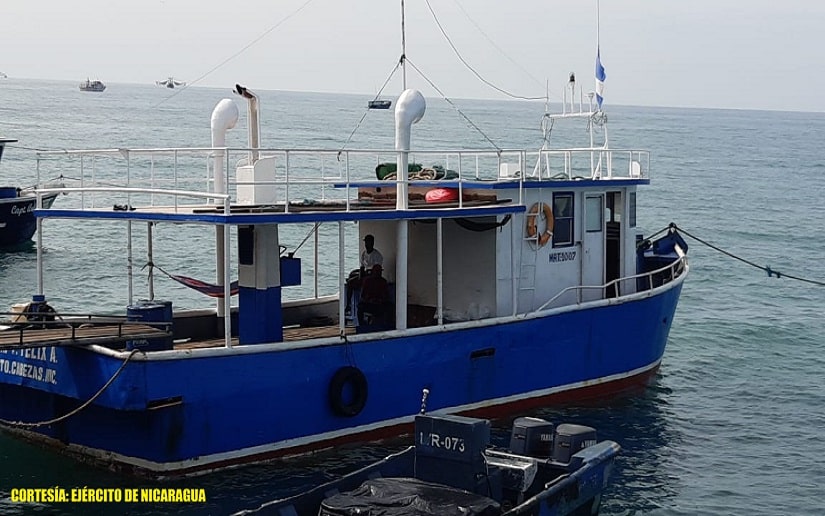
Although Nicaragua stopped reporting its queen conch exports to CITES in 2023, the U.S. continued to record the imports. Photo: DIVERGENTES/Taken from the Nicaraguan Army.
The queen conch has been listed in CITES Appendix II since 1992. This means every export requires a permit from the country of origin, which may only be issued if the harvest does not harm the species and the product was obtained legally.
The importing country requires this permit upon arrival. Each country then reports its operations separately in annual reports that feed into the Convention’s trade database. Therefore, even if the exporter stops reporting, its sales continue to appear in the importers’ records. In Nicaragua, the administrative authority for CITES is Marena.
In 2022, the last year Nicaragua reported its exports to CITES, purchasing countries declared 699,802 kilograms of queen conch meat. The U.S. received 699,122 kilograms, or 99.9%, and the remaining 680 kilograms went to Mexico. That year, the U.S. also recorded 11,340 kilograms of Honduran queen conch that arrived from Nicaragua, which fell within the quota.
The U.S. continued to purchase the mollusk after Nicaragua stopped reporting. In 2023, it was the only country to report imports of Nicaraguan queen conch meat, totaling 560,964 kilograms. By 2024, it had recorded 742,381 kilograms, 99.7% of the total, while Mexico reported the remaining 2,268 kilograms. That year, another 10,341 kilograms of queen conch originating in Honduras arrived from Nicaragua.
The increase in 2024 coincided with a change in the species’ protection status in the U.S. In February of that year, the National Marine Fisheries Service, also known as NOAA Fisheries designated the queen conch as a threatened species under the Endangered Species Act, effective March 15, 2024. The measure did not impose new import restrictions, despite the provisions enacted.