
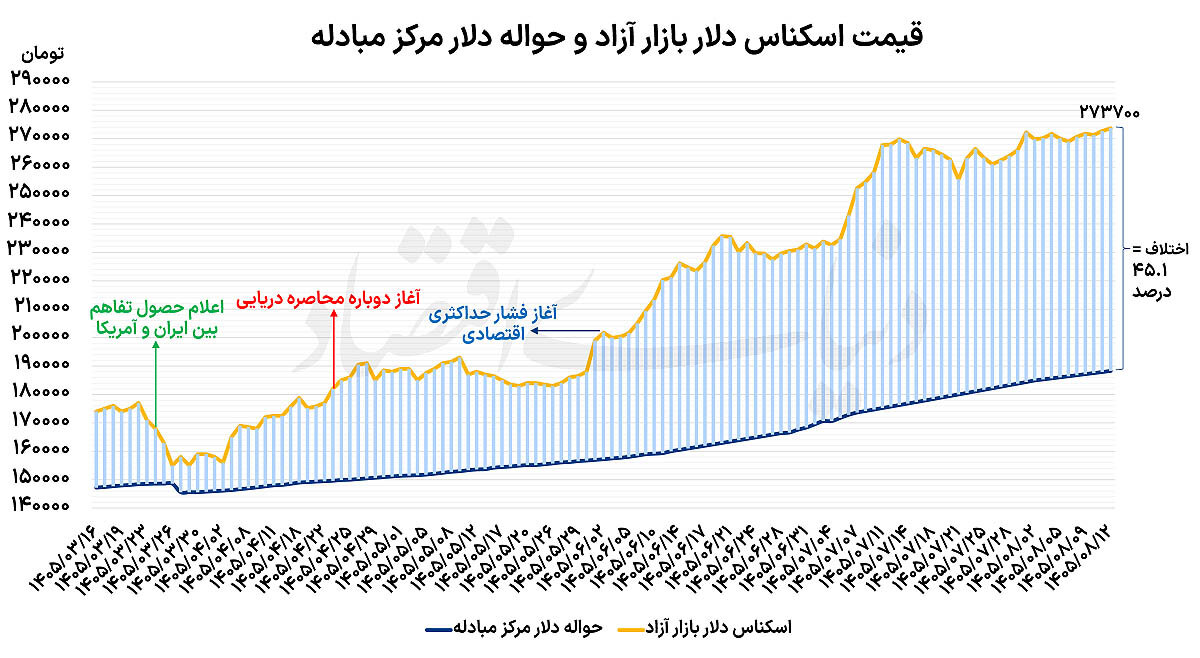
Donya-e-Eqtesad: Cash dollar transactions on the open market began Tuesday with a slight decline but then set a new price record. The dollar opened at 272,500 tomans, 200 tomans below Monday's last recorded rate. However, trading then reversed, and the US banknote rose to 274,000 tomans.
Cash dollar transactions on the open market began Tuesday with a slight decline but then set a new price record. The dollar opened at 272,500 tomans, 200 tomans below Monday's last recorded rate. However, trading then reversed, and the US banknote rose to 274,000 tomans. After this record, trader caution again dominated trading, and the dollar pulled back from its daily high. The last recorded rate for cash dollar transactions on Tuesday was 273,700 tomans, which was 1,000 tomans, or about 0.4 percent, higher than Monday's rate. As a result, despite the new record in Tuesday's trading, the dollar's daily range remained limited. A review of trading in Aban month also shows that the daily change in the dollar's price was less than one percent on every trading day this month.
Caution near the historic peak
In recent days, a growing likelihood of an escalation in military conflict, along with efforts by the currency market maker to contain price expectations driven by geopolitical risks, has influenced trader behaviour. In this environment, the dollar has traded within a narrow range near its historic peak. Notably, the narrowing of daily fluctuations has so far not prevented the price from moving to higher levels. On Tuesday, some cash dollar transactions were carried out at an unprecedented rate of 274,000 tomans. The last rate recorded that day, at 273,700 tomans, was also the highest closing rate ever recorded for cash dollar transactions.
On the previous day, increased trader caution in reaction to political news and the possibility of an escalation in military conflict was also visible during market hours. On Tuesday, the last cash dollar transaction on the open market took place before 3 p.m. Until recently, cash dollar trading usually continued until around 6 p.m.
US elections and uncertainty over the outlook for tensions
On Tuesday, the United States held midterm elections to determine the composition of the House of Representatives and part of the Senate. The vote, held mid-way through a presidential term, matters because it could shift the balance of power in Congress and the direction of Donald Trump's administration's policymaking. In recent days, speculation has emerged about a higher likelihood of an escalation in military conflict and attacks on Iran after the US elections. However, similar predictions of rising tensions within specific time frames have previously drawn market attention at various times. The currency market's experience shows that if such predictions fail to materialise, part of the precautionary demand may fall, but at the same time traders' uncertainty about whether to enter or exit the market may increase.
Heightened uncertainty is usually accompanied by greater caution among traders, which can show up as fewer and smaller transactions. In such conditions, the role of the market maker in managing price swings may become more prominent, although its effectiveness depends on the supply of currency, market depth and the intensity of upward expectations. Currently, several possible time frames for an escalation of military tensions are being discussed. Among the existing speculation, the possibility of an increase in tensions in the first seven days after the end of the US midterm elections has drawn the most attention. Nevertheless, these predictions remain speculative, and they cannot serve as a definitive basis for assessing the future path of the currency market.
Risks beyond military developments
Geopolitical risks are one factor influencing the open-market dollar rate, but not all the determinants of the currency price can be limited to military developments. In Iran's economy, the dollar rate is affected, in addition to expectations driven by political news, by the level of the country's foreign currency earnings, developments in foreign trade, access to foreign exchange resources and the ability to transfer currency.
Since 23 Tir, Iran's economy has faced a naval blockade, and in Shahrivar other trade routes have also faced increasing disruption. Alongside these factors, the government budget deficit and the upward trend in inflation are among the variables that could, in the medium term, support further increases in the exchange rate.
A review of dollar price changes before and after the recent military clashes also shows a significant rise in the exchange rate. The dollar price was around 83,000 tomans on the day before the start of the 12-day war, on 22 Khordad 1404. In the days before the start of the 40-day war, on 7 Esfand 1404, this rate had risen to about 165,000 tomans. Based on these figures, the dollar's price in Tuesday's trading was more than 190,000 tomans higher than its level before the 12-day war, an increase of about 228 percent. Likewise, the dollar rate on the previous day was more than 108,000 tomans, or about 65.5 percent, higher than its level before the 40-day war.
The currency market's experience in two recent wars
During the 12-day and 40-day wars, currency trading suffered a significant decline. In these periods, traders' access to reliable prices became more difficult, and usual pricing and trading methods were disrupted. As a result, trader caution increased, and the volume and number of transactions shrank to the level of essential trades for those who needed currency.
During the 12-day war, on some days no dollar price was announced, and on other days rates were recorded about 10,000 tomans higher than the price before the war began. However, after the 12-day war ended, the dollar price returned to its level before the fighting began.
The situation in the currency market during the 40-day war was different. During this war, part of which coincided with official holidays, the dollar price fell to around 150,000 tomans, about 9 percent below its level before the war began. For about two weeks after the war ended, the currency market suffered from shallow trading. After that, however, the return of traders and the rise in the volume and number of transactions meant the dollar rate reacted more strongly to changes in expectations and political news. The difference in market behaviour between these two periods shows that the occurrence of military conflict alone does not necessarily create a clear path for the currency price. Access to information, the ability to trade, currency supply conditions and changes in expectations can play an important role in determining the direction of price movement.
Modest decline in gold coin and gold prices
On Tuesday, the prices of various gold coin pieces and the price per gram of 18-carat gold, like the dollar, showed limited changes. However, unlike the dollar, which recorded a modest rise, the prices of coin pieces and 18-carat gold fell.
On this day, the new-design gold coin traded at 261.6 million tomans, down 1.6 million tomans from Monday. Half coins traded at 139.2 million tomans and quarter coins at 75.2 million tomans.
The price of one gram of 18-carat gold traded on Tuesday at 25.521 million tomans, which was 150,000 tomans, or about 0.6 percent, lower than Monday's rate. Thus, Tuesday was the fourth consecutive trading day in which the price of one gram of 18-carat gold remained in the 25-million-toman range. A fall in global gold prices on Friday, to their lowest level in a year, alongside limited fluctuations in the domestic dollar market, were among the factors that helped push 18-carat gold back from the 26-million-toman range. In current conditions, a return of the gold price to the 26-million-toman range may depend on global price changes and the dollar rate. By contrast, gold market players believe that a sustained retreat of prices below the 25-million-toman range would require a significant reduction in military risks and signs of political easing and an improvement in the country's foreign currency earnings.
Trade of 65 kilograms of gold bullion at the Iran Mercantile Exchange
On Tuesday, the twentieth standard gold bullion auction of the Iran Mercantile Exchange this year was held. In this auction, a total of 65 kilograms of standard gold bullion was offered, all of which was sold and bought by craftsmen and players in the gold sector.
The average price of each gold bar in this round was 33.522 billion tomans, 2.5 percent lower than the average price at the auction held in the first week of Aban.
Including Tuesday's trades, the total volume of gold bullion traded in Mercantile Exchange auctions since the start of this year reached 1,024 kilograms, passing the one-tonne mark. The total value of these transactions also reached 28.3 trillion tomans.
Global gold trading's attention to oil prices and the US elections
Tuesday was the second trading day of global markets in the current Gregorian week. In the