
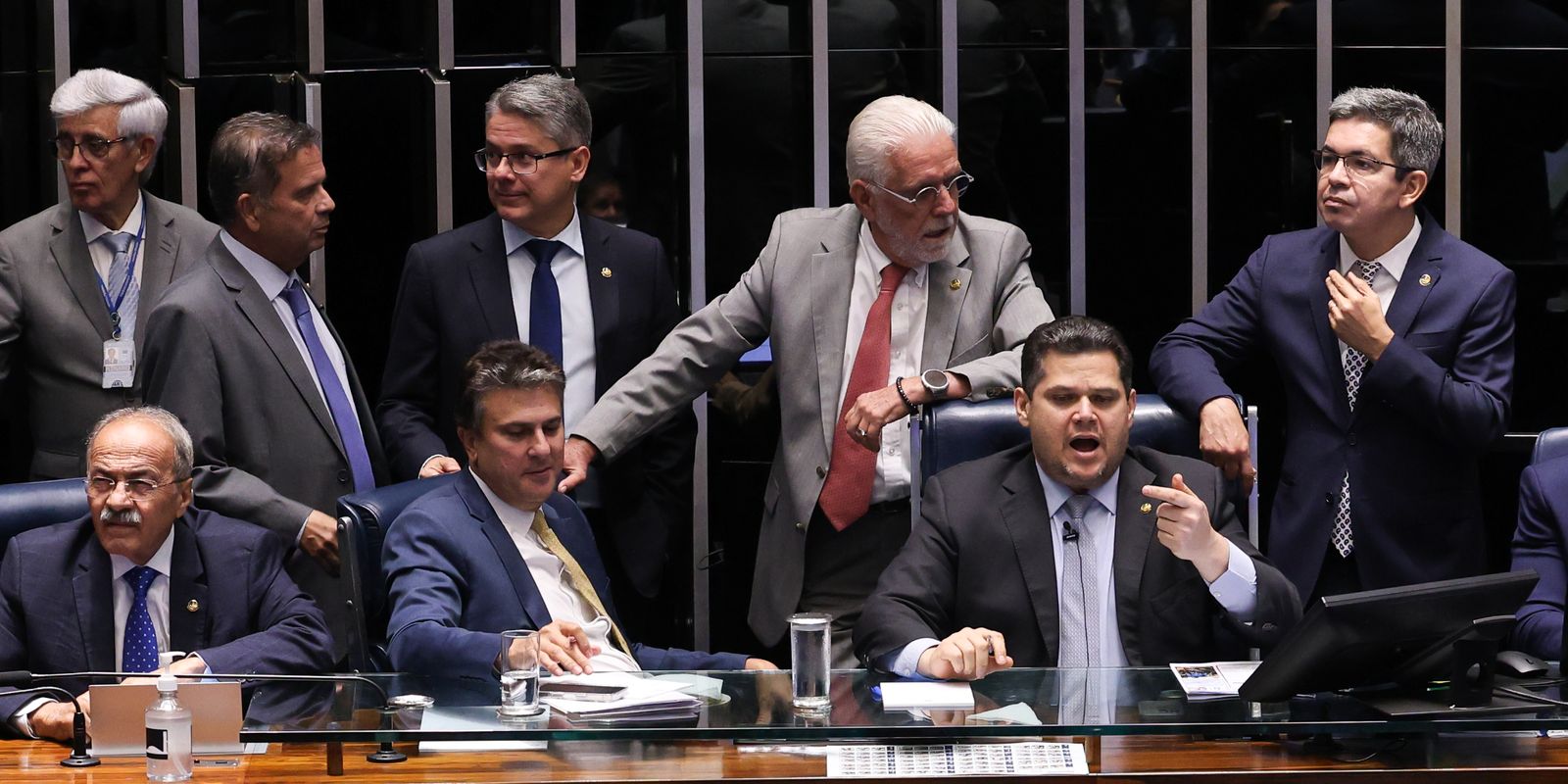
The Senate floor approved on the night of Tuesday (3) in two rounds the Proposed Constitutional Amendment (PEC) on Public Security, which reorganises public forces to step up the fight against organised crime in the country.
The text had unanimous support from the senators who voted, with 73 votes in favour and none against in the first round. In the second round, the tally was 75 votes in favour and none against. At least 49 favourable votes were needed for the constitutional change to be approved.
Submitted by the Executive, the Public Security PEC establishes harsher penalties and stricter prison regimes for faction and militia leaders, and creates a new federative pact between the Union, states and municipalities to combat crime in Brazil.
The proposal was one of the current government's priorities for the security area. President Luiz Inácio Lula da Silva promised to create a Ministry of Public Security after the PEC is approved.
The basic text of the proposal was approved in early September by the Senate's Constitution and Justice Committee (CCJ), and repeated the same content already approved by the Chamber of Deputies. With this, the text will be promulgated by the National Congress.
Before the PEC vote, senators discussed including floor amendments that proposed reducing the age of criminal responsibility from 18 to 16, or even to 14 years.
The PEC's rapporteur, Senator Rogério Carvalho (PT-SE), did not accept the amendments in the final report, but recommended that they form autonomous proposals that could be processed together and voted on separately later. If the amendments had been voted on and approved, the text would have returned to the Chamber. By a tight vote of 38 to 36, the rapporteur's motion to separate the amendments into another bill was approved.
"The matters addressed in the amendments are relevant and deserve to be debated by this House. They are not, however, to be confused with the central objective of PEC 18/2025, aimed at combating organised crime and restructuring the federative governance of public security," the rapporteur argued.
According to Carvalho, there is strong doctrinal and political disagreement over lowering the age of criminal responsibility in the country.
"Some jurists understand that the age of criminal responsibility set out in Article 228 of the Federal Constitution constitutes an entrenched clause, as it is part of the list of individual rights and guarantees and, therefore, the age limit for criminal responsibility could not be changed, not even by constitutional amendment. Another current holds that Article 228 does not fall under entrenched clauses and that the age of criminal liability can be modified by constitutional amendment," he added.
Amendment 84, presented by Senator Rogério Marinho (PL-RN), proposed reducing the age of criminal responsibility to 16 as a general rule and to 14 in cases of heinous crimes, torture, drug trafficking, terrorism and participation in criminal organisations.
Amendment 87, by Senator Camilo Santana (PT-CE), kept the general rule of 18 years but reduced the age of criminal responsibility to 16 in cases of heinous crimes. This initiative does not have broad support within the government's base.
Reducing the age of criminal responsibility is a controversial topic among civil society organisations that defend the rights of children and adolescents.
Four other amendments, which dealt with issues such as access to resources from the National Public Security Fund (FNSP) by the Armed Forces and the inclusion of traffic agents in the list of public security bodies, were also rejected by the rapporteur and never reached a vote.
What changes
Among other measures, the PEC proposes the constitutionalisation of the Unified Public Security System (SUSP), amending Article 144 of the Constitution, which deals with public security.
The proposal provides that security must be exercised "under a regime of federative cooperation" and "through integrated and decentralised action" by the various institutions working in the field.
"The public security bodies shall be articulated under a regime of federative cooperation, through the Unified Public Security System, aimed at ensuring the efficiency of prevention, prosecution and criminal enforcement," the text states.
Factions and militias
The PEC establishes harsher penalties and special prison regimes for leaders of factions and militias, such as imprisonment in maximum-security units and restriction or prohibition of sentence progression.
Asset measures against the proceeds of crime, the liability of legal entities involved, and protection for whistleblowers and their families are also foreseen.
Another novelty of the PEC is the possibility of creating municipal police forces of civilian nature, subject to external control by the Public Prosecutor's Office, with the power to carry out visible and community policing within the cities where they will operate.
The PEC also expands the powers of the Federal Highway Police (PRF), provides for the creation of municipal police forces, and increases the earmarking of the public budget for public security.
Funding funds
According to the PEC, 50% of the resources of the National Public Security Fund (FNSP) and the National Penitentiary Fund (Funpen) will be transferred by the Union to states and municipalities, excluding current and investment expenses of the national penitentiary police from Funpen.
"The financing rules strengthen the FNSP and Funpen, create budgetary earmarks and shields, and guarantee mandatory transfers. These measures increase financial predictability, ensuring the permanence of police actions," the rapporteur wrote.
The text also provides that 10% of the annual financial surplus of the Social Fund, linked to the pre-salt oil layer, be allocated to the security funds, "reinforcing the continuous funding of national public security and criminal enforcement policies."
The proposal also provides for the creation of the Penal Policy System, responsible for the Brazilian prison system, and authorises the Union, states and municipalities to act jointly on legislation concerning public security, police organisation, municipal guards and the socio-educational system.