
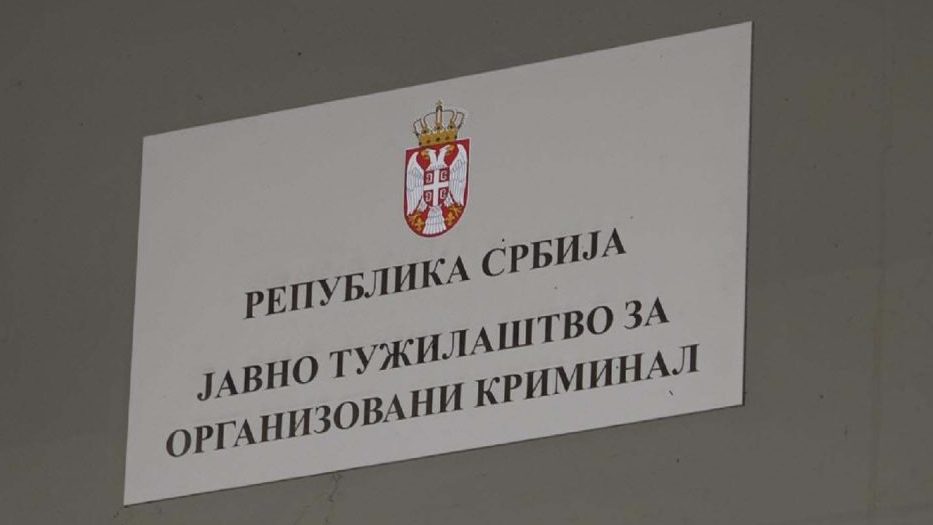
Following the victory of the Student List in the parliamentary elections, a tangled web of revelations has begun to unravel. Amid a flood of information and news of arrests, the Security Information Agency (BIA) has come under scrutiny. It emerged yesterday that the agency had wiretapped certain prosecutors in the Prosecutor's Office for Organised Crime (TOK). Only a day earlier, equipment suspected of having been used for eavesdropping was found at the Faculty of Law in Belgrade.
As the weekly magazine Radar reported, the reason for the secret bugging of TOK's premises was the continuation of work on the "Nadstrešnica" case, that is, the investigation into corruption linked to the collapse of the canopy at the railway station in Novi Sad.
TOK's chief prosecutor, Mladen Nenadić, was also wiretapped, and a source for Radar says that the BIA was informed of every step this prosecutor's office took. The prosecutors were placed under secret surveillance on suspicion of alleged espionage, on several occasions: 9 April, 30 April, 29 May, 19 June and 7 October 2026, when the measures were last ordered. BIA director Vladimir Orlić only decided to end the wiretapping of TOK after the elections, so it continued until 29 October.
In light of the discovery of eavesdropping equipment at the Faculty of Law in Belgrade, two questions arise: was the secret surveillance of prosecutors approved, and was there approval for installing the devices at the faculty, or did the BIA break the law in both cases?
As Danas unofficially learns, the Supreme Public Prosecutor's Office will react to this situation, and the wiretapping is subject to review.
Attorney Aleksandar Olenik says that the two cases, the wiretapping at the Faculty of Law and the wiretapping of prosecutors, must be viewed separately, because of information that the wiretapping of prosecutors was ordered by BIA director Vladimir Orlić.
"That is a special legal basis for wiretapping, which differs from the usual procedure, where the police or the prosecution propose the use of a special evidentiary action, and a preliminary procedure judge decides on it. This is a different legal basis, which exceptionally allows the BIA director to submit a request for approval of secret surveillance. In that case, only the president of the Higher Court in Belgrade decides on the surveillance, and no one else," Olenik explains.
Since Radar reports that the wiretapping of prosecutors was carried out at Orlić's request, our interlocutor points out that this would mean the request was approved by the president of the Higher Court in Belgrade, Dragan Milošević, with the justification that it concerned espionage.
"In other words, with that request Orlić effectively accused the prosecutors of the Prosecutor's Office for Organised Crime of engaging in espionage. This interpretation is absolutely unacceptable and, I must admit, difficult for me to comprehend. However, it shows that representatives of the regime, that is Aleksandar Vučić, truly believed they would rule forever, that no one would stop them, and that they could do whatever they wanted," Olenik assesses.
Once the information became public, Olenik believes it was expected that TOK, that is chief prosecutor Mladen Nenadić, would immediately order the arrest of a large number of people from the BIA, including the director himself, Vladimir Orlić, who, according to published information, requested approval for the wiretapping.
"Since that has not happened, I assume that the prosecutor for organised crime is technically unable at this moment to carry out such arrests and is waiting for the formation of a government that will enable him to do so. Everyone who took part in that chain, from submitting the request for wiretapping, through its approval, all the way to carrying out the wiretapping of the prosecutors themselves, must be held criminally responsible," Olenik stresses.
He believes that, if the legal conditions exist, detention should be ordered for those responsible as soon as possible, to prevent the possible destruction of evidence, and that then, on the basis of that evidence, proceedings should be conducted and appropriate court decisions made.
"As for the technical eavesdropping devices found at the Faculty of Law, we have less information. We do not know on whose request the wiretapping was carried out, or which judge approved it, if such approval existed at all. We do not know whether the legal procedure was followed in that case, that is, whether the wiretapping was lawful or only formally lawful, as I believe is the case with the wiretapping of TOK prosecutors," Olenik states.
According to our interlocutor, there is more than one piece of evidence indicating that the BIA wiretapped political opponents of the regime, in some cases without a court decision, and in others with decisions that only formally met the legal requirements.
"Terrorists, criminals or people who truly endanger the security of our state were not wiretapped, but political opponents of the government. I must remind you that our state security service, that is the former SDB, from which the BIA later emerged, was formed on the model of the Soviet NKVD, a service that dealt primarily with internal enemies," Olenik points out.
He adds that its task was not the fight against terrorism or the protection of the state in today's sense, but finding, identifying, and even creating internal enemies, as well as their political, and often physical, destruction.
"This state will not be able to progress unless we completely dismantle the current BIA and form a new service with entirely new people. That service would have to deal with protecting the constitutional order, state security and citizens' rights, not with finding, inventing and destroying alleged state enemies," Olenik concludes.
Dušan Stanković, an associate of the Belgrade Centre for Security Policy (BCBP), says that if the BIA did not have a court order for wiretapping, its activities were not in accordance with the law.
"That needs to be examined and all officials, especially the director and managers who ordered such activities, must be held responsible. Given the politicisation of the BIA, we can assume that the wiretapping of opponents at the Faculty of Law was politically motivated, while the wiretapping of TOK officials was intended to protect officials of the now former government who violated the law," Stanković believes.
Danica Drašković compares the situation in the BIA with the activities of the Soviet KGB, stating that the Serbian service operates like services in Russia.
"It illegally wiretaps, follows, demonises and kills political opponents, all of which has happened to us," Drašković says.
She adds that after Milošević's fall, there were eavesdropping devices in the walls of their living and bedrooms, which were later removed under a court ruling in the presence of journalists and the public.
"The same happened in party premises, and later former State Security officers testified that they had rented a space opposite the party, from where they monitored who came, took photographs and eavesdropped. Serbia's services are the horror of the state we live in, arrogant robbers who do whatever they want and have no legal or human limits. They destroy both citizens and the state, which still looks like a camp today. Just remember Ćacilend," Drašković concludes.
The Public Prosecutor's Office for Organised Crime (JTOK) has responded to this case, requesting that the competent institutions establish whether the prosecutors of that office were wiretapped, secretly followed and filmed during the past slightly more than a year.
The Prosecutor's Office says that wiretapping public prosecutors would constitute a direct attack on the independence of the public prosecution and the rule of law.
"The information that public prosecutors for organised crime were wiretapped represents a direct attack on the independence of the public prosecution, independence in decision-making and the rule of law," says JTOK, warning that this has compromised the confidentiality of the pre-investigation procedure, as well as the strategic and operational plans of activities in proceedings already under way.
Until the time of publication of this text, Danas has not received a response from the Prosecutor's Office for High-Tech Crime regarding the wiretapping of TOK prosecutors. We also contacted the Higher Court, and we will publish their answers when they reach our address.
Let us recall that the Faculty of Law of the University of Belgrade announced on Saturday that in its largest amphitheatre, "Radomir Lukić" (Amphitheatre V