
News Summary
Generated by OK AI. Editorially reviewed.
- Three judges who issued orders in the Kaski and Rupandehi cases against Ravi Lamichhane have been recommended for the Special Court and the Supreme Court.
- Justice Himlal Belbase was promoted to the High Court just before his retirement and is receiving a pension and other benefits.
- At the full court of the Supreme Court, judges have raised questions about the recommendations of Basudev Acharya and Himlal Belbase, and about the leadership of the Special Court.
16 Kartik, Kathmandu. Amid the Gen Z protests, Ravi Lamichhane, chair of the Rastriya Swatantra Party (RSP), walked out of Nakkhu Jail waving his hand. As prisoners in several jails grew angry, shouting "he is outside, why are we still inside," some were hit by security forces' bullets.
Lamichhane was not the only one whose reputation came under scrutiny for using the movement as a tool to clear his name. RSP lawmakers and office-bearers who had gone to the jail to welcome him with garlands also began to face criticism.
However, within a short time of the movement ending, Ravi was forced back into detention. He had been held until last Poush, and a court order then gave him two concessions.
First, he was released from detention by paying a bail amount.
Second, the Office of the Attorney General advanced the withdrawal of the money laundering and organised crime charges against him, and the court approved it.
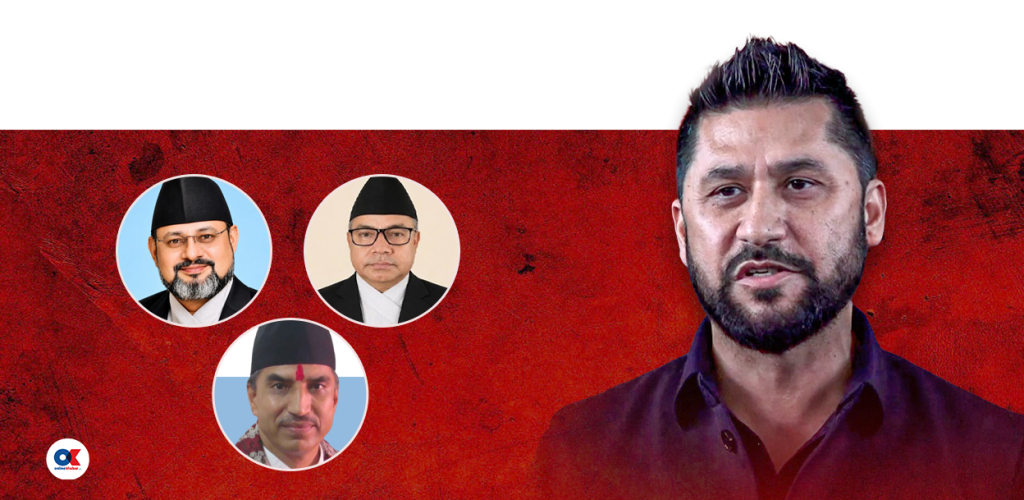
Judges who issued both kinds of orders against him have each received some opportunity or promotion benefit. At least three judges involved in the orders appear to have received such benefits.
Acharya, the judge who demanded bail, becomes head of the Special Court
Let us go back two years. Ravi Lamichhane, implicated in the Supreme Cooperative fraud case, was asked by the Rupandehi District Court to deposit ten million rupees as bail. He was released after paying the bail under an order issued on 13 Magh 2081 (late January 2025).
Later, a division of the High Court in Butwal overturned the district court order and ordered Ravi back into detention, and the Supreme Court upheld that decision. The order to return him to detention was based on grounds that the offence could carry a sentence of more than three years and on analysis of evidence of his involvement in the misappropriation of cooperative funds. That order blocked his release from detention.
While Lamichhane remained in detention, Sushila Karki, who had led the interim government as prime minister, expressed sympathy for him. Lamichhane then applied to the Rupandehi District Court to be released by paying an amount equal to the alleged loss he would have to pay.
On 3 Poush 2082 (mid-December 2025), the Butwal division of the High Court ordered the Rupandehi District Court to accept a possible amount of loss as security and release him. However, the district court initially rejected that application.
Lamichhane filed another application with the Butwal division of the High Court against the district court's decision. A bench of judges Basudev Acharya and Tejnarayan Poudel overturned the district court's order of 26 Shrawan 2082 (August 2025), which had refused bail.
The High Court ordered that the amount submitted by the bank guarantee be secured and that the bail money be accepted. Following that order, the Rupandehi District Court accepted a bank guarantee of 27.4 million rupees submitted by Ravi. The opening of the bail deposit at the district level did not involve any judge's direct role; the High Court order was implemented directly.
After the High Court order, Lamichhane was released from detention on depositing bail. Then, after the House of Representatives elections, Justice Basudev Acharya of the High Court was sent on secondment to the Supreme Court.
The practice is that district and high court judges are seconded to the Judicial Council when they have a specific task or responsibility. But Justice Acharya was seconded to the Supreme Court without any such specific responsibility. Not only was he seconded, but after the new government was formed, he was recommended as chair of the Special Court.
The Judicial Council recommended Acharya as chair of the Special Court on 32 Asar 2083 (mid-July 2026). At that time, Dr Manoj Sharma had already become Chief Justice, and Sobita Gautam, a law minister known as close to Ravi Lamichhane, was serving as a member of the Judicial Council.
Then Bagchand recommended to the Supreme Court
Although Ravi Lamichhane had been released on bail under the Butwal division's order, cases of organised crime against the RSP chair were pending in various district courts. The money laundering case in the Kaski District Court could have led to his parliamentary seat being suspended.
During the interim government, Attorney General Savita Baral Bhandari decided to withdraw the money laundering and organised crime charges pending against Lamichhane in various district courts. A writ petition challenging that decision was filed in the Supreme Court.
According to the Attorney General's decision, government lawyers in Kaski submitted applications to the Kaski District Court to withdraw two charges.
Judge Nitij Rai refused to withdraw the two charges, citing the pending writ petition in the Supreme Court and the amendment of the charge sheet as requested in the application submitted by the government lawyer.
Another application against Judge Rai's order was filed in the High Court in Pokhara. A bench led by Chief Justice of the High Court Dr Ratna Bahadur Bagchand and Merina Shrestha overturned the district court order. Bagchand and Shrestha ordered the lower court to proceed with amending the charge sheet, stating that no interim order had been issued against the Attorney General's decision.
Dr Ratna Bahadur Bagchand, one of the judges who issued these orders, was recommended for the Supreme Court by the Judicial Council a few weeks ago. He had been first in line for promotion among High Court chief justices. However, he had been passed over earlier, and this time he was recommended as a priority.
Promotion for four days
Following the High Court order, the petition submitted by government lawyers moved forward in the Kaski District Court. Judge Himlal Belbase amended the charge sheet on 8 Jestha 2083 (late May 2026) so that the charges of organised crime and money laundering no longer applied.
With Judge Belbase's order, only the cooperative fraud case remained against Ravi Lamichhane. Under the decision of the previous government, a path had also opened to settle the cooperative fraud case through compromise. With the money laundering charge dropped, Ravi was also spared the possible hardship of suspension.
On 30 Bhadra 2083 (mid-September 2026), the Judicial Council recommended District Judge Himlal Belbase for appointment as a High Court judge. Receiving his appointment letter, he reported to the High Court in Janakpur and retired.
The Constitution of Nepal allows a person up to the age of 63 to serve as a district or high court judge. Judge Belbase retired on 4 Asoj, four days after his appointment. He had only four days of his term left when the Judicial Council promoted him to the High Court.
At the time of his recommendation, Judge Belbase was 13th in seniority. The Judicial Council recommended his name by passing over the 12 judges ranked above him. Because of that appointment, he is receiving a pension and other benefits as a former High Court judge.
The appointment of Judge Belbase has been questioned at the full court of the Supreme Court. Judges asked Chief Justice Dr Manoj Sharma: "Why was Belbase promoted by pulling him from the middle of the seniority list, when the practice is for judges to go on leave a month before retirement?"
The chair of the Special Court, Basudev Acharya, has also been questioned in the Supreme Court. Raising doubts about his leadership, administrative capacity and integrity, judges at last month's full court remarked that the Special Court had become "like a department store."
At that time, Chief Justice Dr Sharma committed to judges that after returning from a visit to China, he would reshuffle the leadership of the Special Court and some of its judges. However, the "set" of the Special Court has not yet been reshuffled.