
Published: 2026/11/1 12:53 Updated: 2026/11/1 13:22
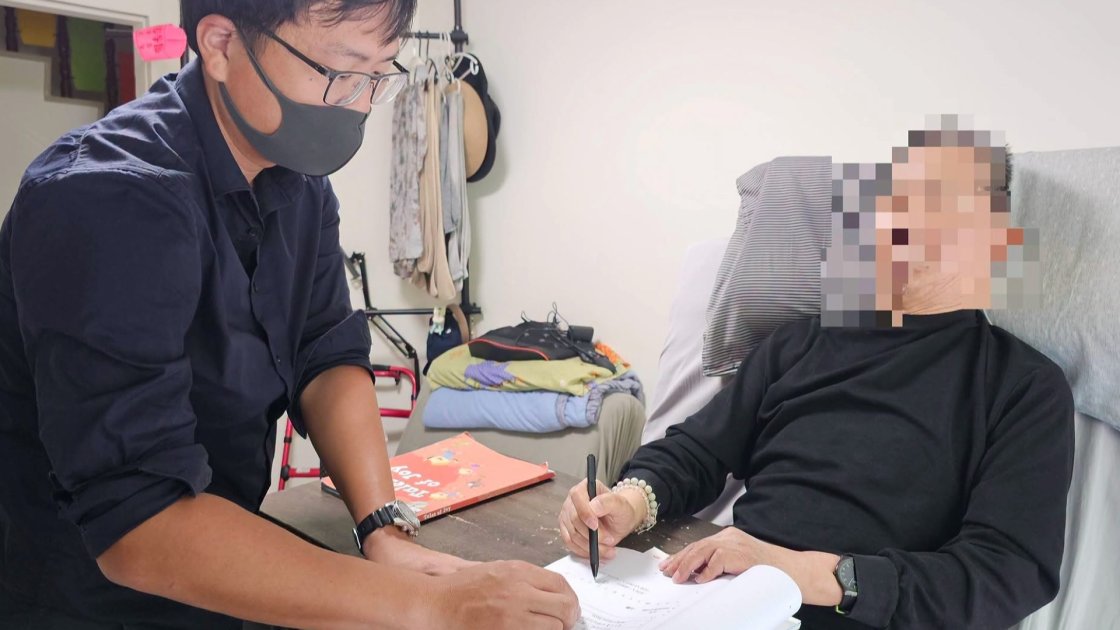
Mr. Chung from Hsinchu, left almost fully paralysed after a fall that injured his cervical spine, says he feels like a "living dead person." Last year he applied to the Hsinchu District Court for permission to exercise his right to die legally. His case was rejected on appeal and again by the Supreme Court. Recently, Mr. Chung's lawyers filed a petition with the Constitutional Court, making it Taiwan's first constitutional lawsuit on euthanasia. The case has sparked discussion in the medical community.
Wearing helmets and professional protective gear, with expressions of anticipation they could not hide, a cycling team of 40 members is about to begin a 10-day ride around Taiwan. They are also cancer patients. The Taiwan Cancer Control Association has for years encouraged cancer patients to exercise as part of their treatment, and this year it chose a cycling tour of the island, which gives the challenge added meaning.
Patient representative Wang Lin-chi said, "I truly hope many patients will bravely step out, because if you take one small step today, tomorrow you can take a big step."
Ho Mo-chen, deputy chairman of the Taiwan Cancer Control Association, said, "Many medical teams are riding with us as accompanying volunteers. Throughout the ride, these volunteers can provide timely help if a cancer patient has any problems."
However, recently the medical community has also turned its attention to the "euthanasia issue." Mr. Chung from Hsinchu fell and injured his cervical spine, and his nerves have atrophied, leaving him almost fully paralysed. He describes his physical and mental suffering and says he feels more like a living dead person.
He had applied to the Hsinchu District Court for permission to exercise his right to die legally, but he lost at both the first and second instances. The case was appealed to the Supreme Court and rejected again. On the 27th he went to the Judicial Yuan to file a petition, becoming the first case in Taiwan to bring a constitutional lawsuit seeking the legalisation of euthanasia.
The lawyer in the case, who is also chairman of the Taiwan Association for the Promotion of Autonomy in Life and Death, Chi Yueh-liang, said, "Ensuring that people can die well is actually very important. I believe it is a matter of human dignity. The most important thing about euthanasia is that there must be an active act that ends a person's life. Taiwan currently has no such law."
The lawyer stressed that Article 275 of the Criminal Code, which criminalises assisting suicide, conflicts with the right to autonomy over one's life when applied to "people with full legal capacity who endure unbearable pain and suffer from incurable diseases."
The Constitutional Court will assign the case to a panel after receiving it, and a review panel will decide whether to accept it. The medical community, however, is divided.
Hsu Li-an, a director of the Taiwan Palliative Care Association, said, "This person is living in great pain. In theory, you should first relieve his suffering, rather than directly ending his life. So the task of palliative care is pain control and symptom control, along with physical care and treatment, and also resolving psychological, social and spiritual difficulties by finding ways to address them."
Clinical palliative care physicians believe that the availability of medical and social welfare resources should be examined, and that patients should be helped by professionals. The Medical Affairs Department of the Ministry of Health and Welfare said that current medical laws centre on protecting the right to life. If academics and the medical community believe that legalisation is necessary, the Criminal Code should first be discussed for amendment.