
Święczkowski back in front of the Constitutional Tribunal. European Commission weighs in
- Agata Kołodziej
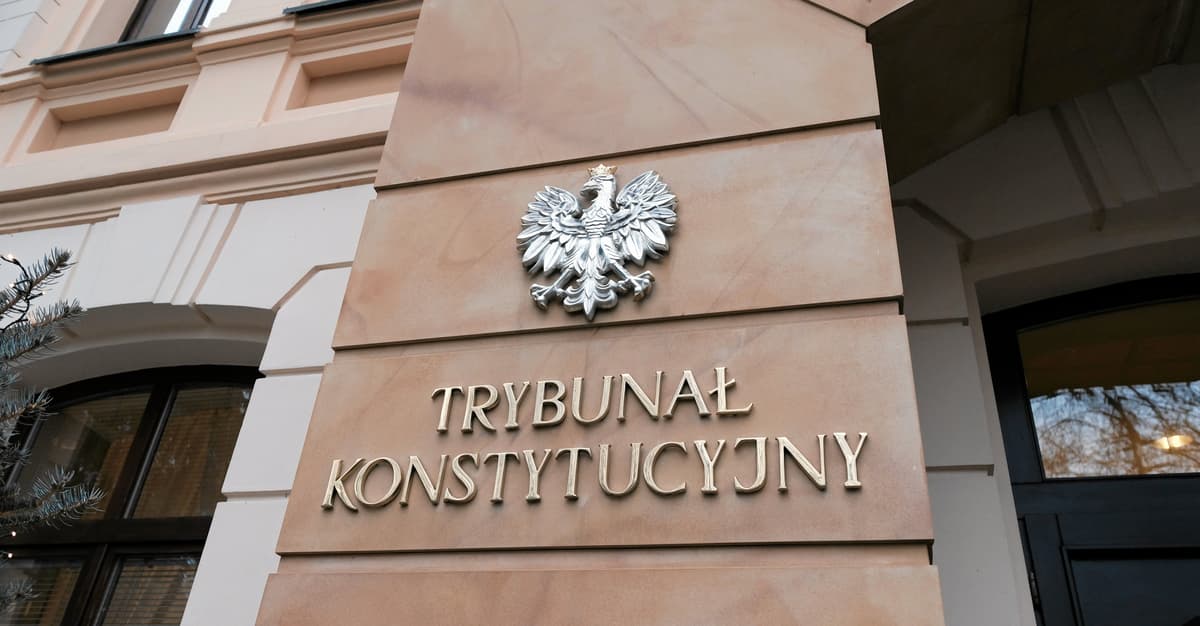
Bogdan Święczkowski appeared outside the Constitutional Tribunal (TK) building on Sunday morning and said he would come there every day. He appealed to police officers who had refused to let him onto TK premises not to “participate in the criminal activities of usurpers.” Meanwhile, the European Commission came to the defence of eight new TK judges who are staying on the Tribunal's premises.
Bogdan Święczkowski arrived at about 8:30 on Sunday morning in front of the Constitutional Tribunal building, where it was calmer than in previous days. Święczkowski demanded to be allowed into the building.
“I am the President of the Constitutional Tribunal. No one has dismissed me from this post and no one can dismiss me. It was a decision of the President of the Republic of Poland,” he told the people gathered there, who were protesting against the takeover of control of the TK by judges elected by the current Sejm.
Święczkowski addressed the police, urging them to let him onto TK premises and “not to participate in the criminal activities of the usurpers” who are inside the Tribunal building. Recall that judges elected by the current Sejm remain in the building, including Anna Korwin-Piotrowska, who currently leads the Tribunal. The president refuses to swear in five of the eight judges, and Święczkowski supports his actions by preventing the newly elected judges from taking up their work.
On Friday, 30 October, in the evening, police surrounded the TK building, and Judge Anna Korwin-Piotrowska announced the suspension of Święczkowski and his successor. As the judge with the longest service, she temporarily took over the running of the Tribunal.
“Don't listen to Anna Korwin-Piotrowska, who is not a judge of the Common Court and has never been a judge of the TK. All the actions she is carrying out are illegal, and you are taking part in illegal actions,” Święczkowski said on Sunday morning.
At the same time, he announced that he would come to the Constitutional Tribunal every day.
What else happened in the TK dispute over the last several hours?
The Supreme Court has convened an extraordinary General Assembly of Supreme Court Judges for Tuesday, 3 November, at 2:00 p.m. First President of the Supreme Court Zbigniew Kapiński made the decision in an order published on Saturday evening.
The judges are to discuss “threats to the constitutional order of the Republic of Poland, in particular with regard to respect for the principle of a democratic state governed by the rule of law, the independence of the judiciary and the proper functioning of constitutional state bodies,” and to adopt a resolution on the matter.
It should be added that setting the General Assembly of the Supreme Court for 3 November does not observe the seven-day notice period for a session provided for by law. However, Zbigniew Kapiński explains this by “the extraordinary nature of the circumstances that have arisen.”
The General Assembly of TK Judges is also scheduled for Tuesday, 3 November. It was convened by Anna Korwin-Piotrowska. Bogdan Święczkowski announced on Saturday evening on Polsat News that he and “the other legal judges” of the TK would not attend the Assembly.
“We have decided that we will not take part in any actions of this group of usurpers, whether these are attempts to convene, in quotation marks, a General Assembly of TK Judges, or a social meeting, or any other calls for us to do anything,” Święczkowski said.
Following Friday's events outside the Constitutional Tribunal and Saturday's meetings of representatives of some parliamentary clubs and circles with the president and Prime Minister Donald Tusk's evening address, further voices have joined the debate over the TK dispute.
Former presidents of the TK issued a joint statement: Marek Safjan, Andrzej Zoll, Jerzy Stępień and Bohdan Zdziennicki. In it, they stressed that judges legally appointed by the Sejm had taken the necessary steps to restore the function and status of the Tribunal as an institution protecting the law and civil liberties.
They noted that the TK has remained in deep crisis for more than 10 years, and they called for the necessary procedures to be enabled, indicating that this is the only way to end the constitutional crisis.
“The conduct of the President of the Republic does not serve this purpose. For many months, together with Judge Święczkowski, he has blocked the possibility for judges appointed by the Sejm to take up their posts,” and in the night from Friday to Saturday he “made a direct attempt to violate the autonomy of the constitutional court,” the former TK judges wrote in the statement.
The judges also pointed out that rulings of the European Court of Human Rights and the Court of Justice of the EU concerning the restoration of the Tribunal's status as an independent and impartial institution have not been implemented.
“There is no other way to end the constitutional crisis and restore the Constitutional Tribunal to society. [...] The judges must be enabled to realise this aim and to apply the necessary, lawful procedures, including above all convening a General Assembly of TK judges and adopting resolutions on the motions submitted to the TK by the Prosecutor General to waive the immunity of judges Bogdan Święczkowski and Bartłomiej Sochański”, the signatories of the statement wrote.
The European Commission also commented on the events surrounding the TK.
“It is the responsibility of the Polish authorities to ensure that the Constitutional Tribunal can function in accordance with the Polish constitution and with due respect for the relevant case law of the Court of Justice of the European Union,” Commission spokesperson Louise Bogey told PAP on Saturday evening.
The spokesperson assured that the Commission is following recent events around the TK and added:
“The appointment of eight new members of the Constitutional Tribunal falls within the constitutional competences of the Sejm, as confirmed by the Venice Commission in its opinion of 13 October 2026.”
And:
“Furthermore, on 5 May 2026 the European Court of Human Rights issued interim measures obliging the relevant Polish authorities to refrain from obstructing judges appointed by the Sejm in March 2026 from taking office and performing their judicial duties.”
EU Commissioner for Rule of Law Michael McGrath also commented on the matter. Speaking to PAP, he said:
“The Polish Constitutional Tribunal must be able to function in accordance with the Polish constitution and the case law of the Court of Justice of the European Union. This matters for every Polish citizen, and ensuring it is the responsibility of the Polish authorities.”
He added:
“The Venice Commission has clearly indicated that the appointment of new judges falls within the competence of the Sejm.”