
News Summary
Generated by OK AI. Editorially reviewed.
- A police team that reached Farak Media House on Friday arrested journalists from Nepal Press, DNA Khabar, Motivate Online, Naya Patrika and Diyo Post.
- Prime Minister Balen Shah said he was unaware of the journalist arrests and had directed their release, but he has not given further clarification on the incident.
- The Nepal Journalists' Federation has called it state terror against press freedom and demanded the formation of an independent judicial committee and action against those responsible.
15 Kartik, Kathmandu. Even when police have picked up journalists, the government does not "know" about it. Even when vehicles are parked at the gates of media houses, the government does not "know" about it. But within Nepal's borders, and especially in the capital Kathmandu, the Home Ministry has not even investigated who ordered such incidents.
A similar incident was repeated on Friday. Journalists were rounded up. A large group of people connected to power remained silent. Some RSP MPs spoke, and the party also spoke. RSP Chairman Rabi Lamichhane gave a strong warning that no one is above the constitution and democracy.
But Chairman Lamichhane could not exert much pressure either. Beyond the party issuing a statement calling for further investigation, it has not been able to create any real pressure. Rather, Chairman Lamichhane has been more interested in matters related to himself, and apart from concern over appointments and decisions made accordingly, he has been shifting blame onto the government. The statements of his supporter leaders within the party make this even clearer.
So through Information and Communications Minister Bikram Timilsina and press adviser Dipa Dahal, the government easily shifted responsibility with a single clarification. News then leaked out that Prime Minister Balen Shah had given a "discretionary directive" to release the journalists immediately. Those who had given clear assurances that they had no involvement in the journalist arrests...
Prime Minister Balen Shah has not provided further information about this incident. Instead, on Sunday evening he wrote a comment on the status of chief adviser Kumar Ben, asking: "Journalists go to Kupandol (Ben's house), what about the others, artists?"
Prime Minister Balen, who is brushing off a major incident with jokes, adviser Ben, silent ministers, nearly all silent MPs with few exceptions, and the many RSP workers who sit as advisers in ministries and "advise" the opposition, have together created a new crisis.
Prime Minister Balen warned on Sunday evening that no one should dream of escaping, saying one or two people may slip away. Writing on Facebook, he said: "When the right time comes, it will be the wrong time for everyone, so one or two people should not dream of escaping."
It is still unclear whom Balen was targeting with this remark, but it does seem to be an attempt to divert attention from the arrest of journalists. Home Minister Sudan Gurung is nowhere to be seen on such a serious issue. Yet Balen's status on Facebook was shared without any delay.
Let us talk a little about Friday.
On Friday, police went to media houses and arrested several journalists. After arresting Biswamani Subedi of Nepal Press, Dhiraj Basnet of DNA Khabar and Shobharaj Baral of Motivate Online, the police team went to the offices of Naya Patrika daily and Diyo Post.
Police were deployed to arrest journalist Nawaraj Mainali of Naya Patrika and editor Sudip Biswakarma of Diyo Post.
But after strong protests, the police team withdrew, and the Prime Minister's press adviser Dahal and Communications Minister Timilsina issued statements through social media. "...Regarding the arrest of journalists, it is made clear that the Honourable Prime Minister, his secretariat and the Prime Minister had no involvement and no prior knowledge," Dahal claimed, "As soon as he learned of the incident, the Honourable Prime Minister has already given clear instructions to the relevant agencies to immediately release the journalists who were detained and not to carry out any arrests in newsrooms."
Communications Minister Timilsina also expressed the government's commitment to press freedom, saying that the detained journalists had been released. "The government is fully committed to press freedom. Press freedom and responsible journalism are the pillars of democracy," Minister Timilsina wrote.
While many people in the ruling camp have spoken about the need for responsible journalism, Prime Minister Shah himself has so far remained silent on this matter. On Saturday he wrote about the digital importance of the Ludo and Clue games, but ignored the issue of a government unit being used to strangle democracy and trample freedom of expression.
Prime Minister Balen Shah, who rose through the promotion of Facebook pages, is misusing power and carrying out arrests of journalists. His desire to run a government of fear by distorting questions is now at the center of criticism from the opposition and from some citizens.
Ramprasad Dahal, general secretary of the Nepal Journalists' Federation, says that it is not enough for the Prime Minister to make the irresponsible statement that he did not know about the state terror in media houses.
"State terror has been unleashed on media houses in violation of international and domestic law," he says, "It is not enough to say the Prime Minister did not know. This must be resolved. An independent judicial committee must be formed and the guilty must face necessary action."
He warns that the ongoing series of attacks on the press sector must be stopped immediately. "We are telling Balen, who became Prime Minister by saying 'let the government let us speak', to let us write," General Secretary Dahal says, "But the government is being presented as an irresponsible government. Let the government return to the constitutional track quickly."
The government's move to arrest journalists for reporting news is being analysed by comparison with the 'coup' period of the then King Gyanendra Shah.
Senior journalist Rajendra Dahal, however, considers the current arrests more frightening than those during the 19 Magh and Panchayat period.
"Arresting journalists was not unusual during the Panchayat era. Using the Kajkaj, treason and public security laws, the CDO and zonal commissioner (civilian) would summon them to take statements," Dahal says, "Even in that time, when there was no press freedom, the police did not arrest like this."
But Senior Journalist Dahal says the present government's arrest of journalists to reach news sources must be treated as a serious incident.
"An editor also does not always ask a reporter for sources; he tries to confirm facts. Journalists are also not obliged to disclose sources in court," Dahal says, "Even when a source has died and gone, what the government is doing to reveal what a journalist would not say is frightening."
This is not the first incident in the seven months of Balen's premiership that has terrorised the press sector. Last week of Asar, vehicles were parked at the gates of media house offices in a way that overshadowed the self-immolation case of Ganesh Nepali.
On 29 Asar, the government's response was also unsatisfactory in the case of vehicles being parked at the gates of the offices of Online Khabar, Himalaya Television and Kantipur. Even when it was confirmed that vehicles of people associated with the RSP had been parked at the gates of media houses, no action was taken. Beyond traffic police saying it was outside their jurisdiction and police saying an investigation was ongoing, no further progress has been made.
On 27 Shrawan, when journalist Kishor Shrestha was arrested, the police had already crossed constitutional limits. Shrestha, who was arrested on the basis of a complaint about published news, had his home and the office of his media outlet raided.
The seizure of computers and other materials from the office of Janaastha, where Shrestha is editor, was an incident that did not even happen during the Panchayat period. Yet the Constitution of Nepal 2072, which guarantees full press freedom in its preamble, commits that media materials shall not be seized.
Article 19(2) of the Constitution provides that media materials shall not be seized. But Shrestha, who was arrested in a kidnapping-style manner, had his house searched repeatedly, and communication materials were seized from his office.
Authoritarian style
The government, which is ready to trample constitutional limits and the principle of press freedom to intimidate media houses and journalists, has spread fear into other areas as well. Balen, who became Prime Minister on the basis of public mandate gained on the foundation of the Gen Z movement, made arrests the very first decision of his premiership.
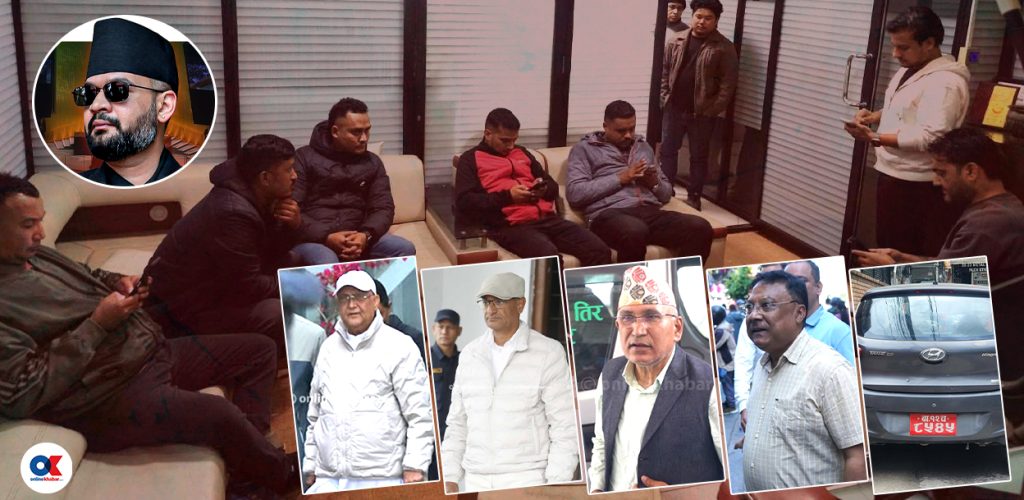
Based on the report of the Karki Commission, on the evening he took the oath as Prime Minister, Balen decided to arrest former Prime Minister KP Sharma Oli and former Home Minister Ramesh Lekhak. Home Minister Sudan Gurung personally went out to detain Oli and Lekhak.
Through the night after the cabinet was formed (on 13 Chaitra), working until the next morning at dawn, they arrested Oli and Lekhak. Encouraged by holding Oli and Lekhak in custody, Home Minister Gurung counted 'good mornings' as an achievement, equating detaining people with success.
But almost all of those arrested have been released on court orders. The practice of being arrested on the orders of the Prime Minister and ministers and then released on court orders began with pan