
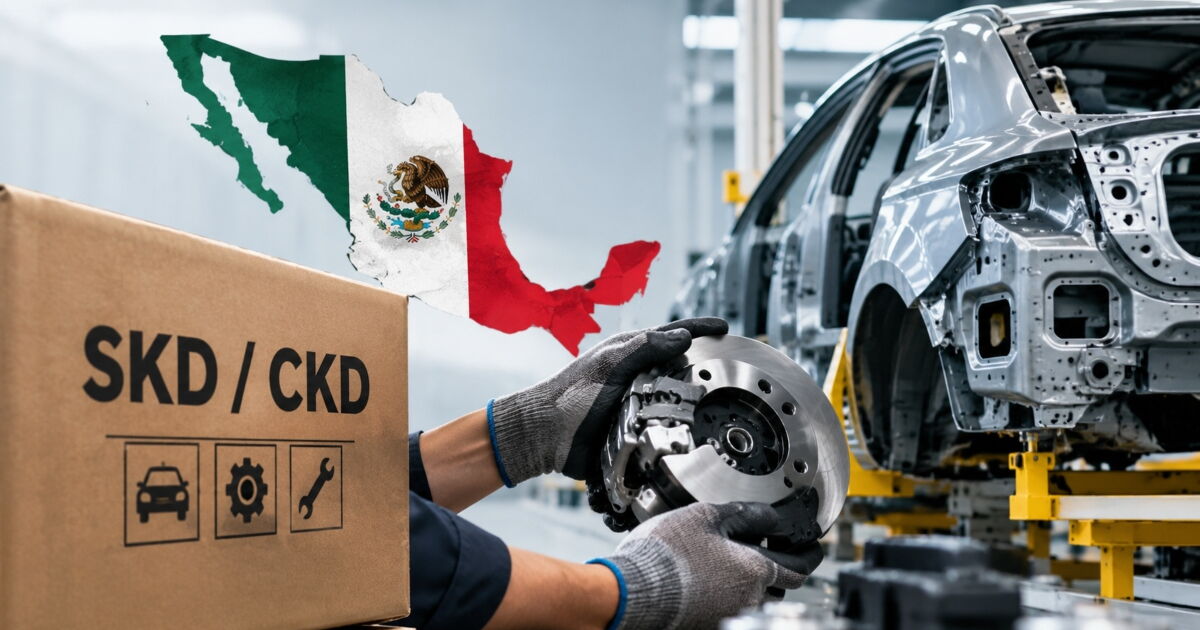
According to the ministry, these final vehicle assembly operations, based on importing all components from countries with which Mexico has no free trade agreement, such as China, could evolve into "complete manufacturing processes" that gradually increase greater national value.
What are SKD and CKD, the schemes López Mateos banned in 1962?
Vehicle assembly under these types of schemes is not new in Mexico. Eric Ramírez, director of the consultancy Urban Science, explains that Mexico already used both schemes in the first half of the last century, before establishing requirements to develop the national auto parts industry in 1962.
At that time, recalls the specialist, President Adolfo López Mateos published the First Automotive Decree of Mexico and established requirements to promote local component manufacturing, prohibiting the import of kits for assembly and requiring that at least 60% of parts be developed in the country.
As of September 10, 1964, the importation of engines for automobiles and trucks is prohibited, as well as the importation of assembled mechanical sets for use or assembly of those same vehicles
Automotive Decree of 1962
As of September 10, 1964, the incorporation of domestically manufactured parts currently used in the assembly of motor vehicles shall represent, at least, 60% of the direct cost of the vehicle manufactured in Mexico
Automotive Decree of 1962
"Since that time, all importation of CKD and SKD car kits was restricted and it was required that 60% be from Mexican suppliers," Ramírez states.
This industrial policy led automakers to incorporate components manufactured in the country.
With the entry into force of the North American Free Trade Agreement, the focus shifted from national content to regional content, so that automakers could integrate components manufactured in Mexico, the United States and Canada.
The Mexican automotive industry thus developed a supplier network that distributes manufacturing among specialized companies. Tier 3 suppliers provide basic materials and parts; Tier 2 suppliers transform them into components or subassemblies, and Tier 1 suppliers integrate systems and modules that they deliver directly to automakers.
A dashboard, for example, may reach the production line as a module integrated by a Tier 1 supplier, which in turn buys parts from other companies. Seats operate under a similar logic.
This model encouraged companies to develop manufacturing, engineering and design capabilities in Mexico, in addition to generating investment across different levels of the chain.
Over time, this model gave rise to a network of more than 2,000 auto parts plants that today generate 880,000 jobs, around 41% of automotive sector employment, a proportion eight times greater than that of assembly plants, according to data from the report Dialogues with the Automotive Industry, prepared by the four associations representing the sector.
With imported kits, by contrast, a significant portion of industrial work has already been performed outside the country.
The difference between the SKD and CKD schemes lies in the degree of disassembly with which vehicles arrive and in the operations carried out in the destination country.
In SKD, vehicles arrive partially disassembled or divided into previously assembled subassemblies. At the plant, these modules are integrated to complete the units.
"With SKD you bring the car in parts and only here do you assemble it and sell it," the specialist notes.
CKD involves receiving vehicles completely disassembled, with parts that must be assembled locally.
The Ministry of Economy justified the measure by the need to preserve jobs, strengthen Mexico's competitiveness as an investment destination and encourage the relocation of production lines from other countries.
"For this reason its validity will be 5 years, a reasonable period for adjusting assembly production processes toward more complex ones," the ministry said in a statement.
Who will be able to import SKD and CKD kits to assemble cars?
The ministry stated that the benefit will be limited to the 11 manufacturers of light vehicles with production facilities in Mexico, namely BMW, Stellantis, Honda, Mazda, Nissan, Toyota, Kia, Ford, General Motors, Volkswagen and Giant Motors Latinoamérica, which assembles JAC vehicles. Only these companies may import these kits from China, for example, to assemble vehicles at their plants.
To access these schemes, companies must hold tax deposit authorization for vehicle assembly and manufacturing, obtain prior permits from the Ministry of Economy and comply with the guidelines the ministry issues.
Imports will also be subject to controls from the Tax Administration Service (SAT) and the National Customs Agency of Mexico (ANAM). Among the requirements foreseen is reporting the vehicle identification numbers of units assembled with imported components and providing information that allows parts to be traced to prevent them from being "stripped" and flooding the spare parts market.
In addition, the guidelines will establish minimum production volumes of complete vehicles in Mexico and limits on kit imports in proportion to that manufacturing.
JAC and GM are already betting on SKD and CKD kits
Giant Motors Latinoamérica is currently the only company in Mexico that uses the SKD scheme to assemble vehicles of the Chinese brand JAC at its plant in Ciudad Sahagún, Hidalgo.
The company, in which Carlos Slim participates as an investor through Inbursa, has assembled 100,000 units under this model, which consists of importing components from China to assemble the vehicles in Mexico.
The plant currently produces 21 JAC models across different categories and technologies, including internal combustion and electric vehicles.
Read: GML prepares export of JAC vehicles made in Mexico to Latin America
According to the Ministry of Economy, General Motors will also incorporate this scheme to assemble the Aveo and Groove models at its plant in Ramos Arizpe, Coahuila. The decision follows the reduction in production of the electric vehicles manufactured at that facility, including the Blazer EV, Equinox EV and Honda Prologue.
"General Motors will relocate from China to Mexico two production lines of models that will begin through assembly and for which local content will be gradually added," the ministry detailed.
Francisco Garza, CEO of General Motors in Mexico, announced in May that assembly of the Groove will begin in 2027, followed by the Aveo. The initial goal, he explained, is to reach a combined production of 80,000 units during the first year of operations of both programs.
Read: General Motors will assemble Aveo and Groove in Mexico
The Ministry of Economy also noted that imports made under the tariff fraction contemplated in the decree represented 0.01% of total automotive imports in 2025. E