
The decision to increase funds for the work of representative offices abroad from 15 million to more than 65 million convertible marks was published in the Official Gazette of Republika Srpska about twenty days after the Constitutional Court of BiH banned the financing of a contract with the firm “Dickens & Madson Canada Inc.” and all other lobbying activities aimed at goals it considered contrary to the BiH Constitution, including advocacy for the independence of Republika Srpska.
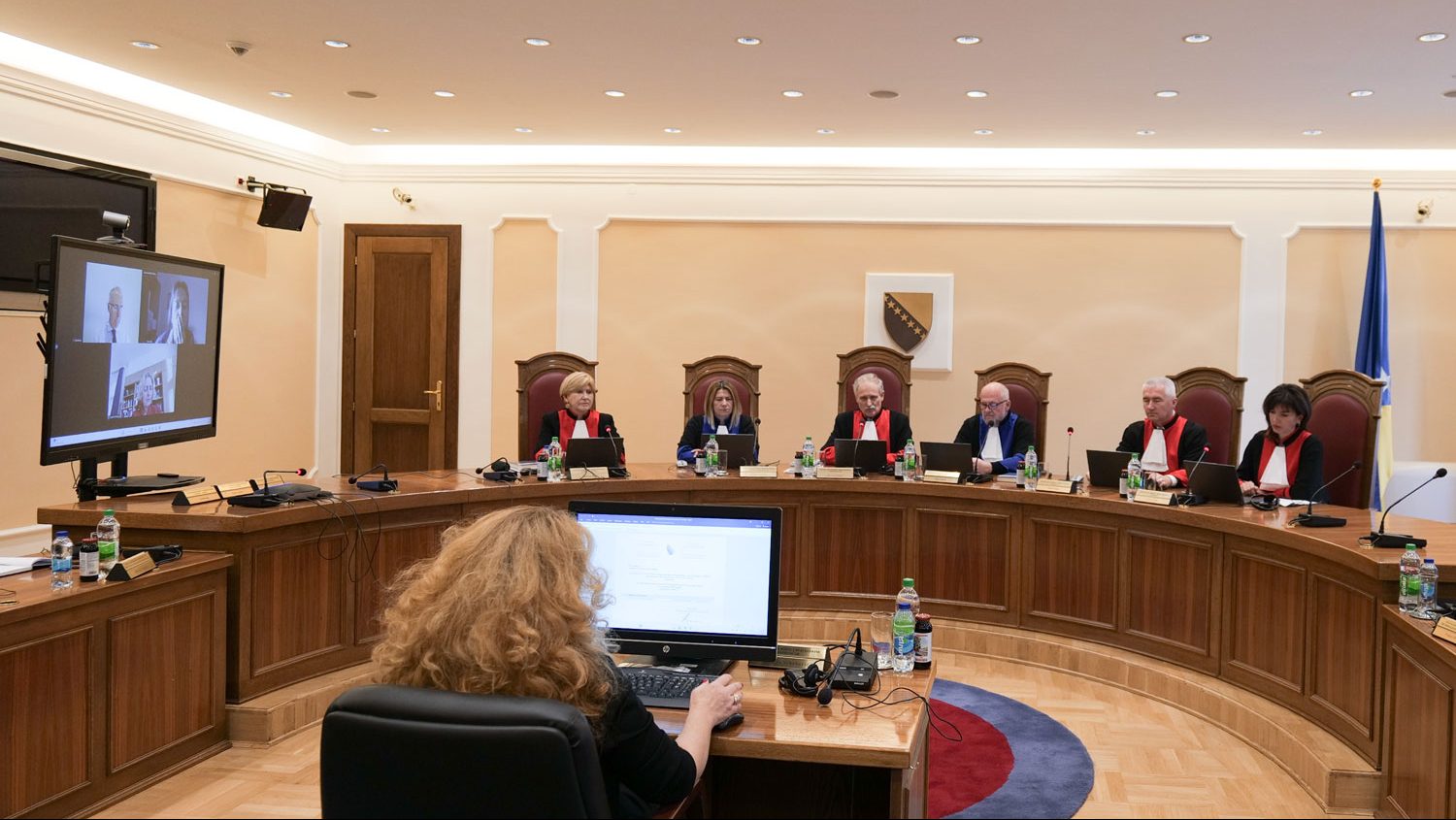
On 25 September, ruling on a request from Denis Zvizdić, first deputy chairman of the House of Representatives of the BiH Parliamentary Assembly, the Constitutional Court found that certain acts and activities of Republika Srpska related to budget-funded lobbying are not in accordance with the BiH Constitution.
All payments from the Republika Srpska budget related to the consultancy contract concluded on 6 September 2025 by Mladen Filipović, director of the Republika Srpska Representative Office in Vienna, and Ari Ben-Menashe, president of the Canadian company “Dickens & Madson Canada Inc.” were prohibited.
Harun Išerić, an assistant at the Faculty of Law of the University of Sarajevo, stresses that both the Federation and Republika Srpska may engage in lobbying activities, but that lobbying cannot be contrary to constitutional values, which include the protection of sovereignty, territorial integrity, political independence and the international personality of BiH.
“So, an entity, even when acting within its constitutionally divided competences, cannot exercise that competence in a way that is disloyal to the state of BiH, its Constitution and its constitutional values, and that is disloyal to another federal unit, which is the Federation of BiH”, Išerić said.
Most of the additional money is earmarked for the representative office in Austria, whose budget has risen from 1.45 million to 31.7 million KM. At the same time, the budget of the representative office in Washington has been reduced from 2.08 million to 1 million KM. The item for establishing and operating new representative offices has been increased from 5.91 million to 14.33 million KM.
Harun Išerić. Photo: N1
“The Government of Republika Srpska and the Ministry for European Integration and International Cooperation have considered the decision of the Constitutional Court of BiH and determined that the contracts the Government of Republika Srpska concluded with law and consultancy firms from the USA and other countries do not contain provisions that contradict it. In addition, the Representative Office of Republika Srpska in Austria has informed the competent ministry that the contract with ‘Dickens & Madson’ has expired and that no payments have been made under it”, the Government of RS told Detektor.
In their response, they added that the other contracts with international consultancy firms are classified as secret, which is why they are unable to provide further information.
Siniša Vukelić, editor-in-chief of the portal Capital, which has already written about the increase in funds for RS’s foreign representative offices, assesses that the increase could be a way of circumventing the lobbying ban.
“I think this is a way to get around the lobbying ban and, by giving money to the representative offices, to try to continue financing lobbying companies in America, probably in Great Britain too, and possibly in Slovenia”, Vukelić says.
The decision on increasing funds for foreign representative offices does not state the activities for which they are intended.
The Government of Republika Srpska responded that, in line with the budget rebalancing, funds for additional activities of the representative offices have been increased. They said that, as every year, they will consider the report on the work and financing of the representative offices for the previous year, as well as information on Republika Srpska’s activities in the field of international cooperation.
“Both pieces of information will be available to the media on request, after the Government, on the proposal of the Ministry for European Integration and International Cooperation, considers and adopts them at a session”, the RS Government said.
Asked how telling it is that the increase in funds for representative offices abroad came only a few weeks after the Constitutional Court’s decision, Išerić said that the timing may indicate the importance the RS authorities attach to international lobbying.
“It is probably indicative in terms of the role Republika Srpska places on investing in its international position, lobbying and approaching foreign governments and international organisations”, Išerić said.
According to him, the goals of such lobbying activities so far have included sanctioning the Central Election Commission of BiH and High Representative Christian Schmidt, annulling OHR decisions and removing foreign judges from the Constitutional Court of BiH.
Išerić says such activities are also aimed at creating an environment that would favour the independence of Republika Srpska, as well as at spreading a narrative about the endangerment of the Christian population in BiH, which, in his assessment, can serve to justify a potential secession of RS or changes to the Dayton Peace Agreement.
The text of an e-mail sent from the address “SanctionChristianSchmidt” to the US Department of Justice three days before the general elections in BiH refers to a request by Congresswoman Celeste Maloy of 31 August that the US Treasury examine whether Schmidt and members of the Central Election Commission committed acts subject to sanctions under the Global Magnitsky program.
The allegations in the e-mail include interference in the democratic process in Republika Srpska, through, as it claims, the illegitimate removal of Milorad Dodik and efforts to deprive Serbs of their voting rights.
The e-mail was reportedly sent by the American lobbying and PR company “DCI Group” on behalf of the Government of Republika Srpska.
Smith, Garcia, LaCivita and Blair at the SNSD pre-election rally on 2 October. Photo: SNSD
Detektor has previously reported on this lobbying company’s role in spreading calls to sanction Christian Schmidt and members of the Central Election Commission of BiH.
From the same address, just three days after the general elections in BiH, a second e-mail was sent under the subject line: “Elections have consequences: is Schmidt guilty of transnational repression?”
The text of the e-mail also quoted Dodik’s statement that Serbs are seeking the independence of Republika Srpska and support for Presidents Trump and Putin, as well as words spoken by Željka Cvijanović during the election campaign that Republika Srpska needs “the right to a referendum”.
Detektor has earlier confirmed that at least three associates of US President Donald Trump, along with two representatives of the “DCI Group” company, attended the SNSD pre-election rally held in Banja Luka on 2 October 2026, the day after the first e-mail was sent to the US Department of Justice.
They include Alex Garcia of the lobbying firm “Continental Strategy”, which is paid by the Government of RS, James Blair and attorney Andrew H. Smith. According to The New York Times, they, together with Chris LaCivita, one of the managers of Trump’s campaign, and former Trump associates Caroline Wren and Barry Bennett, also attended the celebration of the SNSD’s election victory on election night, 4 October.
Trump described Blair and LaCivita as independent outside consultants, saying he sees no conflict of interest.
Ivana Korajlić of Transparency International in BiH told Detektor earlier that mere attendance at a rally does not necessarily constitute a violation of regulations.
Išerić explains that lobbying can become illegal when standards are breached.
“In that sense, the burden falls on the guardians of the Constitution and other persons, so that if they recognise that contracts are being concluded whose lobbying goals are contrary to the BiH Constitution, they react either by addressing the Prosecutor’s Office of BiH or the Constitutional Court of BiH”, Išerić said.
He explained that a position on whether such lobbying contracts are constitutional or unconstitutional can only be taken after gaining insight into the contracts.
“However, these contracts are often broadly formulated and abstract, so in that sense these persons who can address the Constitutional