
Major investment
1.1 billion for a domestic site: what Infineon plans in Villach
From the end of 2027, Infineon will manufacture its latest semiconductors at scale at its Villach site. The federal government is contributing 319 million euros. Where does the money come from?
Nicolas Dworak
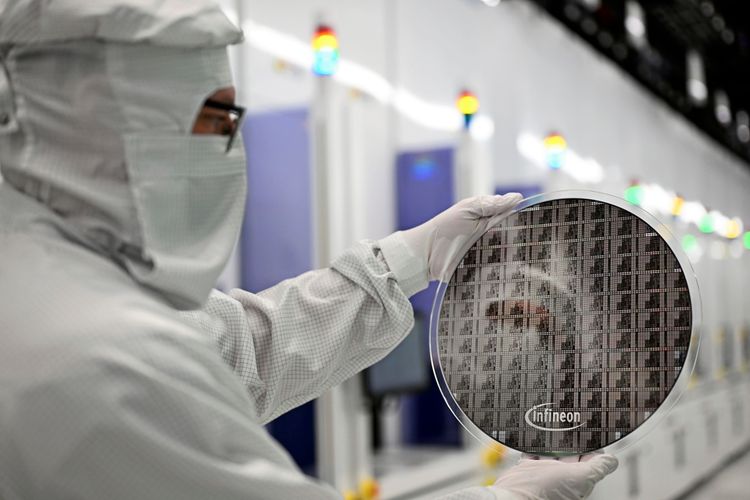
1.1 billion euros will flow into the Villach site. No new jobs will be created, but the 4,800 jobs created over the years will be secured, it is said. The money is intended to ramp up production of novel semiconductors (pictured).
When an industrial company's press conference is attended not only by the economy minister but also by the chancellor, it is clear that something is being announced that goes beyond the everyday. It is something a politician does not want to miss. On Tuesday morning, this was once again the case. The German global corporation Infineon Technologies announced that it would invest around 1.1 billion euros in Austria through 2034.
Economy Minister Wolfgang Hattmannsdorfer called it "one of the largest direct investments in industrial history"; Chancellor Christian Stocker (both ÖVP) welcomed "a really good day for our domestic industry". These are lofty words, which, given the investment sum in the midst of difficult years for industry, do not seem so exaggerated after all. For the German global corporation, this is the second major investment in its Austrian development and production site within a few years, following 2018.
With the current investment, the company intends to manufacture a new generation of semiconductors at scale from the end of 2027. The "gallium nitride power semiconductor on 300 mm wafers", developed in 2024, is a world first, said Infineon Austria chief Sabine Herlitschka. "Building on this, we are now moving into large volumes."
In future, the new technology is expected to generate 1.5 billion euros a year for the company; currently, Infineon Austria generates around 4.7 billion euros a year from its eight billion chips sold. The emissions of energy-intensive applications, from the automotive industry to AI data centres, are also expected to fall as a result.
New terrain
What is so special about the new semiconductors? On the one hand, a thin layer of gallium nitride is used as a material in addition to silicon. This material enables higher power densities, lower switching losses and higher frequencies. Put differently, it is far more energy-efficient than a semiconductor made of silicon alone.
On the other hand, Infineon has turned another screw that has always been a major focus of work. The cost of a semiconductor is determined by the diameter of the so-called wafers. With the leap from 200 to 300 millimetres, the usable area increases by a factor of 2.25. Depending on the application, this yields a few thousand to hundreds of thousands of chips per wafer. Group CEO Jochen Hanebeck therefore promises himself and his customers reduced system and energy costs.
The 300 millimetre wafers are no longer unusual, and the leap has reduced the cost per chip by up to 30 percent, according to current industry estimates. Until now, however, these were silicon-based. With the ramp-up of gallium nitride wafer production, Infineon is entering new terrain.
The high-tech semiconductors are to be used, for example, in power supplies for AI data centres, in photovoltaic systems, in robotics, and in fast chargers for smartphones and laptops or onboard chargers for electric cars.
No new jobs
And why was the Villach site chosen, given that Austrian soil is considered expensive when it comes to energy and personnel? Group CEO Hanebeck cited three key factors: continuity of political support, skilled specialists and scale effects. The Villach site is already established as a global centre of competence, and the new, highly automated production will take place on the existing premises. No new staff are required. And the federal government is contributing 319 million euros under the European Chips Act.
The domestic budget, known to be under strain, does not have to be reworked for this. The previous black-green government had reserved a total budget margin of 2.8 billion euros through 2031 by means of a preliminary-burden law, in order to promote key technologies in line with EU legislation. As part of this, 227 million euros have already flowed into chip production at ams-Osram in Premstätten. Infineon has now been awarded the funds, with a ten-year site guarantee. The EU Commission approved the state aid already on Monday. (Nicolas Dworak, 27 October 2026)