
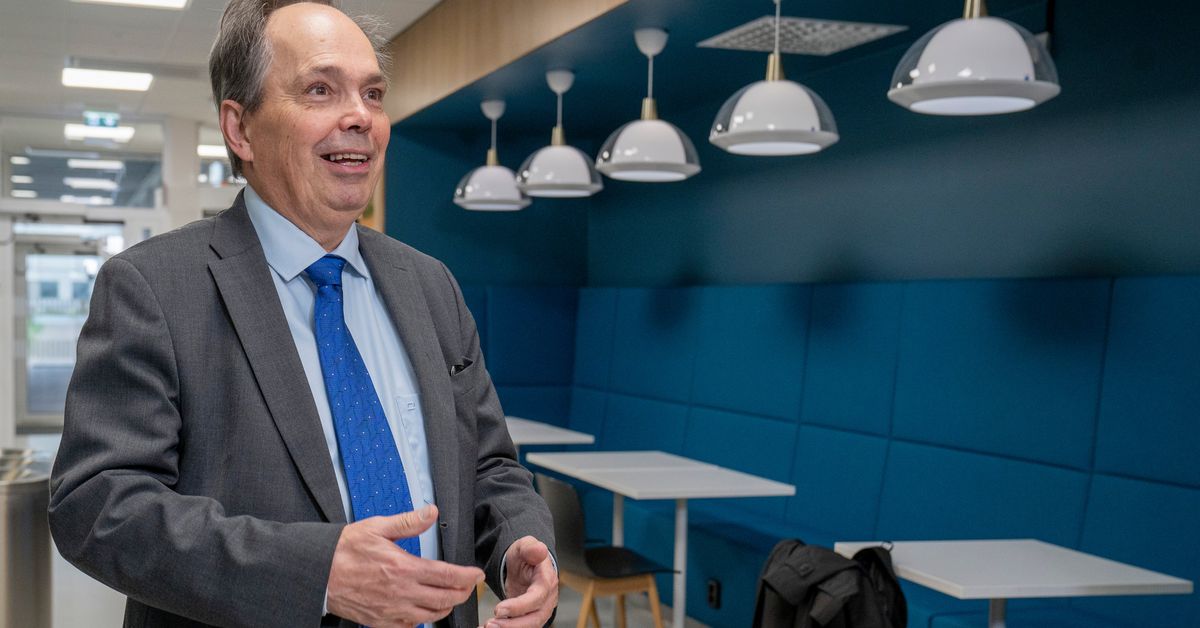
Professor Tapio Bergholm, who is writing a biography of Mauno Koivisto, says the digital archive will deepen historical research, judging by the mood of the discussions that can be heard in the recordings.
Professor Tapio Bergholm is writing Mauno Koivisto's biography and considers the recordings of his discussions, which will be made public, to be extremely valuable to historians. Photo: Thomas Hagström / Yle
25.10. 19:31
On Sunday, Yle reported on political discussions recorded by President Mauno Koivisto and his office, which will be published for the first time soon in Yle's Outo historia series.
Professor Tapio Bergholm, a historian writing a biography of President Koivisto, is excited about the material.
– This is modern material. Earlier presidents have not produced this kind of material. We hear Mauno Koivisto's voice, we hear Mauno Koivisto's and his governments' discussions on foreign policy, and we get the drama of the meeting, its dramatic arc.
Bergholm praises the project, in which Yle is digitising the recordings, and which will eventually be available to researchers and the public at the National Archives.
– This material is so central to social history, economic history and political history, to the material of Finnish history, that it is good that it is available to researchers, journalists and citizens alike, Bergholm says.
Yle News has already published samples in its online article, for example a recording of a meeting in August 1991 between President Koivisto and the government's Foreign Affairs Committee, where they considered how to respond to the declarations of independence of the Baltic states.
Koivisto's hesitation over Baltic independence can be heard on the recordings
Professor Tapio Bergholm considers the recording above to be particularly fascinating.
It captures how President Koivisto and Esko Aho's government sought wording that would signal Finland's intention to restore diplomatic relations with the Baltic states, which had broken away from the Soviet Union and were regaining independence.
– At the start of the meeting, Mauno Koivisto is skeptical, and at the end the dramatic arc leads to him being of the view that the recognition of independence should be restored.
The recording also reveals the rather different positions of then Prime Minister Esko Aho and Foreign Minister Paavo Väyrynen on the Baltic question.
Bergholm notes that it is precisely in this respect that the audio material is unique.
– The tones of voice tell us which direction the discussion is taking.
Even small fragments of the past make history come alive in a new way, Bergholm says.
– I have also wondered why so many statesman biographies have been written in Finland without using the rich sound recording and digital video archives of Yleisradio. It gives new depth to historical research.
Koivisto's Russian skills gave him an advantage
The recordings also show that Mauno Koivisto spoke Russian fluently with Russian leaders. Yle's news article includes, among other things, a conversation between Koivisto and Soviet leader Mikhail Gorbachev at what was reportedly their last meeting.
Professor Tapio Bergholm says that Koivisto's knowledge of Russia and his language skills were exceptional, but they also gave him an edge in discussions that the Soviet side did not always welcome.
– At some point the hosts didn't always like it when Koivisto was one step ahead. When the host spoke first and then the interpreter translated it into Finnish, Koivisto had more time to think of a response. It might even raise suspicions about who this man was.