
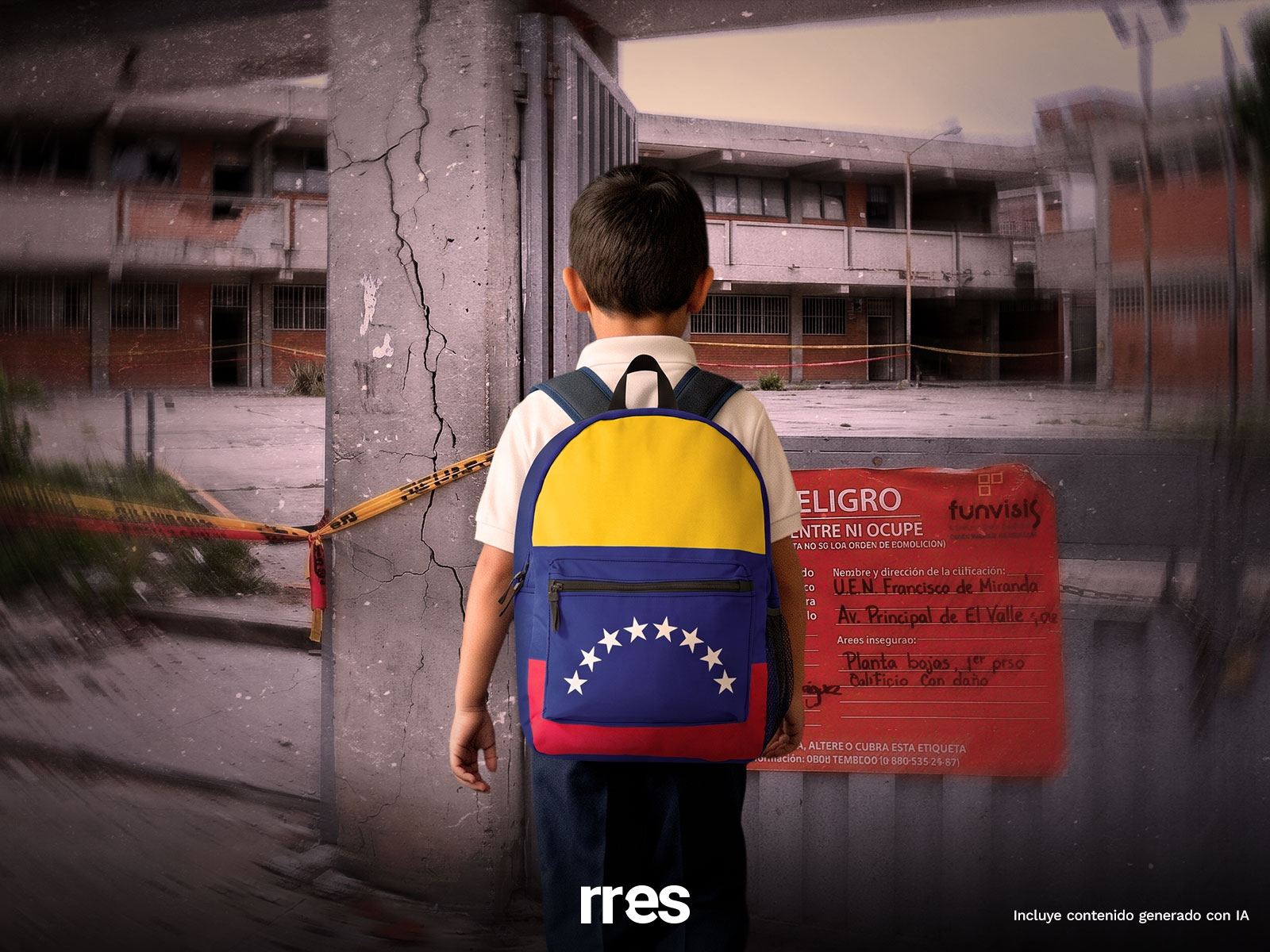
As the school year that should have been underway with classrooms open gets going, the reality in the parishes of western Caracas shows a different picture. In Propatria, at least six educational institutions have been marked with a red tag four months after the earthquakes. This technical verdict bars students from entering and keeps the doors shut because of damage that may compromise the building.
Sources linked to the education community in the area report that the few public schools still standing have been assigned to assist those displaced and affected by the earthquake. “They are looking for a solution for those people to relocate us while the State repairs our schools,” said Roxy Portillo, representative of the Unidad Educativa Nacional Mariano Picón Salas, located on Avenida Principal in Propatria.
Some of the affected schools include the Unidad Educativa Nacional Andrés Eloy Blanco, Escuela Básica Sergio Medina, Unidad Educativa Nacional Bolivariana “Almirante Brión” and the Unidad Educativa Nacional Mariano Picón Salas. The Escuela Técnica Industrial “Rafael Vegas” and the Colegio José Gervasio Artigas no longer operate as schools, but as temporary camps for those harmed by the earthquake.
“For the time being, they send us the activities to take home every week,” Portillo said. She also said students are not receiving classes online. They only receive assignments, which are handed in at the schools a week later, a system that, in her view, does not guarantee adequate learning for young people.
The parents of these students have expressed total disagreement with the contingency arrangement imposed by the schools. On September 17, 2026, in a video posted on TikTok by “La Venezolana 100%”, the Picón Salas school community made a direct appeal to Education Minister Héctor Rodríguez, asking him to urgently intervene to rescue the infrastructure of the affected institutions.
Faced with a lack of response, on October 6, 2026, discontent spilled into the streets. Representatives and community members held a protest in front of the Gustavo Ledo institution, as documented in a video by TikTok user “@yubisney.24”. With placards and chants, they demanded immediate solutions for facilities that are not in good condition to provide public service.
Representatives revealed that this institution introduced a system in which students must attend the campus three days a week, but educational activities remain strictly online.
Additionally, a representative of the Unidad Educativa Nacional Bolivariana “Almirante Brión,” located on Calle 12 in Propatria, said that “at the first inspection the institution received a red tag, and at its second inspection, carried out on September 30, they reported that they would change the tag.” However, so far they have not given any answers. “Teachers are responsibly sending homework via WhatsApp, and students then hand it in.”
Directors of several affected schools in Propatria were contacted to learn more about the structural situation and the number of students affected, but they have consistently refused to comment. They only limit themselves to saying that they “cannot provide further information.” However, an internal source linked to the Unidad Educativa Nacional Andrés Eloy Blanco reported that this institution has approximately 1,500 enrolled students who are affected by the situation.
Concern over a school year that has not fully started is not an isolated case in Propatria. On October 5, the digital outlet JunquitoNews published a video denouncing that schools such as the Escuela Básica Bolivariana Sabaneta, Unidad Educativa Nacional Sucre, Unidad Educativa Nacional Luis Hurtado Higuera (which operates as a temporary camp), Escuela Carlos Lanz, Escuela Básica Nacional José Antonio Páez and Unidad Educativa Nacional Augusto Pisuñer are facing the same situation: red tags, attendance limited to a single day, which representatives consider “not education,” and concern within the education community, which keeps calling on the Ministry of Education to take action.
Earthquakes deepened the education crisis
A report by EFE found that approximately 200,000 girls, boys and adolescents were left out of classrooms after the earthquakes. In statements to the agency, the director of the Fundación Unidos en la Misión, the priest Jesús ‘Txuo’ Rodríguez Villarroel, warned that if schools do not recover urgently, “many of those 200,000 may not return to their school.”
“With the seismic doublet that occurred in June, the schools were unfortunately hit harder, because the structures of the educational buildings were fully weakened,” said Raúl Parra, secretary of Labor Legislation, Hiring and Conflict of the Venezuelan Teachers’ Union (Sindicato Venezolano de Maestros). Parra provided information on other areas of Caracas facing a situation similar to that in Propatria, including Antímano and El Paraíso.
Parra said that in the parish of La Vega there is also a “considerable number” of schools operating under various study modalities (mostly online). One of the centres with a red tag is the Escuela Básica Nacional Amanda de Schnell, whose students “were relocated to what was once the Escuela Nacional La Vega,” where classes are held for three hours a week (on Thursdays only).
The parish of Caricuao is another area where the earthquakes hit schools hard. It has 46 national institutions, five district schools, two autonomous schools and 14 private schools. Thirty-nine of them have yellow tags, and students are not receiving in-person classes. Some of the damaged schools include the Unidad Educativa Valero Hostos and the Escuela Bolivariana Nacional Maestro Jorge Rodríguez.
In El Paraíso, at the Colegio Bicentenario de Bolívar, students are not attending classes. “They only receive the representatives on Fridays to hand over and collect the study guides they are preparing,” Parra said. He stressed that this is the reality for most schools in the cities affected by the earthquakes.
“But for the Minister of Education, everything is normal, and that is not fair. Apart from the fact that teachers are suffering because of their salaries, which are not enough to survive, now they are forced to go in, because otherwise they are threatened with sanctions,” he said.
Private-sector institutions were also hit, and many are waiting for resources to carry out repairs. The general director of the Consejo Educativo, Fausto Romeo Monte, said that in the state of La Guaira, 11 private institutions suffered major damage that left them in ruins. He noted that the State provided support for clearing rubble, but rebuilding the structures requires support from organisations such as UNICEF, NGOs or private funding.
Romeo Monte also explained that the earthquakes affected student retention in the private sector. He said families are moving to other cities for reasons unrelated to the institution, which forces students to fit into other places and schools.
“Changing tags” as an improvised solution
In some schools in the capital, given the i