
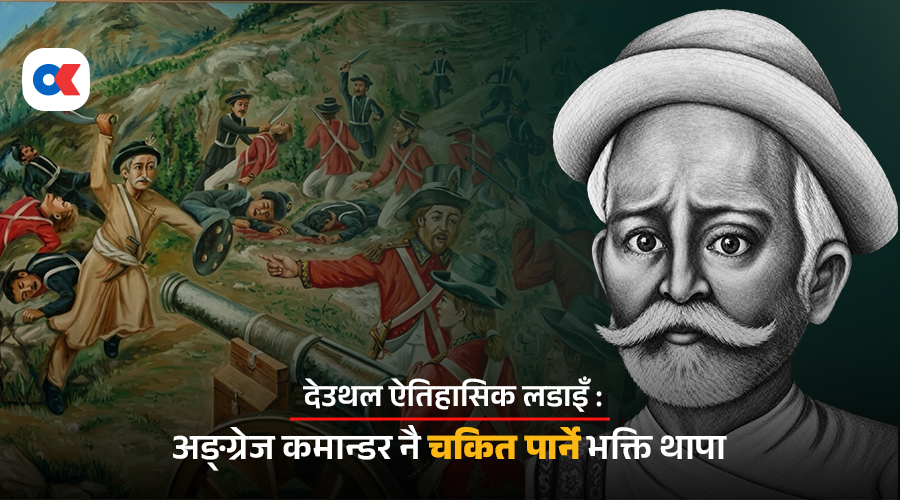
Bhakti Thapa: From Lamjung Commander to Gorkhali Officer
Bhakti Thapa, aged 73, died in battle at Deuthal while attacking to seize a British cannon during the Nepal-British War. He died with five hundred of his fellow fighters. [Translator's note: the summary above has been omitted from this translation.]
Bhakti Thapa made himself immortal in Nepali history. Even in old age, when he should have been resting and spending his remaining years in comfort, his courage on the battlefield amazed the enemy. Relying on traditional weapons such as spears, khukuris and bows and arrows, along with a small number of matchlock muskets, he and his troops charged uphill against the enemy to capture a British cannon stationed at Tippa in Deuthal.
He was 73 years old when he showed his valour in the war with the British in what was then Nepal, across the Mahakali River. He died there with five hundred of his fellow fighters.
He was not of an age to fight a war. Yet driven by patriotism and courage, he fought. While he was waging this difficult battle, his financial situation was also far from secure.
The government had seized the land he had been receiving as a stipend and assigned it to a military regiment. Facing financial hardship, he had to plead earnestly with the government to restore the stipend that had sustained him. Before he could enjoy the income from the land for even one full year after it was finally restored, he breathed his last on the battlefield.
From Lamjung to the Gorkhali Army
Bhakti Thapa was a Puwar Thapa Chhetri. He was initially a nobleman at the Lamjung royal court. He was wounded and captured while fighting against the Gorkhali forces. As a prisoner of war, he agreed to serve in the Gorkhali (Nepali) army.
In 1840 BS, during a war against Nepal led by Kazi Balibhanjan Malla of Parbat, Lamjung had sided with Parbat. In that war, Bhakti Thapa and Balibhanjan were both wounded and taken prisoner. While they were being taken to Kathmandu, Balibhanjan died at a place called Gaikhur.
After he recovered, the surviving Bhakti Thapa agreed to serve in the Nepali army. Bada Kazi Amar Singh Thapa played a role in bringing him into the army. Initially he was given the rank of subba in the army (Tulsiram Baidya and others (eds.), Nepal's Military History, 2049 BS: 478).
By 1846 BS, Jumla had already become part of the Nepali kingdom. However, a rebellion broke out there after some time. Bhakti Thapa, who was deployed as the administrator of the region, played an important role in suppressing the revolt and restoring peace. He also suppressed a rebellion in Doti and administered the area on behalf of Nepal (Baidya et al., 2049 BS: 478–79).
Although he had once been a military commander from Lamjung, after he was absorbed into the Nepali army he carried out his responsibilities with integrity.
Promotion to Sardar and Governor of Kumaon
In the Pajani of 1851 BS, Bhakti Thapa was promoted to the rank of sardar and became governor of the Kumaon region. Through Kazi Damodar Pande, the then king Ranabahadur Shah issued a royal decree on 10 Shrawan Sudi 1851 BS, a Monday, concerning Bhakti Thapa's sardari and his governorship of Kumaon, addressed to officials and stakeholders responsible for Chepe and western Marsyangdi.
The decree stated: "Bhakti Thapa, sardar, is to be released and sent to Kumaon. Your protection depends on the sardars. Take your army and go to Kumaon with the sardar, in full readiness" (Maheshraj Pant, Purnima, Issue 11, Kartik 2023 BS: 33).
To administer the region as governor of Kumaon, on 12 Shrawan Sudi 1851 BS, a Friday, King Ranabahadur Shah granted him eleven important powers. This was the greatest authority he received in his lifetime (Pant, 2023 BS: 35–36).
Some time later, the governorship he had been given was also taken away, and the nearly unlimited powers he had held were reduced.
While he was serving as governor of that region, Amar Singh Thapa, father of General Bhimsen Thapa, arrived there with a subordinate post. He served under Bhakti Thapa.
At that time, relations between Nepal and the Kilapuri kingdom were deteriorating. However, when Amar Singh Thapa attacked Kilapuri without consulting his governor, Bhakti Thapa, a rift developed between the two.
To resolve the matter, Chautariya Bam Shah, a senior official, was sent to that area as governor. From then on, Bhakti Thapa had to act on Bam Shah's instructions, and the nearly unlimited powers previously granted to him came to an end (Baidya et al., 2049 BS: 481).
His service in the Kumaon and Garhwal region fluctuated. He was in Kathmandu for the coronation of Girvanayuddha Vikram Shah. On 28 Falgun 1855 BS, when the throne was handed to the king's son, Ranabahadur Shah had most of the nobles sign a charter.
Bhakti Thapa was one of those who signed. Later, after returning from Banaras, as the chief administrator under Swami Maharaj Ranabahadur Shah, in 1861 BS he sent Bada Kazi Amar Singh Thapa to seize Garhwal. At that time, Bhakti Thapa served under Amar Singh in that campaign (Maheshraj Pant, Purnima, Issue 14, Shrawan 2024 BS: 149–50).
When the throne was handed to the minor Girvanayuddha Vikram Shah, the nobles had to state their three generations of ancestry when signing the charter. In that charter, the name of Bhakti Thapa's grandfather is recorded as Pratap Thapa and his father's name as Amar Singh Thapa (Chittaranjan Nepali, Shree 5 Ranabahadur Shah, 2075 BS: 109). However, this Amar Singh Thapa was not the father of Bada Kazi Amar Singh and General Bhimsen Thapa, but the father of Bhakti Thapa.
After spending about six years in Kathmandu after returning from the Kumaon-Garhwal region, Bhakti Thapa was once again posted to that region. At that time, travel between Kathmandu and Kumaon alone took four months.
A Precarious Financial Situation
Bhakti Thapa himself had reached old age. His household was also large. He had three wives. At that time, war or rebellion was always a possibility, so there was no situation in which he could live in peace and comfort. During the pajani, he also had to move to whatever post the government assigned.
An old and experienced warrior, Bhakti Thapa had been on the battlefield for a long time. He was unable to enjoy even one year of income from the five fields whose stipend had been restored.
In the same period, when the government transferred him and sent him to Garhwal on 10 Asar 1867 BS, he was immediately overwhelmed by two family bereavements. On 27 Asar, his son Sarvajit Thapa died, and shortly after, on 8 Bhadau, the mother of that son also died (Maheshraj Pant, Purnima, Issue 20, Magh 2025 BS: 303).
He was on the battlefield while in old age, and at the same time he faced family grief. In that period he was also in severe financial distress. The government had not given him a regular salaried position (khangi). At that time, service was typically compensated with land, and the produce of that land served as the salary. According to Mohan Mainali, author of Mukam Ranmaidan, Bhakti Thapa had not fought in comfort, because the government had not given him a proper post.
At that time, he wrote a letter on 5 Magh Sudi 1870 BS, a Thursday, from Mukam Arki to Amar Singh Thapa, father of Chief Minister General Bhimsen Thapa, who was then running the state, complaining about his situation. According to his letter, the year before, through Amar Singh's kindness, five fields had been secured as his stipend. His army and his three-generation family had survived on that income. However, those five fields, the stipend, had now been confiscated.
In the letter asking for the confiscated fields to be restored, he addressed Amar Singh Thapa as "Kazi (Amar Singh Thapa), you are like a mother. Please help settle this matter, and I will serve you... Even if you tie me with a gun, please have this matter resolved. Why would you write such a thing... I will hold myself responsible for this matter and will serve you to resolve it. I have been in Bhot, Madhes and other places, and my fortune rests on your grace."
At that time, Amar Singh was posted in Palpa. Because Bhakti Thapa believed that his son Bhimsen Thapa would heed whatever Amar Singh said, he addressed Amar Singh as "mother" (aama) in that letter (Mainali, 2081 BS: 130–31).
How did his family also become deprived of its livelihood?
Bhakti Thapa's five fields, which had provided his stipend, had been assigned to a military company's salary, leaving his family without income. After his complaint reached Amar Singh Thapa (father of Bhimsen Thapa), Amar Singh wrote to Kathmandu in support of Bhakti Thapa's position. The government then decided to return the land Bhakti Thapa had been receiving and to give the military company another piece of land in exchange. Chief Minister General Bhimsen Thapa and executive official Kazi Ranadhwaj Thapa informed Bhakti Thapa of this decision by letter on 1 Chaitra 1870 BS.
Bhakti Thapa, who was camped at Baghal on the bank of the Shatrudra, received this letter on 25 Baisakh 1871 BS.