
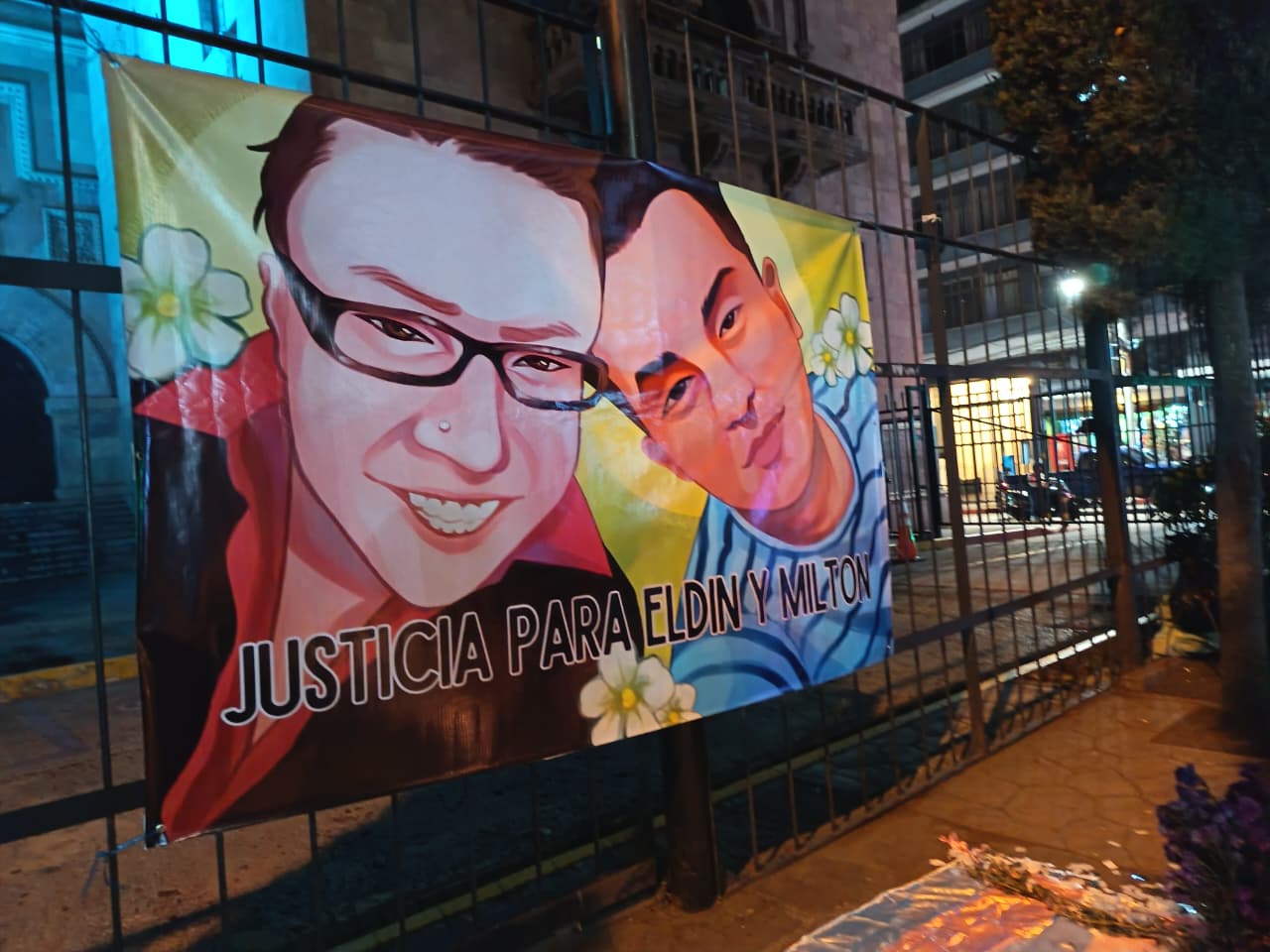
After more than two years of seeking justice, seven former police officers were convicted for their role in the extrajudicial killing of Eldin Choc and Milton Santamaría. While the High-Risk Court B handed down the sentence, relatives, activists and civil society members kept their memory alive outside the Torre de Tribunales, among flowers, candles and messages against homophobia.
By Sergio Sor
The night of Wednesday, October 21, 2026, marked an important moment in the pursuit of justice for Eldin Leonel Choc Xi and Milton Nelson Santamaría, a gay couple who were victims of police violence in San Andrés Itzapa, Chimaltenango, on April 18, 2024.
After more than two years of waiting, the High-Risk Court B convicted seven former agents of the Policía Nacional Civil (PNC, National Civil Police) for their responsibility in the events.
The hearing brought together relatives, representatives of civil society organisations, activists and media. The ruling was issued by judges María Eugenia Castellanos Cruz, presiding, and members Marling Mayela González Arrivillaga and Missulla Eunice Solís Rodas.
While the ruling was being read inside the court, a vigil demanding justice in this case was held outside the Torre de Tribunales.
Those present had placed banners, flowers and candles to remember Eldin and Milton, in a gathering marked not only by the court ruling but also by collective support and solidarity.
Seven convictions and a demand that remains
While the ruling was read, the judges detailed the individual responsibilities of the seven former officers involved in the case. Edy Leonel Vásquez Rabanales, who was head of substation 73-15, and Fredy Santiago Velásquez Pérez were convicted of the extrajudicial killing of Eldin and Milton. Each received 30 years in prison per victim, for a total of 60 years.
Mauricio Abraham Contreras Salán was sentenced to 30 years in prison for the extrajudicial killing of Milton Santamaría, while he was acquitted of that crime in the case of Eldin Choc Xi. Separately, former officers Yulisa Nabely Ayala Yol and Yorleni Lisbeth Macario Ramos each received 11-year sentences: six years for discrimination, three for each victim, and five years for dereliction of duty.
Former officer Ángel Mario Roquel Sajbochol was sentenced to ten years in prison for obstructing criminal action and dereliction of duty, in addition to a fine of one thousand quetzales for failure to report a crime. Finally, Jeremías Jacobo Rojas Rojas received an eight-year sentence for abuse of authority and unlawful detention.
An important aspect of the reading of the rulings was the acknowledgement that Eldin and Milton were in a relationship. Likewise, during the presentation of the facts and evidence, references were made to homophobia and hatred, elements that had been pointed out throughout the search for justice.
However, although the convictions represent progress, one important demand remains: legal recognition of crimes motivated by hatred and prejudice.
In Guatemala, these are not classified as specific offences when motivated by the victims' sexual orientation or gender identity. For this reason, the ruling also opened space to reflect on the need to strengthen laws and protection mechanisms, as well as to recognise the responsibility of state institutions for violence committed by their agents.
Events that gave rise to the search for justice
On April 18, 2024, Eldin and Milton were detained by National Civil Police agents in San Andrés Itzapa, Chimaltenango. Subsequently, both were killed in events that led to an investigation and a judicial process against the officers involved.
Since then, their relatives, human rights organisations and people from the sexual diversity community pushed for action to ensure the deaths did not go unpunished. The case also brought into discussion the violence and discrimination faced by LGBTIQ+ people in Guatemala, particularly when it comes from those responsible for guaranteeing the safety of the population. For more than two years, the demand for justice for Eldin and Milton was accompanied by commemorative actions and calls to recognise violence motivated by prejudice against sexual orientation and gender identity.
Memory that remains alive
The demand for justice did not begin on the day of the ruling. On Thursday, October 15, the date initially set for the court ruling, activists and civil society organisations had organised a first vigil, accompanied by actions in front of the Ministry of Governance.
Although the reading of the sentence was rescheduled, the accompanying actions continued until Wednesday, October 21, when people gathered again outside the Torre de Tribunales.
Photo 3. Vigil and collective altar outside the courts demanding justice for this crime. Photo Sergio Sor
During the vigil, banners and signs were displayed with messages such as “La homofobia mata” (“Homophobia kills”) and “Justicia para Eldin y Milton” (“Justice for Eldin and Milton”). A collective altar with flowers and candles was also set up, as a space to remember their lives and express solidarity with their families. After the hearing ended, the gathering in front of the altar allowed relatives and people who had accompanied the process to speak.
There, the sentence took on another meaning: it was not only about the years of imprisonment imposed, but about the lives that were lost and the importance of continuing to demand justice for those who face violence and discrimination. The collective altar was also a space to remember other people from the sexual diversity community murdered during 2026, more than thirteen victims, and the need to keep their memory alive, so that their stories are not reduced to statistics.
Among the flowers, candles and messages, the vigil brought together people with a shared demand: that no one be a victim of violence because of their sexual orientation or gender identity, and that institutions responsible for protecting the population act with respect for human rights.
One of the significant moments at the altar was the speech of Henry Alexander Choc, Eldin's older brother, who thanked those who had accompanied the demand for justice over the course of the days. “I have no way to repay all the support you have given us since Thursday,” he said to those gathered. His words reflected the importance of solidarity during a process that stretched over more than two years.
The presence of family members, friends, activists and organisations ensured that the call for justice was not confined to the judicial sphere, but also made its way into public spaces.
During the vigil, Javier Yantuche, of Asociación Lambda, also highlighted the value of staying united against violence and discrimination. “Al