
The Central Administration for Teachers' Affairs announced on September 10 that 43,400 candidates had passed the fifth batch of the "30,000 Teachers" competition to be assigned to primary schools. This came eight months after Prime Minister Mostafa Madbouly approved starting the recruitment of 72,000 teachers in a single round.
The gap between the two figures is 28,600 jobs. The Egyptian Initiative for Personal Rights (EIPR), in a statement issued on September 13, described this as "some 29,000 jobs removed from the appointments list." It suggests that behind the exclusion of those who would have filled these posts is a criterion called the "specific weight," applied with a new minimum, despite these candidates having passed the Central Agency for Organization and Administration's exams. Over the following five weeks, at least eight MPs submitted requests for briefings asking about the basis for this criterion and when it was adopted. The body applying it has not issued a single public statement.
What goes into the score?
The "specific weight," as the EIPR defines it, is not body weight. It is the total score, out of one hundred, of a candidate for the assistant teacher post. The examination committee at the Military Academy assigns it based on the average grade in study, the medical examination scores, the physical test and the appearance assessment. According to the same statement, teachers reported that the minimum score to pass the tests under this criterion in the fifth batch became 71 points. Meanwhile, Senator Ayman El-Safti, speaking on the program "Min Awal we Gedid" hosted by Nevine Mansour, said the same criterion had been applied in the four previous stages with a 65 percent threshold, and that no one had announced why it was raised.
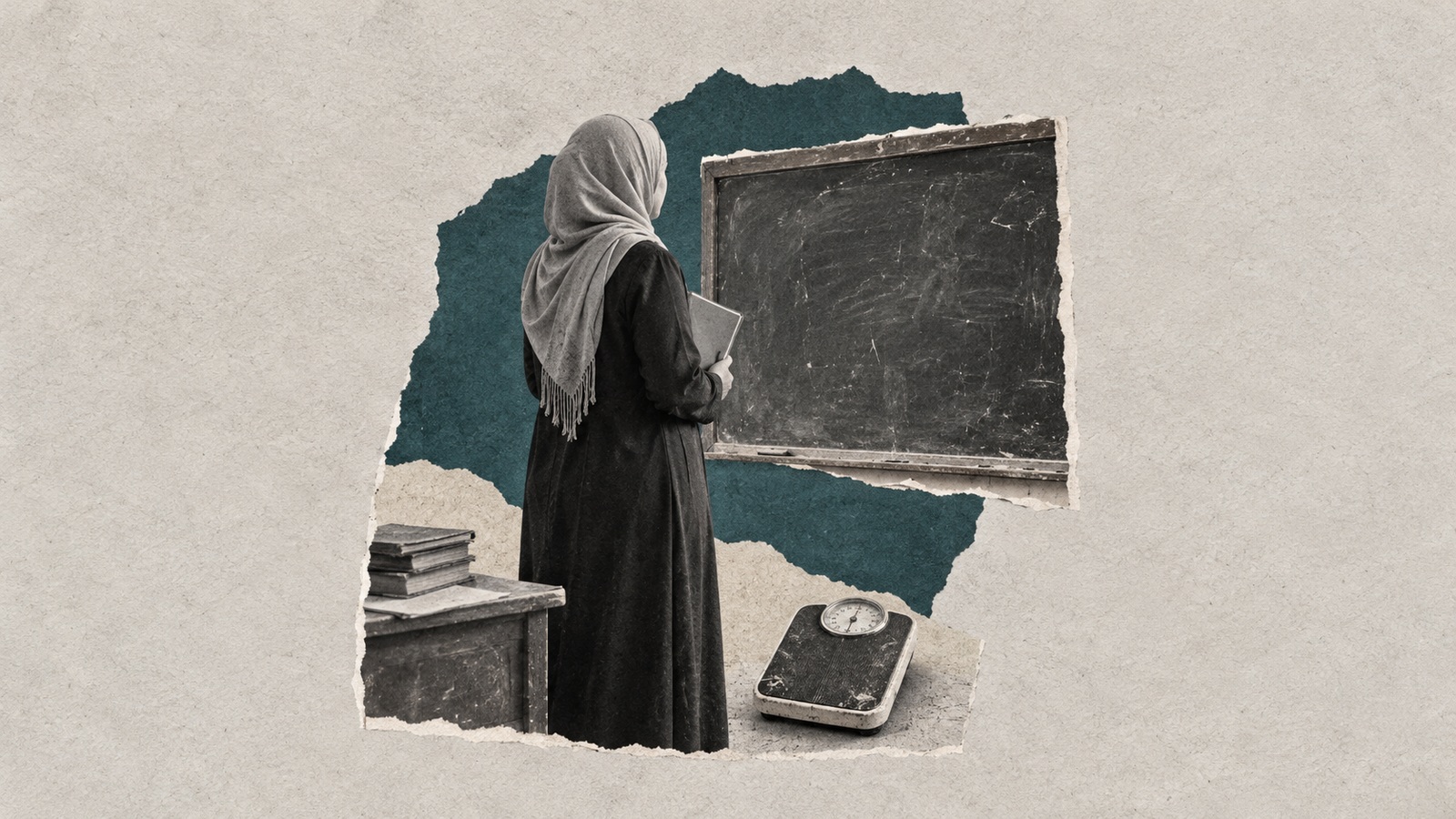
Body weight also enters this criterion through the appearance assessment. According to the EIPR, the new condition is that a candidate's weight must not exceed the "ideal weight" by more than five kilograms. Previous batches allowed an excess of up to twenty kilograms. The EIPR says a test instructions document, published in its February report titled "On the Scale of Discrimination," confirms this. A new fee of 1,008 Egyptian pounds (about $21) was also added for the medical examination at the Academy, which had previously been free.
One point
Sabrine Ibrahim, a social studies teacher from Fayoum, told Zawia3 that she passed all the tests, from the academic to the medical, physical and appearance assessments, and then failed the total by a single point: "My specific weight is 70, and the threshold was raised to 71. This is the first time this has happened. Previous batches passed with 65 and with 61."
Mona El-Sayed, a mathematics teacher who has been teaching for eleven years, described her experience in two posts on her page. She sat the Central Agency's exams in the New Administrative Capital two weeks after giving birth. She attended educational training carrying her infant, who was not yet six months old, and paid 1,008 pounds for the medical examination, which had been free for those before her. Her weight was 52 kilograms before pregnancy and rose to 83 after it. During breastfeeding she followed a strict diet for five months until she reached 58 at the medical examination, which allowed ten kilograms over the ideal weight. In the physical test she received ten out of forty points for running, jumping and zigzag exercises. Then, at the appearance assessment, she learned that the limit was 57 and that every kilogram above 52 deducted a point. She reduced her weight to 55. After all that, she was shocked to be rejected.
The EIPR describes this pattern as a direct result of the new condition. Rapid weight-loss regimens cause some candidates to become anaemic, and they are then excluded at the medical examination because of what they did to pass the appearance assessment. Pages of those excluded shared collective and individual appeals demanding an investigation into their files and disclosure of the legal and technical reasons for their exclusion. Others called for amending the weight condition. According to Al-Watan, the official response was that medical and physical fitness is carried out by bodies other than the Ministry of Education.
Three bodies and no answers
According to the EIPR's documentation, a candidate in this competition passes through three successive bodies. The first is the Central Agency for Organization and Administration, which conducts the electronic, specialist and educational tests and announces the conditions. Next is the Ministry of Education and Technical Education, which handles educational training. Finally, the Military Academy conducts the medical examination, the physical test and the appearance assessment, in the presence of military commanders and representatives of the Ministry and the Agency. The Academy was not mentioned in the announcement of the first competition, which the Agency published on July 2, 2022. According to the same report, those who passed the Agency's tests were surprised to receive messages asking them to report to the Academy for additional tests.
Refaat Fayad, an education expert, told Zawia3 that since the presidential initiative to recruit 150,000 teachers was launched in 2022, the selection of candidates is no longer the responsibility of the Ministry of Education. Instead, it lies between the Central Agency and the Military Academy, and the Ministry is "only informed of the number suitable for appointment." He argues that selecting teachers on the basis of competence alone was an outdated concept, back when education faculty graduates were assigned to work with their qualifications without regard to health, fitness or appearance. He says that the state's current practice in public jobs is to verify that a candidate is fit for the post and able to perform it. He adds that earlier stages excluded pregnant women and those who were overweight "because they could not fully perform their job, and because a pregnant woman takes long leave."
The EIPR has challenged this explanation since 2023. It argues that excluding pregnant women, recent mothers and people who are overweight violates Articles 9, 11, 12 and 53 of the Constitution, which require the state to ensure equal opportunities and non-discrimination. It also notes that Civil Service Law No. 81 of 2016 requires health fitness for a post, certified by the relevant medical council. Candidates already obtain this certificate from Ministry of Health hospitals before the Academy's tests are added.
The Ministry's position today has not changed from what it said in October 2023. It says the competition procedures follow the rules and laws that govern them, and that its jurisdiction is limited to assessing the technical aspect of the teacher, while "the competent authorities" conduct the physical and mental fitness tests. On September 7, three days before the result was announced, the Central Administration for Teachers' Affairs said only that an appeal against the fitness test was possible after the result was announced, without specifying a body or deadline. Zawia3 contacted Shady Zalta, spokesperson for the Ministry of Education and Technical Education, who had not responded at the time of publication. As of writing, neither the Central Agency nor the Military Academy has publicly commented on the raising of the threshold to 71.
Eight MPs and one question
The question moved to parliament two weeks after the result. On September 27, El-Safti said the exclusion of around 30,000 candidates did not match the aim of a competition announced to fill a teacher shortage. He added that if budget constraints were the reason, they did not justify the exclusion, given that the Prime Minister had announced the government's intention to appoint 72,000 teachers in coordination with the Finance Minister to fund their salaries. On October 1, MP Yasser Arafa submitted a briefing request to the Prime Minister, the Minister of Education and the head of the Central Agency. It asked about the criteria for ranking candidates, the basis for the 71 percent criterion, and the position of those who had passed advanced stages. On October 5, MP Mahmoud Rashad Habib of the Al-Nour Party called for a review of the percentage, a return to the threshold used in earlier stages, and placing those excluded on waiting lists instead of requiring them to reapply.
On October 7, MP Mohamed Sami Shahda asked about the legal basis for the specific weight, the body that approved it, the date of approval, and whether it had been announced before the tests. He called for publishing the numbers of applicants and successful candidates at each stage, opening an appeals process, and allowing each excluded candidate to see their scores and ranking. MP Mohamed Abdullah Zein El-Din requested a neutral investigation into the distribution of successful candidates across the directorates of Beheira Governorate. On October 13, Yasser El-Hodaiby, deputy chair of the Human Rights Committee, along with Mohamed Abdel-Alim Dawoud and Bassam El-Sawaf, submitted three requests asking how the criterion was calculated, when it was applied, and how many people reached the appearance assessment and were then excluded. MP Sanaa El-Sayed, a member of the Education and Scientific Research Committee, also said in television remarks that the budget could be one factor in determining the number accepted. She said the criteria should have been set in advance to match the target number, rather than admitting large numbers and then introducing additional criteria at the final stages to reduce them.
2023 precedent: from exclusion to detention
This is not the first time. In the first batch, around 110,000 people applied to the competition announced by the Central Agency in July 2022. Of these, 28,170 passed its tests and the medical examination, and 27,853 of them registered for the Military Academy's tests. The Ministry appointed only 15,902 under Ministerial Decision No. 190, issued by then-minister Reda Hegazy on October 4, 2023. According to the EIPR's report, 11,951 were excluded. Government MPs were accused of not being serious about appointing the required number, and submitted briefing requests about the exclusion of people who had passed the tests and had borne the hardship and cost of travel.
On October 15, 2023, dozens of successful candidates protested outside the Ministry's headquarters in the New Administrative Capital against the appointment of some of them but not others. Fourteen were arrested and held in pre-trial detention until their release in February 2024, according to the EIPR. In December 2023, the EIPR challenged the exclusions before the Administrative Court of the Council of State on behalf of 106 excluded candidates: 94 women and 12 men from seventeen governorates. Fifty had been excluded because of weight, 28 because of pregnancy and 28 because of the medical examination. Zawia3 documented these stories in April 2024. The court referred