
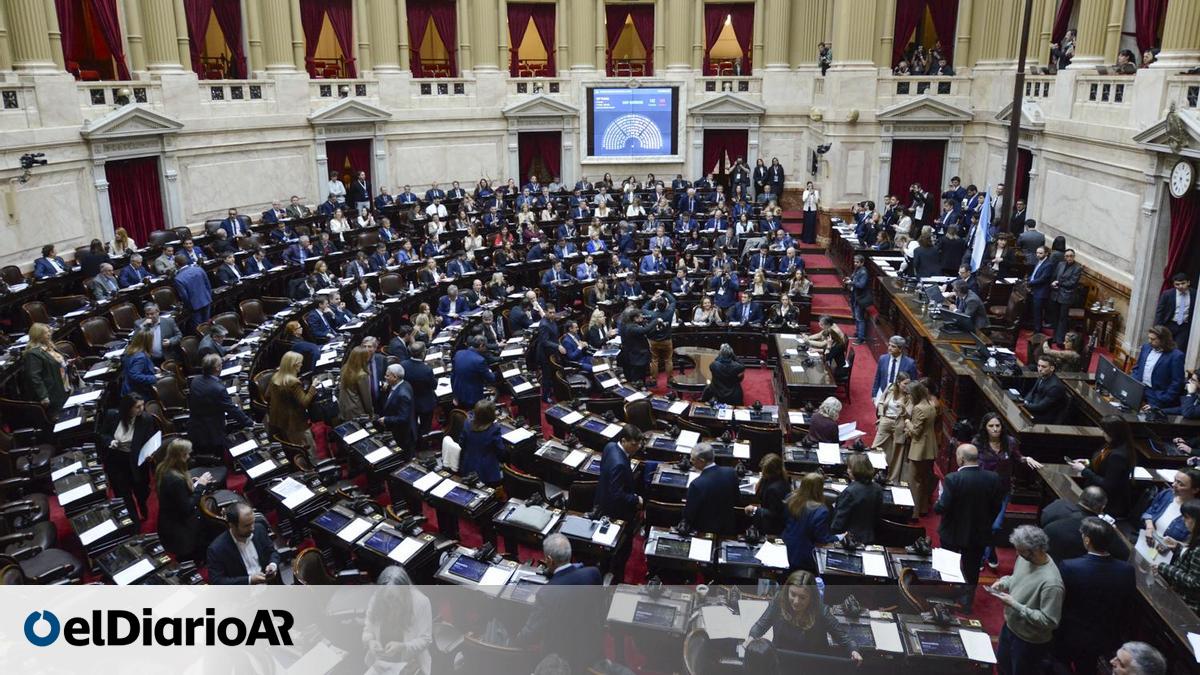
The Chamber of Deputies on Wednesday approved, by an overwhelming majority, the new law on disability social protection, following negotiations that brought Peronism into an agreement with La Libertad Avanza and the centrist blocs.
The bill passed its first chamber with 237 votes in favour, 9 against and four abstentions, and was sent to the Senate, where it is expected to be considered in the short term.
The majority report, titled “Law for the Strengthening, Sustainability and Permanent Efficiency of the Disability System,” which the ruling party agreed with the head of the Argentina Federal bloc, Oscar Herrera Ahuad, takes in virtually the entire benefits scheme set out in Law 27.793 on Disability. However, it removes the emergency and temporary character of that law, turning it into a norm of public order with permanent effects that outlast any government in office.
What is retained from the emergency law includes, for example, the compatibility between receiving a contributory disability pension (70% of the minimum retirement benefit) for holders of the CUD and holding formal employment or being registered as a monotributista, provided income does not exceed two minimum vital and mobile salaries.
The principle of a single nomenclature is also maintained, the periodic automatic indexation of service fees to the pension mobility index (tied to CPI) is reaffirmed, and basic medical coverage under the Plan Federal Incluir Salud is guaranteed for those receiving the disability pension.
On financing, the bill establishes that the budget allocation of the Ministry of Health may not be lower, in real terms, than the previous fiscal year.
In addition, the bill creates a system of periodic audits with cross-checking of data from ANSES, ARCA, SINTyS and RENAPER, under the principle of inclusive due process.
At the request of allies, a transitional clause was also included requiring a schedule for paying overdue compensation to service providers, with a maximum of 30 days for the Executive to issue regulations.
Throughout the day, Unión por la Patria leaders met for hours with representatives of disability organisations to discuss whether to join the ruling party’s majority report instead of insisting on extending the emergency until 31 December 2027.
Key points of the Law for the Strengthening, Sustainability and Permanent Efficiency of the Disability System
- Permanent regime: replaces the current emergency scheme with a definitive legal framework.
- Non-contributory pensions: confirms their continuity and sets their value at 70% of the minimum retirement benefit, maintaining compatibility with formal employment up to two minimum salaries.
- Medical coverage: guarantees access to a medical care and health coverage programme for beneficiaries.
- Employment inclusion: establishes tax benefits for employers who hire people with disabilities.
- National nomenclature: maintains the universality and uniformity of fees, with periodic updates.
- Financing: provides specific budget allocations to ensure the sustainability of the system.
- Pending compensation: includes a transitional clause requiring the Executive to publish a schedule of payments owed to service providers.
The speeches
The ruling party’s rapporteur, Gerardo Huesen, defended the initiative and said that “disability is not a slogan and must certainly not be trapped in political debates.”
“We are talking about people with the right to live with as much autonomy as possible, and we are working to make that happen. We inherited a system that we did not break and, faced with this reality, La Libertad Avanza is taking responsibility,” he said.
According to him, “the discussion should focus on how to build a transparent and accessible system, with controls and with rights guaranteed for those who are entitled to them.”
“The time has come to stop managing that debt to people with disabilities and start building permanent solutions. We are working to leave behind a more orderly system, with clear rules and greater predictability for people with disabilities, their families and the service providers,” he stated.
The libertarian from Tucumán said that “what politics should ask itself is whether we can keep legislating one emergency after another, instead of thinking about permanent policies.”
“People with disabilities cannot live in permanent emergencies or depend on extensions or political decisions every time they want to exercise their rights,” he insisted.
He added that “this majority report goes beyond that logic” because “the proposal is to transform the mechanisms of the emergency law into permanent responses.”
He cited as examples the specific financing, the continuity of benefits, the updating of the nomenclature by CPI, and the compatibility of pensions with formal work, as well as compensation to service providers for late payments.
“These are concrete tools that generate predictability, guarantee rights and bring peace of mind to people with disabilities and their families. This is also freedom. It is not about leaving a person alone in the face of their difficulties, but about giving them tools,” he concluded.
For his part, Juan Marino confirmed that Unión por la Patria would accept joining the bill that the ruling party had closed with Herrera Ahuad, since they did not have the votes to fight for an extension of the emergency and, after all, the majority report addressed most of the demands of organisations of and for people with disabilities.
“Today we got up and started talking among deputies. We saw that we would not have the necessary votes to extend the emergency law. We began talking with the organisations to decide our position. Based on those conversations, they asked us to take part in discussions so that the report that could actually be approved would include improvements and not regressions,” the opposition deputy said, describing the sharp shift in Unión por la Patria’s position.
One of the improvements Marino highlighted in the bill is the 160-day period for people with disability pensions whose eligibility requirements are questioned in an audit to present their defence before their benefit is suspended.
During his remarks, the UxP legislator praised the struggle of the disability community, which had “at the time achieved the passage of the Disability Emergency Law” and then overturned the veto, as well as “obtaining court rulings that forced the National Executive Branch to comply with the law.”
“To this day, organisations continue fighting for Milei to comply with the law,” and he identified non-compliance with the law as the main cause of the sector’s “critical situation.”
He also recalled that in the original 2027 Budget bill, ministers Diego Santilli and Luis Caputo proposed “eliminating the nomenclature and health coverage,” which he described as “an all-out attack on the rights of people with disabilities.”
“There is a fundamental problem here: no law will overcome the emergency situation. For it to be overcome, Milei has to comply with the law, because what we are ratifying in this statute is already covered by the Emergency Law,” he stressed.
He specified that “there are 324,303 people waiting for the Executive to resolve their pension request and have no answer” and that “only 8,000 have been granted approval.”
“They have to comply with the law so that the emergency can be overcome. The nomenclature of services also has to be updated. The budget includes a cut of 1