
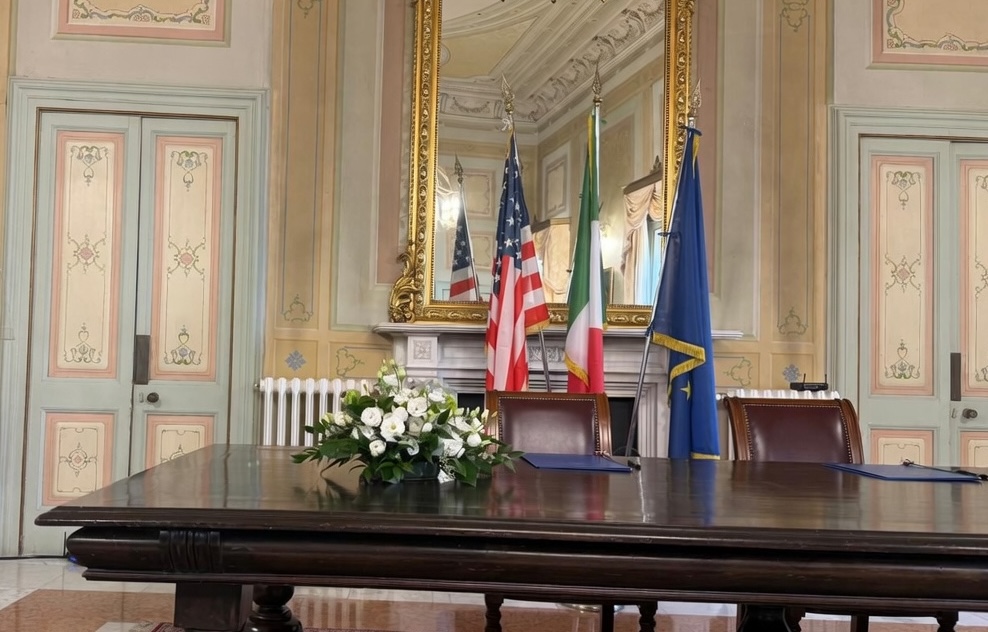
Italy Joins Pax Silica
It is done: the Pax Silica Declaration was signed this morning in Brindisi. Italy formally enters the architecture of US-led technological alliances on semiconductors, artificial intelligence, and critical minerals.
"Italy made the right choice in joining Pax Silica. At a moment when other capitals are still hedging between Washington and Beijing, hoping to preserve commercial ties with China while avoiding the cost of choosing sides, Rome's accession—following its entry into the 6G security coalition and Foreign Minister Tajani's participation in the Critical Minerals Summit—signals that it does not intend to play that game," comments Valbona Zeneli, expert on transatlantic dynamics at the Atlantic Council and senior advisor at Decode39. "This decision fits a course of action in which Rome positions itself ahead of events rather than waiting for the new international order to fully define itself, betting on the actual direction of power shifts rather than keeping all options indefinitely open."
As expected, the signatories were Armando Varricchio, Special Envoy for Innovation and New Technologies at the Italian Foreign Ministry, and Tilman Fertitta, the US ambassador to Italy, in the presence of regional institutions gathered at the prefecture in the regional capital.
The Foreign Ministry explains that with accession, Italy enters "in full" an initiative that now counts more than 20 countries, and that the signature represents "another crucial element of the strategic character of relations between Italy and the United States." The goal is to build a reliable and resilient ecosystem founded on common standards for key technologies of the AI era—from silicon to critical minerals, from high-tech systems to digital infrastructure—within a Euro-Atlantic framework that remains, for Rome, "one of the pillars of Western unity." On the critical raw materials front, Foreign Minister Antonio Tajani and his US counterpart, Secretary of State Marco Rubio, will sign a Memorandum of Understanding in the coming weeks, which follows operationally from the Critical Minerals Summit held on February 4 in Washington.
The Italian government frames Pax Silica accession as complementary, not alternative, to that already signed by the European Union a few weeks ago. This complementarity is measurable today on another front as well: Brussels has just launched a tender worth over 30 billion euros to build up to seven AI Gigafactories in Europe, with Italy as a candidate to host one through a consortium bringing together Eni, Leonardo, and the Italian Institute for Artificial Intelligence for Industry (AI4Industry) in Turin.
It is significant to read the initiative in the same logic as Pax Silica rather than as a chapter of fully autonomous European technological sovereignty—a target that remains, at present, largely unrealistic. For hardware, for instance, the Commission has already signed letters of intent with AMD, Nvidia, and Qualcomm, three US giants without which European Gigafactories would lack the necessary computing power. The European Gigafactories become another piece of the same transatlantic supply chain in which Italy has just formalized integration in Brindisi, not as an alternative to it.
"The Italian move actually goes beyond Pax Silica alone. The European Commission has opened its call for a maximum of seven Gigafactories, and together, the two moments capture transatlantic technological cooperation at this stage—not Europe choosing Washington over its own capacity, but the two strengthening each other," Zeneli adds. "Pax Silica anchors Italy in a reliable supply-chain architecture designed by the United States; the Gigafactory initiative gives Europe the sovereign processing capacity to use such access on its own terms."
Speaking at the ceremony, Forza Italia deputy Mauro D'Attis emphasized how the choice of venue is not casual: the city, he explained, is already part of that network, "at the forefront" of the country's economic, industrial, environmental, and digital transition, with over 35 investment proposals identified for the industrial area—more than 10 billion euros in potential investment and over 2,000 direct jobs expected—including Eni Storage Systems' FAENIX project on LFP batteries, Solaria's data center of over 400 MW with a US partner, and Enel's electrochemical energy storage system.
On the political front, following what is stated in the text of the joint declaration signed in Brindisi, the purpose of cooperation is to pursue "a global economic partnership aimed at building an order of economic security founded on trust, technological complementarity, shared interests, and common commitment to a more prosperous future."
To achieve this goal, the work done on both sides of the Atlantic must be recognized—by Ambassador Fertitta in Rome and by the Italian ambassador to Washington, Marco Peronaci—who in recent weeks worked to smooth some tensions in the bilateral relationship, including the slip-up of Italy's participation in Shanghai's WAIC, without this undermining the overall direction.
Today's signature, despite being delayed by a few weeks precisely because of those tensions, confirms that diplomacy remains the instrument holding international relations together even when domestic politics creates friction. Not by chance, on the eve, Senator Enrico Borghi—vice president of Italia Viva and member of Copasir—had previewed to Formiche.net his judgment on Italian accession to Pax Silica: "It is not just important. It is decisive."
The signature closes the phase of formal accession; the real test remains Italy's capacity—together with other coalition members—to translate political alignment into real investment and productive capacity.