
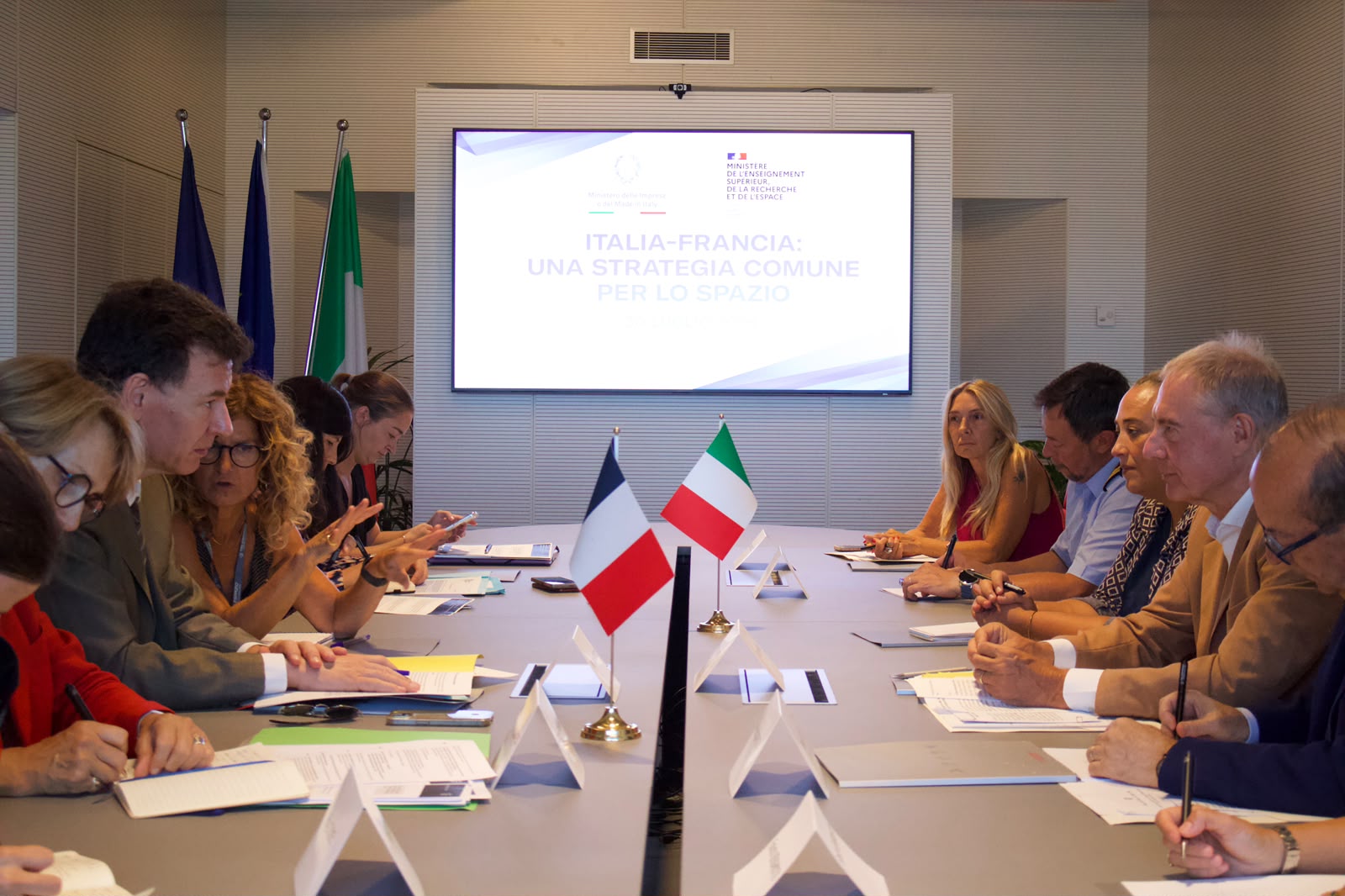
Italy's European Space Turn: Ministers Confirm Continental Strategy at Fucino Centre
Italy's visit by Ministers Urso and Baptiste to the Fucino Space Centre confirms the country's choice to bet on Europe for its future in space. From cooperation with France and Germany on the Bromo project to the role of Iris² and launch vehicles, Rome is looking to build continental industrial capacity and more concrete strategic autonomy. The relationship with the United States remains in the background, while the centre of gravity shifts to European champions and already-operational infrastructure.
Never before has Italy seemed to rely on Europe as the natural horizon for its future in space. Not just the Europe of agencies and shared programmes, but Europe of industry, satellite constellations, launch vehicles, and continental champions. This line was not born at the Fucino Space Centre, but it was restated clearly during the visit by the Minister for Industry and Made in Italy, Adolfo Urso, alongside French Minister for Higher Education, Research and Space, Philippe Baptiste.
The move comes after a series of meetings that have already shaped cooperation between Rome and Paris. First came the joint declaration on space economy signed by Urso and Baptiste, then the bilateral summit in Antibes between Giorgia Meloni and Emmanuel Macron, then another meeting in the Abruzzo space hub managed by Telespazio, a joint venture between Leonardo (67%) and France's Thales (33%). The message is always the same, but becomes increasingly clear. Italy aims to build European capacity together with France and Germany, rather than simply seeking ready-made solutions outside the continent.
In this framework, the relationship with Washington remains important, but is certainly less central today. Urso's visit to the United States had opened a dialogue channel on space and strategic technologies, but produced no comparable developments to those achieved on the European front. After months in which the possible adoption of Starlink for secure satellite communications was discussed, the centre of gravity of Italian political discourse has shifted.
Bromo as a Political Choice
The project that best represents this approach is Bromo, an alliance between Leonardo, Airbus, and Thales to create a European champion in satellites. Its importance lies not only in its industrial dimension. Bromo involves Italy, France, and Germany, and seeks to address the most obvious limitation of European space—fragmentation that weakens the capacity to compete with large American and Chinese actors.
From this perspective, Minister Urso linked the project to precisely this change in scale. "Italy and France together must show Europe the way of European champions," he said, explaining that "competition is no longer only internal to Europe; it is especially external." The formula is political before it is industrial, because it challenges one of the habits of the European market. Internal competition remains a principle, but in space it risks becoming a constraint when it prevents companies on the continent from reaching the scale necessary to compete with large global actors.
For the French side, Baptiste pressed in the same direction. Space, in his reading, is now at the centre of European sovereignty because it concerns defence, security, research, and industry. His presence alongside Urso in the Abruzzo space centre demonstrated a convergence that does not remain only in bilateral documents. The point is to build shared tools, not simply to coordinate national positions.
The same logic applies to Iris², the future European constellation for secure communications, for which the Fucino Space Centre is identified as one of the control hubs in complementarity with Toulouse. The site managed by Telespazio thus becomes part of the operational architecture of European autonomy, not merely a showcase of cooperation between Rome and Paris. Massimo Claudio Comparini, managing director of Leonardo's Space division, recalled that it is the "world's largest civilian teleport," with over 170 antennas, but the technical detail mainly serves to explain why that infrastructure is relevant to Iris² and the management of constellations. In the same vein, Comparini spoke of a "concrete testimony to European excellence in the space sector" and the value built over time by industrial cooperation between Italy and France.
For Italy, therefore, Iris² is a lever to bring already-operational capacity within the continental architecture, while Bromo serves an analogous function on the industrial plane. If Europe is to count in space, it must control satellites, data, services, and access to orbit.
Next Steps
European cooperation will also have to grapple with the issue of launch vehicles. Without autonomous access to space, constellations, services, and secure communications remain exposed to external dependencies. This is why Urso recalled Vega-C and the need for more integrated European cooperation on this front as well.
The Paris summit on 9 and 10 September and the intermediate ministerial of the European Space Agency scheduled in Italy in December will be the next steps in this trajectory. They will serve to understand how much the line indicated by Rome and Paris can transform into programmes, resources, and industrial capacity. The direction, however, is already visible. Italy wants to build its space role within Europe, not merely seek solutions outside the continent.