
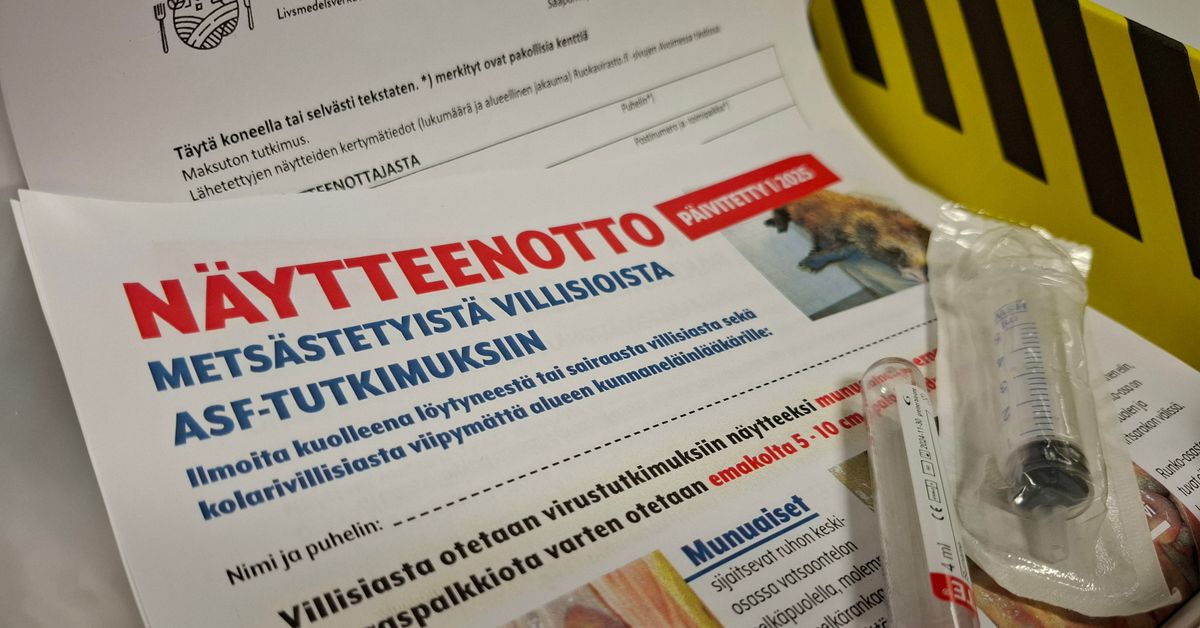
African swine fever: Sweden's 2024 experience shows disease progression can be halted, writes business correspondent Jarmo Koponen.
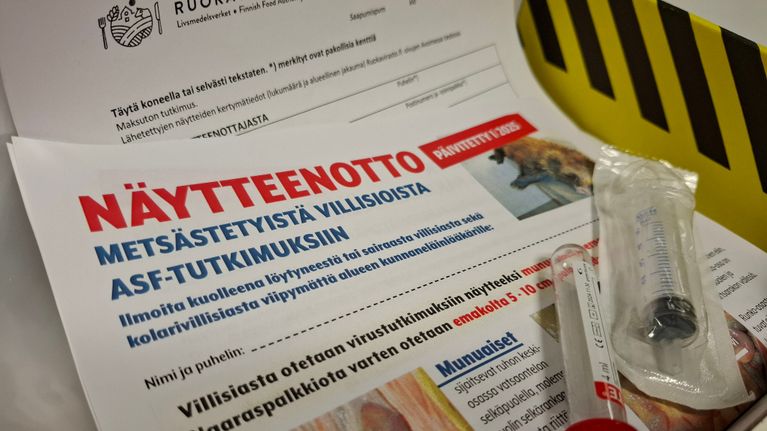
Samples submitted by hunters are an important part of African swine fever control efforts. Photo: Jarmo Koponen / Yle

30.7. 20:00
The suspected arrival of African swine fever (ASF) in Finland is major news that has been anticipated and feared for years.
The disease has advanced systematically across Europe, and Finland has been in a state of waiting, knowing that the question was more one of "when" rather than "if" it would happen.
The Food Authority's swine virology laboratory has emphasised that dead wild boar found would be extremely important to have tested.
It is precisely in these that African swine fever has now been found.
According to the laboratory, even samples from partially decomposed wild boar carcasses are worth reporting to an official veterinarian, as the virus can be detected in the bone marrow of long bones.
An important control measure has also been wild boar hunting. This way the virus population has been kept in check.
The threat came close to Finland once before in 2025, when the African swine fever epidemic raging in Estonia led to the culling of over 50,000 animals on Estonian pig farms.
Following this, Finland has prepared for the situation in multiple ways. Pig farmers have implemented various protective measures: visits to pig farms are not permitted, and in some cases production facilities are fenced off to prevent wild boar access. Biosecurity at pig facilities has been improved, and dead wild boar are systematically tested.
On the other hand, it is encouraging that Sweden has gained experience with successful disease control measures.
Finland was particularly vigilant in 2023, when the disease was found in wild boar in Fagersta, Sweden.
Through extensive restrictive measures, Sweden succeeded in halting the spread of the disease, and in 2024 the country could again be considered disease-free. Sweden implemented truly effective and rapid countermeasures. However, the measures were costly – at least 28 million euros, and this likely does not account for export effects.
Because the ASF samples released by the Food Authority are still to be confirmed in a Spanish laboratory, there remains a small possibility that Finland is experiencing a false alarm.
But it is good that Finland has already begun following Sweden's model of rapid control measures.
African swine fever is a Class A animal disease – highly lethal to pigs and extremely harmful to production, though it does not infect humans.
The virus causes a haemorrhagic fever leading to death in both domestic and wild pigs. There is no vaccine or treatment for the disease, and its mortality rate in pigs is nearly 100 percent.