
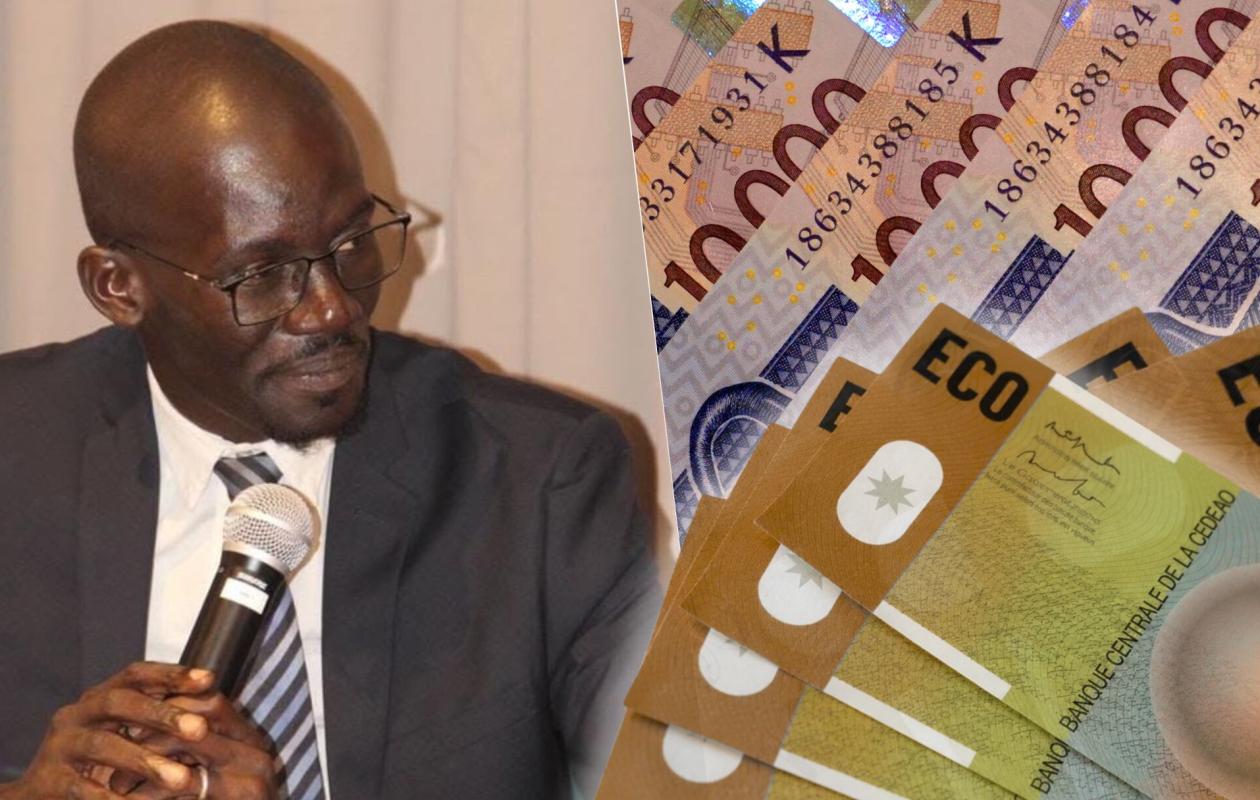
At the end of its 69th summit, the Economic Community of West African States (ECOWAS) announced a gradual implementation of its single currency "Eco" starting in 2027. But is Senegal ready? Where does it stand with convergence criteria? What could the Eco bring to our countries? Babacar GAYE, Economist-Statistician and Director General of Cabinet Gaye & Associés Consulting, provides useful insights in this interview granted to Seneweb.
ECOWAS announced the launch of the ECO starting in 2027, with countries meeting convergence criteria. Is such a start feasible?
Technically yes, institutionally no — and these are not the same things. First, we must clear up a misunderstanding created by the announcement. The final communiqué of the 69th Summit, held in Lungi on July 19, specifies that the first phase will concern Sierra Leone, Liberia, Nigeria, Ghana, Guinea, and Gambia — that is, the West African Monetary Zone. The ECO of 2027 is not the death of the CFA franc: it is the birth of a second West African monetary zone, alongside ours.
Three obstacles remain, and none is a calendar obstacle. The institution does not exist; the future common central bank has neither adopted statutes nor decision rules nor a capital allocation key — the summit moreover requested that the presidential Task Force meet before December 2026, which means fundamental questions remain open eighteen months before the deadline. The exchange rate regime is equally unsettled; without a regime there is no conversion rate, and without a conversion rate there is no currency. Finally, convergence is not observed, it is sustained over time — a country compliant in 2026 but deviating in 2028 brings its indiscipline into the common currency. You can print banknotes in eighteen months; you cannot build a credible central bank in eighteen months. A currency is not decreed; it is credibilized.
Given its current aggregates, can Senegal claim to be among the states that will begin next year?
I respectfully correct the question: it is not posed in those terms. Senegal is not a country with a national currency that would apply to a monetary union; it is already a member of a union governed by treaty, equipped with a central bank and a convertibility guarantee. Senegal cannot join the ECO: it is already married. The question is not one of accession, but of dissolution of the existing union — a legal and diplomatic act, not a statistical exercise.
Let us examine the criteria nonetheless. Inflation stands at 0.4% on an annual basis as of June 2026; Senegal is first in the regional class. Monetary financing of the deficit is zero by construction. In contrast, the budget deficit is 6.44% of GDP in 2025, against a target of 5.37% in 2026 — the criterion is not met. Foreign exchange reserves, meanwhile, are pooled at the BCEAO; the criterion is therefore not measurable at the national level and will need to be adapted. As for debt, it reaches 118.8% of GDP for central government at end-2024, and 132% on an expanded basis according to the IMF, against a ceiling of 70%. Here is the Senegalese paradox: the best inflation in ECOWAS and the worst debt in ECOWAS.
What will Senegal therefore need to address first to aspire to the ECO?
Three areas, and the first is not what one might expect. First, statistical integrity. The February 2025 report of the Court of Accounts corrected the debt ratio from 74.4% to 99.7% of GDP for 2023, and the deficit from 4.9% to 12.3%. A convergence criterion is worth only what the statistic measuring it is worth. In a union, mutual surveillance rests entirely on shared figures: a country whose accounts had to be corrected brings not only debt but also doubt, and doubt is paid for collectively in risk premiums.
Next, the reconstruction of budgetary adjustment capacity. In 2025, debt service absorbed 106.6% of tax revenues. A state whose debt service exceeds its tax revenues no longer has budgetary policy: it has a treasury. The reasoning becomes decisive: in a monetary union, you renounce the exchange rate, and the budget remains the only shock absorber. Senegal would abandon the exchange rate instrument at the precise moment its budgetary instrument is entirely preempted.
Finally, real convergence. The criteria measure the nominal; what durably protects a union is the real — productive diversification, labour mobility, price flexibility, in the sense of Mundell, McKinnon, and Kenen. Two economies hit by the same oil shock in opposite directions do not form an optimal currency zone: they form a problem.
Which convergence criteria risk being most difficult for it to meet at this stage?
By far the most difficult is debt. Let us do the arithmetic. Bringing indebtedness from 118.8% to 70% of GDP requires, at an apparent rate of 5.5% and nominal growth of 7%, a primary surplus of around 8.4% of GDP annually over five years, or 3.5% annually sustained over ten years. Yet Senegal posted a primary balance of −1.8% in 2025. The gap to be bridged exceeds five percentage points of GDP, to be maintained over a decade. This is not a budgetary effort: it is a generation of austerity. And the dynamic hardens: the average cost of debt was 3.9% at end-2024, when new regional issuances now require 7 to 8%.
Next comes the deficit. The target of 3% in 2027 is achievable on paper, but the pact requires sustained compliance, which pushes real qualification toward 2029–2030; and the trajectory rests on tax pressure rising from 19.3% to 23.2% in a single year. The easiest, conversely, is inflation. But let us be clear-eyed: this performance is not the product of our economic policy; it is the mechanical product of the euro anchor. The only criterion we brilliantly respect is precisely the one we owe to the anchor we are being asked to abandon.
In the end, what could this single currency bring to Community countries?
Three real benefits, two illusions. Real: the elimination of exchange rate risk and conversion costs, the deepening of a regional financial market covering more than four hundred million people, and the end of parallel currency markets that weigh on our cross-border operators. But let us calibrate honestly: intra-ECOWAS trade does not exceed 12 to 15% of regional exchanges, and the literature has reduced the "Rose effect" from a tripling announced in 2000 to a gain of 5 to 15% in subsequent work. A single currency does not create trade: it reduces its cost. Now one hardly reduces the cost of trade that does not yet exist.
First illusion: believing we are trading one dependence for independence. Nigeria accounts for roughly 70% of community GDP, and in any union, someone sets the anchor. The real question is not whether we will leave the CFA franc, but whether we will exchange an euro anchor for a Nigerian oil anchor. I am not saying the answer is wrong; I am saying it has not been asked. Second illusion: believing a currency produces development. The eurozone has shown that a monetary union deprived of budgetary union and banking union remains a fragile construction.
What is your personal view on the matter?
For my part, the ECO will be neither a chance nor a threat: it will be a revealer. It will distinguish those who have made their reforms from those who have made speeches. Monetary sovereignty is not proclaimed.