
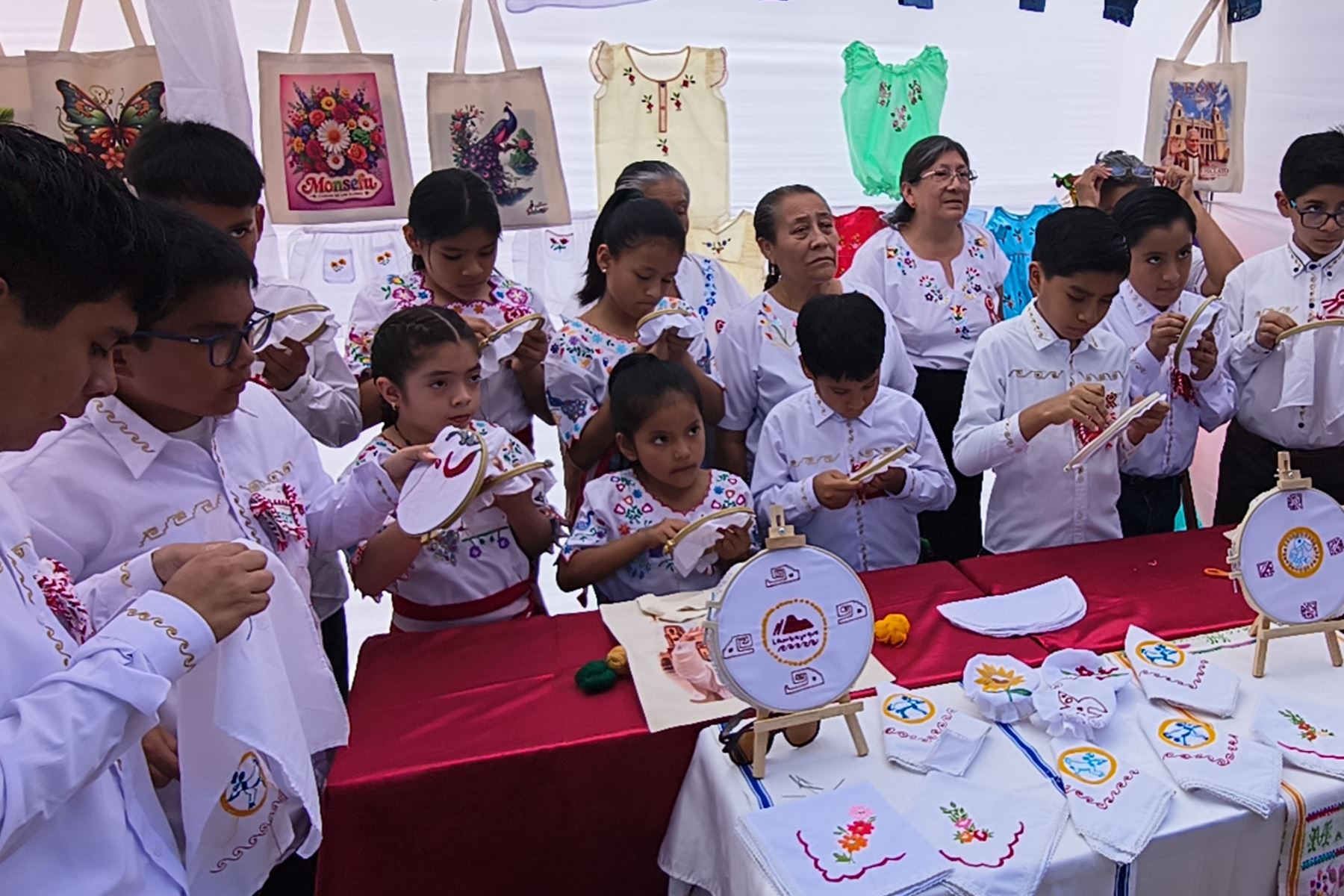
Keeping Embroidery Alive: Children Master Monsefú's Ancient Craft
While many children spend their free time on screens, a group of 12 youngsters aged 6 to 14 picked up needle and thread to become the new guardians of one of the region's most emblematic artisanal expressions: the embroidery of Monsefú.
Guided by renowned master hand-embroiderers from the Chiclayana district of Monsefú in the Lambayeque region, the children learned to render Mochica cultural symbols and regional identity onto fabric, ensuring the continuity of this legacy.
After completing their training, the young artisans presented their first creations at the 2026 Monsefú Typical and Cultural Exhibitions Fair (Fexticum), as part of Independence Day celebrations.
The exhibition, held in the district's main park, received recognition from the public and representatives of the Lambayeque Tourism-Artisan Technological Innovation Center (CITE Sipán), who highlighted the quality and cultural significance of the works produced.
Artisanal Technique
The free workshop "Embroidering with Identity," offered since 2018, was created to preserve Monsefú's traditional embroidery in the absence of specialized schools or institutes teaching this artisanal technique.
For roughly two months, from early June through late July, participants learned not only how to stitch and finish pieces, but also the historical and cultural value of each design.
"A training process has just concluded that seeks something more than teaching an artisanal technique: preserving the cultural memory of Lambayeque," said Manuela Ayasta Caicedo, ambassador of the Lambayeque Brand, in conversation with Andina news agency. Ayasta and five other master artisans lead this initiative to pass on ancestral knowledge.
Lambayecan Roots
The exhibited pieces reflect pride in Lambayecan heritage. The children embroidered ceremonial masks, ornaments, and figures inspired by the legacy of the Sipán dynasty and Mochica culture, as well as flowers characteristic of Monsefú, sunflowers, and elements representative of the Lambayeque Brand.
"The first thing we teach them is tradition and culture; children must begin by knowing and valuing what is ours," said Ayasta, convinced that artisanal learning also strengthens identity and sense of belonging.
The project is driven voluntarily by master artisans María Túllume Reluz, Clara Ramos Chero, Rudecinda Carrillo Castro, Edelmira Uceda Trujillo, Yolanda Delgado de Mimbela, and Manuela Ayasta, who donate their time, knowledge, and materials to ensure no child is excluded for economic reasons.
"Everything has been free: the materials and the instruction. For us it is a blessing to see the little ones learn and feel that the tradition will continue," Ayasta said.
One aspect that most surprised the masters was the talent shown by several students, including the children, who achieved delicate finishes on their first works. They even recounted the case of one young participant who came to the workshop on medical recommendation due to stress and found in embroidery a space of tranquility, creativity, and community.
"The masters and students have formed one big family; here they learn while enjoying themselves," commented the artisan.
Keeping a Tradition Alive
Family mothers agreed in highlighting that these workshops allow their children to continue a tradition inherited from their ancestors and become the new custodians of Monsefú embroidery.
Melissa Montalván Labrín, mother of two participants aged 7 and 12, said both learned the technique quickly and have already made several pieces, including an embroidered representation of the traditional peasant hat.
"I am proud because from a very young age they are learning our culture," she said.
She explained that manual skill is part of family history, as on the maternal side there is a tradition of hat weaving and on the paternal side the making of shawls, which facilitated her children's learning. "They love embroidering and look forward with enthusiasm to workshop days," she added.
Another mother, Zuly Capuñay Gonzáles, highlighted the patience and dedication of the master artisans, who have managed to spark interest in children for a creative and productive activity that, in addition to keeping them away from excessive use of cell phones and tablets, can become a future source of income thanks to the national and international recognition of Monsefú embroidery.
The masters announced that the workshop will continue operating every Saturday and remain open for more children and adolescents to join. Their goal is to form a new generation of artisans capable of representing Monsefú and Lambayeque on regional, national, and international stages, carrying with them the ancestral legacy of Mochica culture and the tradition of embroiderers.