
Kyrgyzstan Opens New Railway Section in Naryn Region
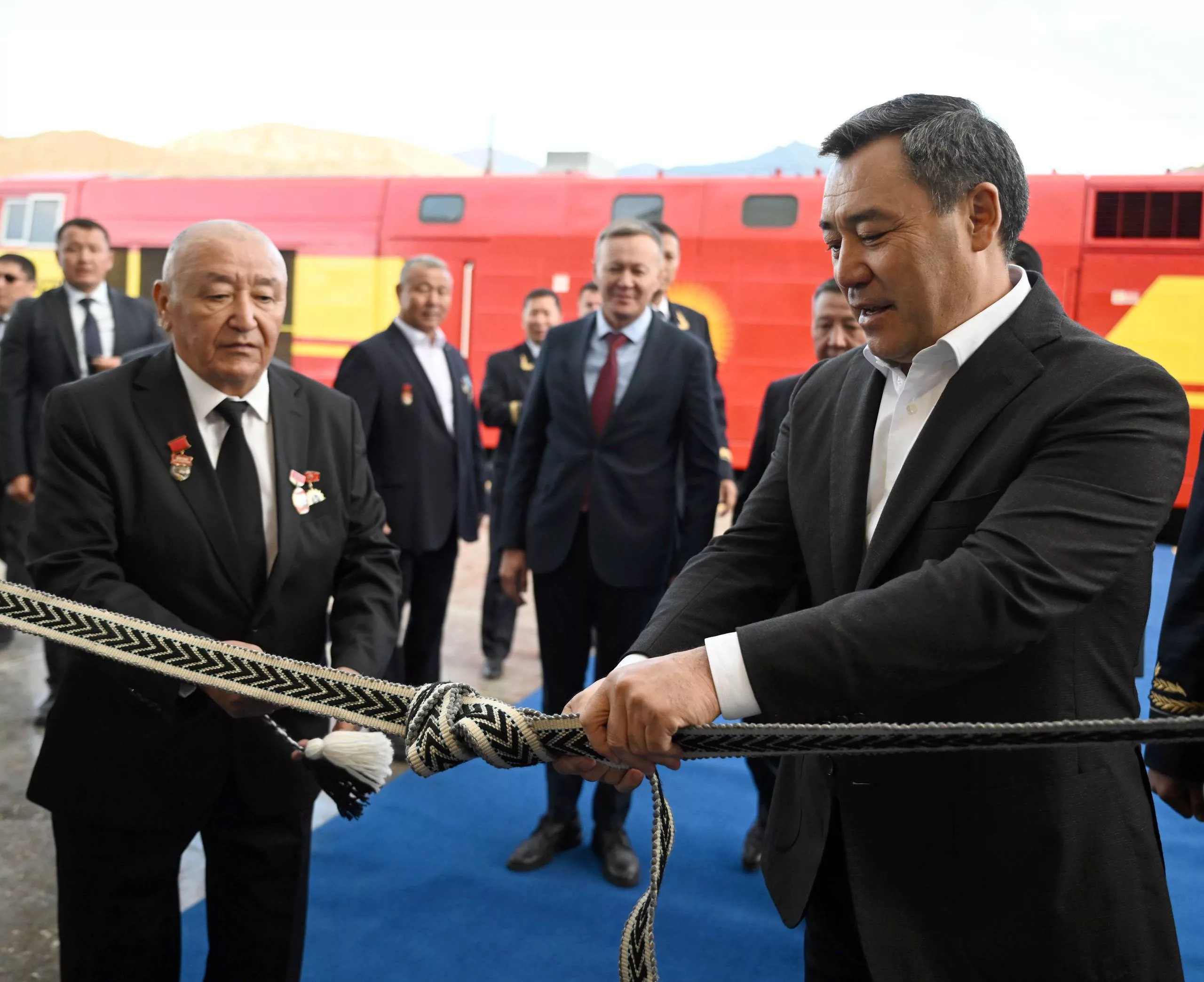
President Sadyr Japarov of Kyrgyzstan attended the opening ceremony of the Balykchy–Kochkor railway and Kochkor station in Naryn Region on July 25. The head of state arrived at Kochkor station by train, personally inspecting the new railway route and assessing the quality of the completed work, according to the presidential press service.
He then toured the new station building and familiarised himself with its infrastructure.
In his remarks, Japarov noted that this day would enter the history of independent Kyrgyzstan as another important milestone.
The Balykchy–Kochkor section, stretching 63 kilometres, is the first phase of the larger Balykchy–Kara-Keche–Makmal railway line project.
"First of all, I want to emphasise that we are building this railway with our own resources. During construction, approximately 1 million cubic metres of blasting work was carried out and 8 kilometres of mountain terrain was cleared. Construction of the track itself cost 955,000 US dollars per kilometre," the president said.
By comparison, he cited costs proposed by foreign companies, which ranged from 4.8 to 6.8 million US dollars per kilometre.
"Understanding that this was too expensive, we decided to take the risk and, following the principle 'the road will be mastered by those who walk it,' undertook the work ourselves. Another comparison suggests itself regarding the alternative North–South road. For the Balykchy–Jalal-Abad project spanning 433 kilometres, the cost was listed at 2.5 million dollars per kilometre. Yet even with that figure, the road remains unfinished and has not been fully commissioned. It is clear that more than half of that sum was simply embezzled," Japarov said.
He stressed that railways and highways cannot be compared—the former is significantly more complex and expensive. However, despite all difficulties, one kilometre of railway was built considerably cheaper.
"We have revived the culture of railway construction, our engineering potential, and professional expertise. This historic achievement demonstrates that our country is capable of independently implementing large-scale infrastructure projects," the president said.
He recalled that in March 2022, construction of the Balykchy–Kochkor–Kara-Keche railway began and a time capsule was laid for future generations.
"At that time, many doubted the successful realisation of this project. But today we can not only say with pride, but also prove in deed, that the historic decision was correct," the head of state emphasised.
The work required enormous labour, with construction conducted in the most challenging areas: in swampy and rocky terrain, near the Orto-Tokoy Reservoir, and in conditions involving existing roads and engineering communications.
The president also focused attention on the economic dimension.
By the end of 2025, freight transport volume reached 11 million tonnes, 36 per cent higher than in 2021, when the figure was 7 million tonnes. This is among the best results in the entire history of the domestic railway industry.
During the same period, passenger traffic increased significantly: whereas 255,000 people used rail transport in 2021, by 2025 the figure had risen to 432,000. Growth was 69 per cent.
"Such dynamics testify to a steady increase in the efficiency of the railway industry, strengthened public confidence in this form of transport, and its further strengthened role in the country's transport system," the president said, and reminded of the recently launched construction of the Balykchy–Tamchy–Cholpon-Ata railway.
Japarov also noted that in future, construction will begin on the Kochkor–Kara-Keche–Makmal railway. This strategic project will connect the north and south of the country with a single railway trunk line, link the Kara-Keche coal deposit with industrial centres, bring internal freight transport and Kyrgyzstan's logistics capabilities to a qualitatively new level.
A multiplier effect was particularly emphasised. The realisation of these large-scale infrastructure projects will unite Kyrgyzstan's internal railway network into a single system, strengthen the country's transport connectivity, deepen economic integration of regions, and provide a powerful boost to sustainable development of industry, tourism, and logistics.
"In prospect, this direction will become part of the international railway corridor China–Kyrgyzstan–Uzbekistan. As a result, Kyrgyzstan will become a strategic transport hub connecting continents. This will expand the country's transit potential, increase exports, attract new investment, and ensure growth in tourist flow, which today has already reached 13 million people, creating a solid foundation for sustainable economic growth," the president emphasised.
He noted the work of thousands of railway workers, engineers, builders, and specialists, expressed his sincere gratitude to them, and wished that the results of this work serve the wellbeing of the Kyrgyz people and the prosperity of future generations for many years to come.
Japarov then tightened the final track bolt of the Balykchy–Kochkor railway section with a special key, a symbolic confirmation of the successful completion of construction on this stretch of the line.
Brief conversations with local residents followed. They expressed hope that the railway will be extended to Makmal and then connected with the China–Kyrgyzstan–Uzbekistan trunk line. The head of state, for his part, stressed that the key guarantee of successful realisation of all planned objectives is stability in the country.