

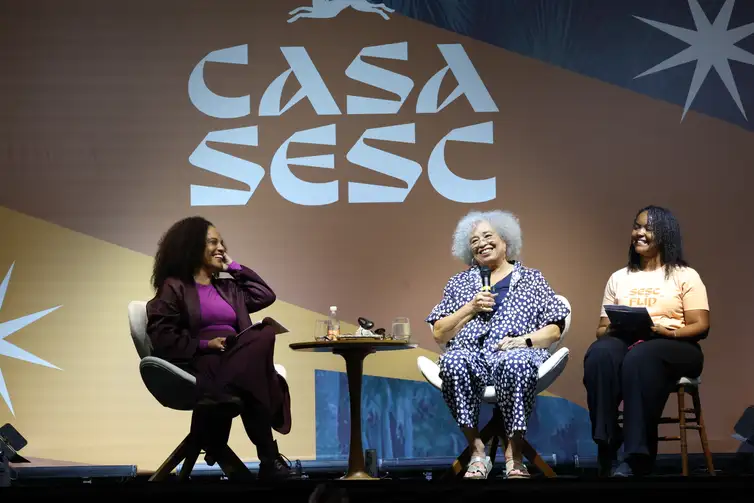
On International Day of Afro-Latin American and Caribbean Women and also Brazil's National Day of Tereza de Benguela and Black Women, celebrated this Saturday (25), activist and researcher Angela Davis was one of the highlights of the 24th Paraty International Literary Festival (Flip). She participated in a free public event at Sesc Caborê. The conversation with journalist Flávia Oliveira was part of the Festival's parallel programming, which ends today (26).
"We can feel the presence of our ancestors here in this place, who played a fundamental role during the period of enslavement," the activist said about the city of Paraty, home to the literary festival.
According to her, the process of struggle for freedom in the Black movement has a cultural dimension, which was being celebrated at the occasion of the event. "There is something about the nature of music, art and literature that allows us to reach dimensions that are not reachable in any other way."
The activist also denounced the process of gentrification and environmental racism in the city. "I wanted to talk about the gentrification that is happening in poor communities here in Paraty. And also about environmental racism. Young people tell us that they are worried about the environment, that they have no future. They will have no future to live on this planet. Here in Paraty, they try to create ways to make more profit, removing people from their lands, from the lands of their ancestors," Angela said.
Gentrification is the process in which the appreciation of a neighborhood raises the cost of living and ends up expelling poorer residents to more peripheral regions.
The activist reported that she had the opportunity to speak with the community itself in Paraty. "We can listen to what is happening here in this area. We should not pay attention only to literature, but we should pay attention to the role of literature in influencing people and promoting change."
Angela stated that she was happy to participate in the conversation panel and regretted that guest Wole Soyinka, the first African to win the Nobel Prize in Literature, was not present due to health issues. He would have shared the panel with her. Angela also thanked the presence of writer Conceição Evaristo from Minas Gerais, who was in the audience.
"It is a pleasure that she is here present. Thank you very much for your beautiful literature."
For the activist, Conceição is at the same level of relevance as singer Nina Simone and writer Toni Morrison, both American.
When commenting on "escrevivência" (a literary concept created by Conceição Evaristo), the activist mentioned that it took a long time for recognition that Black people needed to tell and share their own stories. "Toni Morrison showed us that white experience is not universal," she stated, citing the first Black woman to receive the Nobel Prize in Literature, in 1993.
With mediation by journalist Flávia Oliveira, who presented names of researchers and activists related to Black, environmental and human rights movements, Angela commented on the contributions of Brazilian Beatriz Nascimento. "When she said 'I am Atlantic,' she expressed a feeling that reaches all of us, that makes us feel part of a gigantic world."
"Internationalism was my first enlightenment," she said.
The activist recounted that she went to France and thought she would find equality, liberty and fraternity, which were key elements of discourse during the French Revolution. "I did not find what I was looking for. I discovered the Algerian revolution. The Algerians were under attack by French police, so I discovered that I could be in solidarity with people in France, that I could be part of something larger, which is what Beatriz Nascimento says when she speaks of 'I am Atlantic.'"
Lélia Gonzalez
Angela Davis also cited Brazilian author and activist Lélia Gonzalez, a reference in studies and debates on gender, race and class. "I love Lélia Gonzalez," she stated.
She added that Lélia is a long-time inspiration, highlighting the concept of Amefricanity of the activist and professor. "In that concept she recognizes that the Black struggle, anywhere in the world, cannot happen without indigenous people either," she said, exemplifying the concept.
"I would like to say that Lélia Gonzalez is a critic of capitalism, something we need to do in the first era of trillionaires, especially because we have billionaires and trillionaires who are exploiting the earth, who do not care about anything more than making money without thinking about the consequences," she mentioned.
In her criticism of trillionaires, she emphasizes that they do not represent the future of the planet. "We must consider that these people are the reason why life is so difficult for so many other people on the planet. Capitalism ends up profiting more."
For Angela, one of the difficulties faced for people to inhabit the planet in a fair and balanced way stems from the capitalist system. She emphasized that exploitation and destruction affect not only natural resources but human beings themselves.
Current context
The activist also commented on the harm to populations due to the rise of authoritarian governments and stated that people are stronger than the fascism that seeks to govern them. "Fascism is something that is emerging in Europe, the United States and Latin America, but not among the people," she said. She also cited the elections in Brazil this year, mentioning that one cannot allow candidates aligned with fascism to be put in power.
The reduction of working hours and the inclusion of Black people in universities were also topics addressed by the activist. According to her, a reduction in hours could allow more leisure time and opportunity for workers to access culture. Angela notes that some places in Europe are already experiencing reduced working hours.
"The first time I visited Brazil, there were few Black people at the university. I was here and I saw a new university system develop in Bahia, I saw tangible changes and we must celebrate these changes because you won them. We achieved these victories, but let us not become complacent with these victories. We have to keep fighting."
Popular struggle
As a way of demonstrating the power of collective struggle against people in positions of power, Angela recalled the period of her imprisonment. "I say that I did not do much, I was sitting in prison. People were in the streets generating the movement that would prevent those men who were in power from making that decision [for the death penalty]."
"This experience taught me that people coming together across borders can prevent people [who violate rights]. Around the world people said: we will not allow our sister to be executed," she concluded.
Persecuted for her activism in the Communist Party and the Black Panthers, she was imprisoned under false accusations of conspiracy, kidnapping and murder. In various parts of the world, there were protests demanding her release.
When recounting this period of her life, she said she believes that most of what she did in activism and academic work was because prison brought her an evolution.
"When I look back at that period, I see that it was a gift. I was shaped by what I went through in that prison, with the experience with those women who were also incarcerated. I never thought that this would end up shaping my life."
Angela recalled