
Aldeniza Silva e Silva is expecting her fifth child. Seven months pregnant, the resident of the Boa Vista riverside community, located in the Uacari Sustainable Development Reserve (RDS) in the Middle Juruá River region in Carauari (AM), previously had to travel to the urban area of the municipality to get a medical consultation.
A journey that can take two or three days by rabeta (small boat) — depending on whether the river is high or low, when navigation becomes more time-consuming. The only way to travel to the city is by river: in many regions of the interior of Amazonas, surrounded by the grandeur of the Amazon rainforest, there are no roads and the only possible path is by navigating the rivers.
It was only in the city — as riverine residents call the urban area of Carauari — that Aldeniza could have her prenatal care. Because of access difficulties, so far she has had only three consultations, when the ideal, according to the Ministry of Health, is that pregnant women receive a minimum of six.
This situation is faced daily by thousands of riverine residents spread throughout the rural area of Carauari, a pleasant city bathed by the winding Juruá River and home to about 28,000 inhabitants, according to the latest census by the Brazilian Institute of Geography and Statistics (IBGE).
Carauari's extensive territory is located more than 1,600 kilometers away, in river distance, from the capital of Amazonas — a journey of approximately 36 hours by express boat, with the river dry. The rural area is made up of dozens of riverside communities, which are days away from the urban area.
Like Aldeniza, riverine resident Maria Valkiane Freitas e Silva, from the Bauana community, also has to face a long journey of about 12 hours by rabeta to go to the city for a consultation.
"To go [the cost] is a canister, R$ 160. But to come back is two or three," she said.
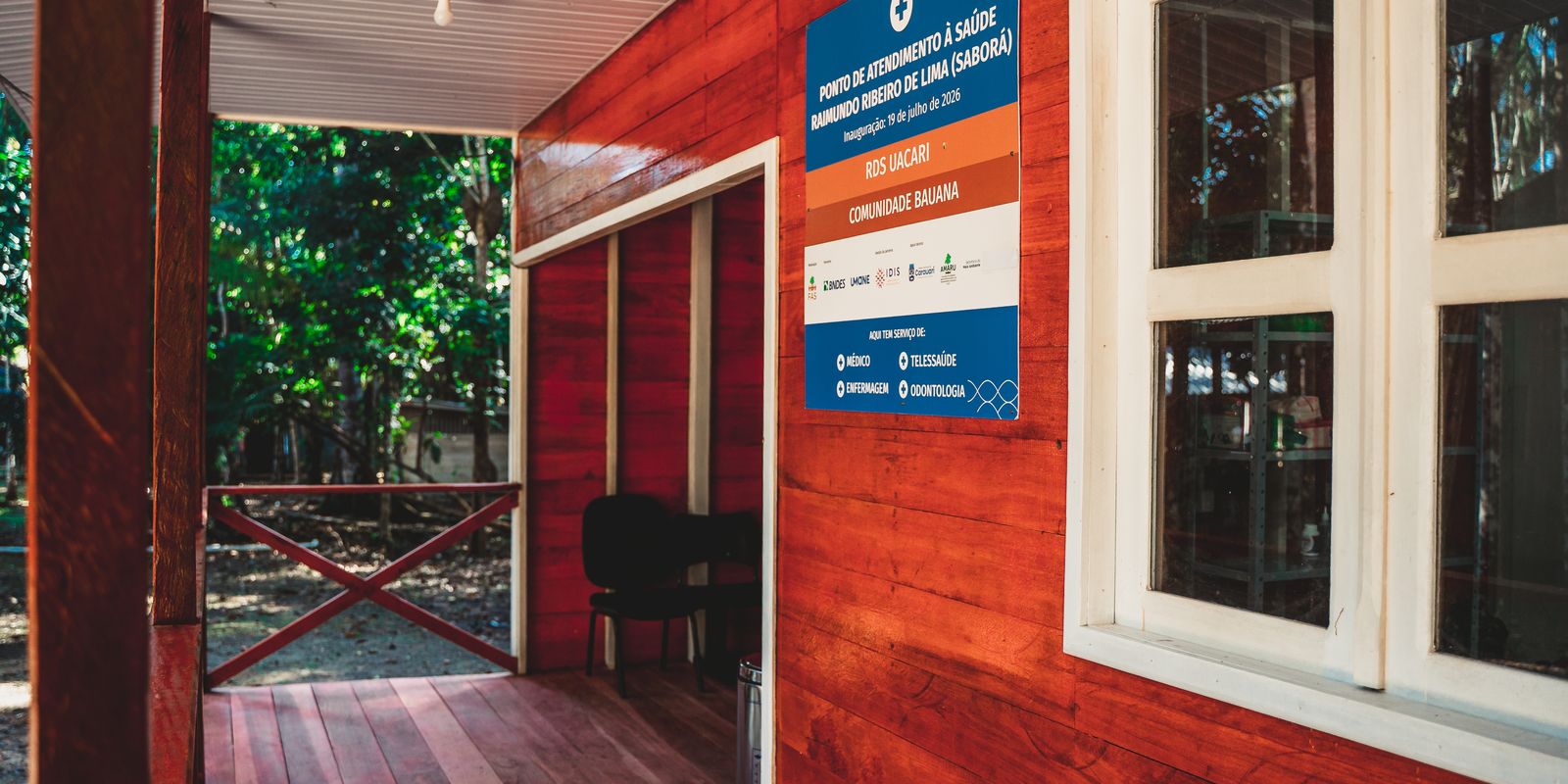
After the inauguration of two health care points at the bases of the Sustainable Amazon Foundation (FAS) in the Campina and Bauana regions, which took place last week, this distance has been shortened.
"Now [the distance] is just one beach," celebrated Aldeniza, who began following her prenatal care at the Campina health post.
"I had to go to Carauari for my consultation, but thank God, there's this post here. So I came today to consult."
She also took the opportunity to bring her six-year-old daughter, who was not well health-wise. "The doctor said it could be worms," she said.
Structure
The structure of the two care points is a solution adapted to local reality, with a focus on supporting health teams, providing in-person care, and using telehealth. Each unit is equipped with offices for in-person and remote care, a triage room, a dental office, internet connection, telehealth equipment, and areas for health team accommodation.
All services offered are integrated into the Unified Health System (SUS), although the entire project is developed through a public-private partnership.
Called SUS na Floresta (Health System in the Forest), the model adopted in Carauari is the result of a public notice from the Juntos pela Saúde (Together for Health) program. The project is executed by the Sustainable Amazon Foundation (FAS), in partnership with the National Bank for Economic and Social Development (BNDES) and Umame, with management by the Institute for the Development of Social Investment (IDIS) and technical support from the Carauari municipal government and the Amazonas Environmental Secretariat.
"A fundamental principle of this project and of all participants in Juntos pela Saúde is not to create a structure parallel to the SUS, but to strengthen it. The care points are implemented in partnership with municipalities and municipal health secretariats, and the professionals responsible for care are linked to the public network and the Family Health Strategy," explained Guilherme Sylos, director of prospecting and partnerships at IDIS.

Brasília - 25/07/2026 - Bauana Health Post. Photo: Lucas Bonny/FAS
Scarcely had it been inaugurated when rumors about the installation of a health point closer to the riverside communities were already circulating in the region. In the São Francisco community, close to the FAS unit in Campina, for example, the population was already aware of the news and preparing to seek care.
"If we get sick, there's a better way for us to be treated because it's near here. There's no comparison to going to the city, which is very far. Sometimes, we don't even have time to get there. Like one time when I hurt my back and got there [to the city], after lying on straw, almost lying in the basement, because I couldn't stand sitting anymore," said riverside resident Cecilia Bispo de Lima, from the São Francisco community.
The new structures should not only offer some treatment for dona Ceci's back pain or provide Aldeniza's prenatal care, but also help in disease prevention and vaccination strategy, as is the case with Luana do Carmo da Gama, who will take her son Antonio Pedro, just four years old, to be vaccinated.
"It will be great for us. Anything happens, we can come here. There's staff to help us, right?".
Shortened Distances
Before, to get basic health care, residents of the rural area or riverside communities of Carauari had to make a journey of hours or days by boat to reach the nearest health post, located in the urban area of the city.
In extreme and serious situations, the Carauari municipal government also provides a rescue boat (called ambulanchas) for riverside residents — picking them up in their communities and taking them to the city in journeys that last hours or days, depending on the distance of the community and the condition of the river.
Last week, the two new health support points were inaugurated closer to the riverside communities of the Uacari RDS.
The first was inaugurated last Sunday (19) in the Bauana community and was named after Raimundo Ribeiro de Lima (Saborá), in honor of a community leader in the region. The second was named in honor of community leader Laice Santos do Nascimento and inaugurated last Tuesday (21) in the Campina region, also in the municipality of Carauari.
The two points are located within two units of the Sustainable Amazon Foundation (FAS) in Carauari. Together, they should serve 56 riverside communities, benefiting about 4,700 people.
"SUS in the Forest is an initiative that seeks to adapt and strengthen Primary Health Care in riverside and traditional communities of the Amazon, considering the large distances, the seasonality of the rivers, the low availability of professionals, and the cultural particularities of these territories," explained Guilherme Sylos, director of prospecting and partnerships at IDIS.
Only in the week they were inaugurated, the two points already managed to avoid several calls for rescue boats.
In Campina alone, five were prevented, including that of young Thiago Freitas Andrade, from the Xibuauzinho community, who stepped on a board with nails while playing ball. Thiago suffered foot pain for a week before seeking care at the Campina health point.
"It was hurting a lot, I spent two nights without sleep," he said.
At the health post, he was treated by a nurse and a nursing technician. "I got two injections. Since it was very inflamed, they cared for my toe and then gave me all the medication and also gave me medicine to reduce the inflammation. And then they advised rest," said Thiago.
Besides Thiago, a child who was injured by