
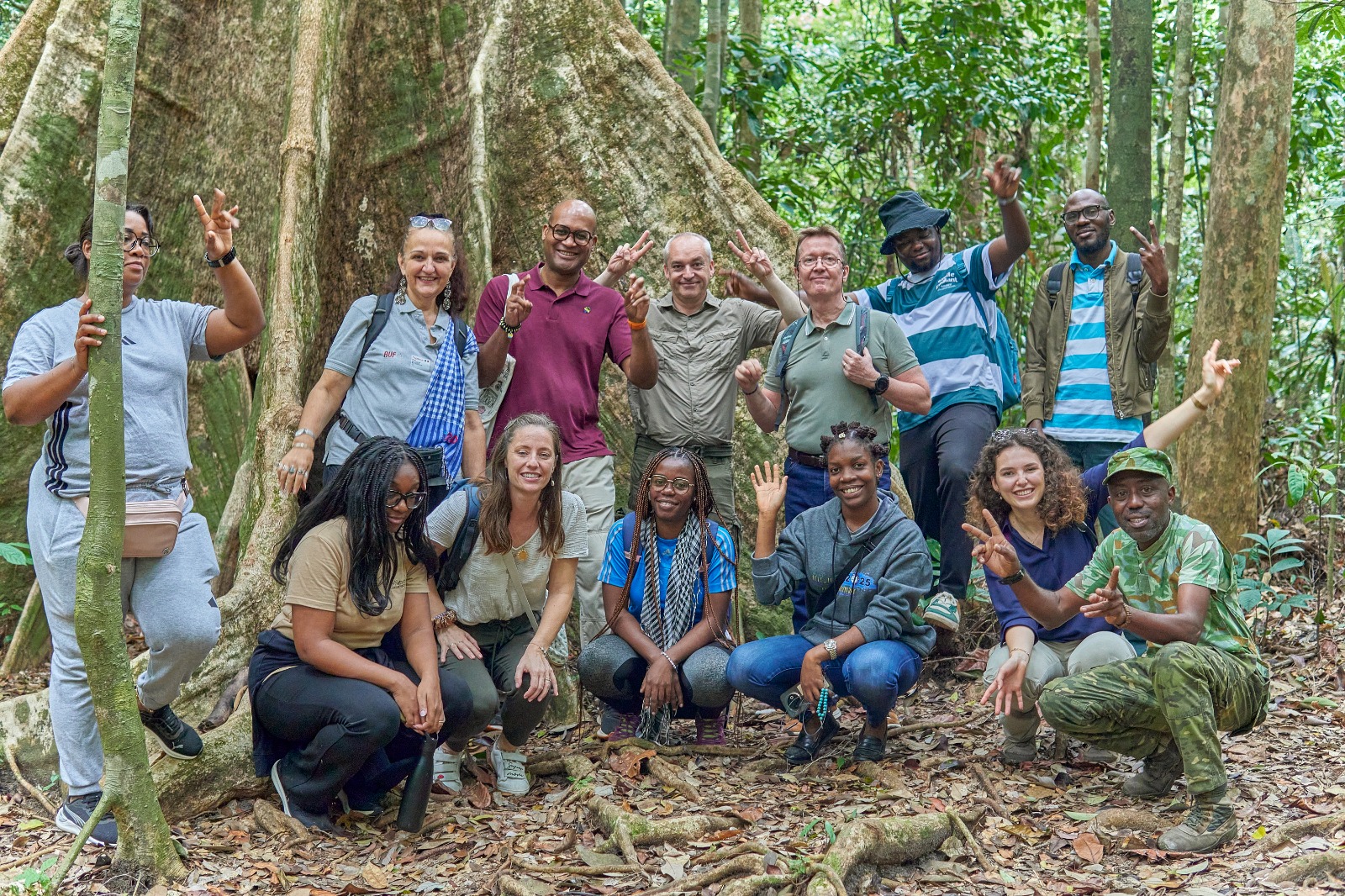
Around fifteen researchers, doctoral students, representatives of French and Gabonese institutions, and technical partners gathered at the Raponda Walker Arboretum in Libreville for a morning of exchanges focused on the tropical forests of the Congo Basin.
Organised at the initiative of the Institute for Research and Development (IRD) and the One Forest Vision initiative, the meeting took the form of a "Walk & Talk," alternating fifteen minutes of walking with ten minutes of presentation. Participants covered a five-kilometre loop through the Raponda Walker Arboretum, exchanging directly on site about their missions and projects related to research, conservation, and international cooperation.
The objective of the morning was to foster spontaneous exchanges among scientists, public institutions, funders, protected area managers, and civil society actors, in order to create lasting connections and generate new collaboration opportunities in service of the tropical forests of the Congo Basin. The meeting also highlighted the "Classroom in the Trees," a 100 m² space perched 14 metres high, supported by the French Development Agency (AFD) and the National Agency for National Parks (ANPN), inaugurated in 2021.
This structure, built entirely in padouk wood, constitutes an innovative environmental education tool designed to raise awareness among schoolchildren, students, and the general public about the richness of Gabon's forest ecosystems. Among the participants were notably Mme Issembé, curator of the Raponda Walker Arboretum; Yves Mercier, adviser for cooperation and cultural action; Eva Desthieux, environment adviser at the French Embassy in Gabon; Odile Ouwe Missi-Oukem, regional representative of the IRD; as well as several researchers, doctoral students, and representatives of conservation organisations.
The "Walk & Talk" at the Raponda Walker Arboretum is part of a dynamic of scientific and diplomatic cooperation around the preservation of the Congo Basin forests, the world's second largest tropical forest massif after the Amazon. This first edition, deemed promising by the organisers, made it possible to strengthen ties between actors in research, international cooperation, public institutions, and conservation organisations, with the prospect of renewing this initiative soon.
Nkili Akieme