
From the beloved vanilla orchid, whose pods give flavour to many of our favourite desserts, to the bewildering corpse flower, whose giant bloom attracts crowds of people with its putrid scent, even the world's most precious flowering plants are in serious danger.
And scientists are only now beginning to realize how much we stand to lose.
In a recent article published in the journal Science, an international group of biologists warns that we risk losing more than a fifth of the evolutionary history of flowering plants as a result of ever-intensifying human impact.
Assessing species loss in terms of their evolutionary history and degree of extinction threat is a relatively new approach in conservation science.
The method, developed in 2007 by the Zoological Society in London, combines the evolutionary uniqueness of a species (EU) with the risk of its extinction (global extinction threat, GT).
The result is an "EDGE" metric that helps biologists identify species that should be prioritized in conservation efforts.
EDGE metrics particularly highlight the value of species that uniquely represent a long, isolated branch on the evolutionary tree, such as Ginkgo biloba, the sole living descendant of a lineage with a history spanning at least 300 million years.
In a recent report, scientists used EDGE metrics for the first time to assess the probability of extinction of angiosperms — that is, flowering plants.
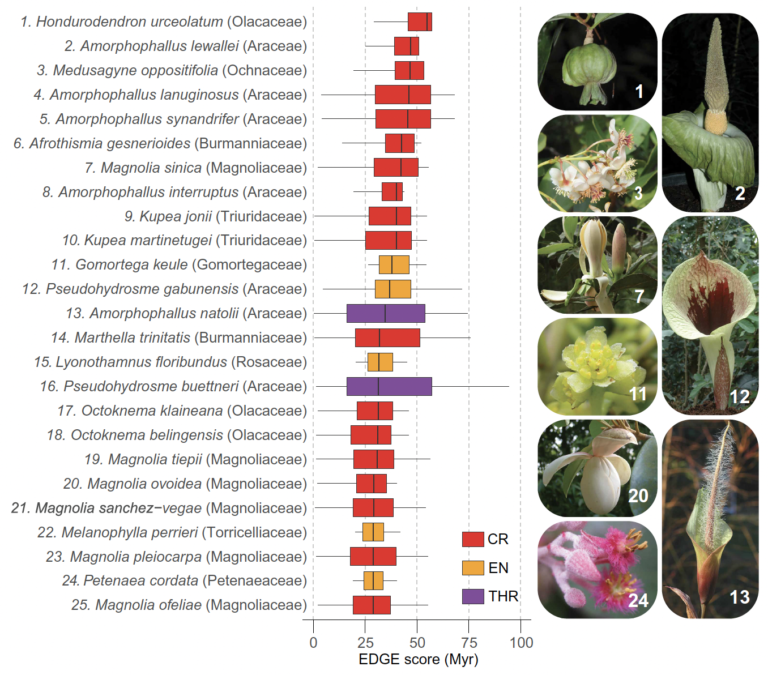
The 25 highest-priority angiosperm species (classified by EDGE). (Forest et al., Science, 2026)
"These EDGE metrics provide vital information needed to highlight irreplaceable and endangered species that often go unnoticed, and whose conservation will help preserve current and future benefits for people and the future of all life on Earth," says Felix Forest, lead author of the study and evolutionary plant biologist at the Royal Botanic Gardens, Kew.
Ricky Gambs, a biologist at the Zoological Society of London and one of the lead authors of the article, says the EDGE approach has enabled conservation specialists to identify animals that have needed urgent conservation action for nearly two decades, while plants have remained underrepresented in this field.
"Flowers and forests are not simply a beautiful backdrop for photographs of bees and tigers," he says.
"Each plant is a vital living building block of life on Earth, providing us with the air to breathe and food to eat. By applying the EDGE approach to flowering plants, we can better protect the rich, thriving ecosystems of our planet, which took billions of years to develop."
Applying this approach, the researchers found that 21.2 percent of the evolutionary history of angiosperms is at risk of extinction.
Of the 335,497 known flowering plant species included in the analysis, 9,945 were classified as EDGE species — meaning that approximately 3 percent of all known plant species are simultaneously evolutionarily unique and globally threatened with extinction.
The list includes several familiar plants: Vanilla planifolia, the plant that gave rise to the most classic ice cream flavour; Nymphaea thermarum, the world's smallest water lily; and Amorphophallus titanum, the giant stinking flower that we all despise, along with many of its relatives.
But of course, many other plants on this list may never have been known to you: for example, the jellyfish tree (Medusagyne oppositifolia) or gumbo-limbo (Hondurodendron urceolatum), a tree that is the only living representative of its genus.
"The benefits that species recognized under the EDGE programme bring to society are as unique and irreplaceable as the species themselves," explains Matilda Brown, a botanist at the Royal Botanic Gardens, Kew.
"The loss of a deep branch of the tree of life means the potential loss of the next breakthrough cancer drug or antibiotic, with no second chance."
Although the threat of losing these unique species is concerning, it is also an opportunity for plant conservation programmes around the world to direct resources where they could bring the greatest benefit to biodiversity.
"Given that an estimated more than two of every five plants are threatened with extinction, and 75 percent of those yet to be discovered are predicted to be threatened, now is the time to initiate a new generation of monitoring and conservation action for the many different, overlooked and endangered plant species on Earth," the authors conclude.
The results of the study were published in the journal Science.