
You may have had this experience
It's dinnertime. You peel a clove of garlic and notice a small greenish-gray patch. Do you cut it away or toss the clove and reach for another? It's a small annoyance that won't derail your dinner, but, if social media posts are any indication, it's an annoyance that is happening across the world, with users saying they are noticing it more and more.
It is also a reminder that food quality is shaped long before an ingredient reaches the cutting board. Garlic's journey often begins in China, the world's largest garlic producer and exporter, accounting for more than 70% of global production. When the kind of extreme or unusual weather made more common by climate change affects China's garlic-growing regions, the consequences can travel well beyond the field, reaching processors, warehouses, supermarkets, and kitchens around the world.
The garlic-growing cycle
In the garlic-producing provinces of Shandong and Jiangsu in the east, and Henan in central China, garlic is planted in the fall. Farmers will break up the soil to create crop rows, separate and select cloves, then press them, one by one, pointy-side up, into the soil. Then, after the cloves are covered with more dirt, watered, and mulched with plastic, they embark on several months of exposure to changing temperatures and moisture conditions.
The timing for this process needs to be exact. Plant too early, and the young sprouts might overdevelop, draining energy. Too late, and the plant doesn't develop enough. In both cases, it might not be able to defend itself against diseases and the winter cold.
After planting, garlic must undergo a period of cold to initiate a process called vernalization. Only after prolonged exposure to low temperatures will the plants successfully develop bulbs — the cluster of garlic cloves. Vernalization typically requires a temperature range of 0 to 10 degrees Celsius for at least three weeks. Too much cold will harm the garlic; too little will disrupt the plant's maturation.
When weather disrupts the process
Weather extremes can upset this process. In the fall of 2025, for example, excessive rainfall across northern China delayed garlic planting by about three to six weeks. The winter that followed was mild, and as a result, government data show, the garlic harvested in Shandong continued to grow during a period when no growth should have occurred.
Though this period of extra growth, in some ways, made up for the season's late planting, this additional early-stage growth may have affected resource allocation within the plant. For example, it can cause the bulbs' side buds — which later become cloves — to develop their own leaves instead of growing in size.
The garlic scape season
When the seasons change to spring and the world begins to bloom, a slender flower stalk begins to bolt from the center of the garlic plant. This flower stalk, known as a garlic scape, is a beloved vegetable in Chinese cuisine, often stir-fried with meat, eggs, or tofu. For the farmers, garlic scapes are a lifeline, as they represent the first opportunity to turn a profit in the garlic farming season. Large, high-quality garlic scapes can provide needed revenue to cover the costs of seasonal workers, farm supplies, and farm management for the rest of the season. Harvesting scapes also leaves more resources for the developing bulb.
However, the harvest window for garlic scapes is extremely short, often lasting for only one or two weeks. If the scapes are not harvested in time, they become old and lose much of their market value, and harvesting them relies heavily on human labor. Usually, different regions reach their harvesting season at different dates, allowing workers to move from one area to the next.
In many garlic-growing regions, this year's spring was warmer than usual. When that happens, harvesting timelines start to overlap, tightening the labor market and placing additional strain on procurement and distribution. At this point, the farmers face the difficult decision of whether to pay more to harvest their garlic scapes or let them continue to grow, potentially affecting the quality of their bulb harvest later in the season. News stories about the pressures Chinese garlic farmers faced earlier this year spawned the social media meme, "Got garlic scapes, any takers?"
The summer harvest
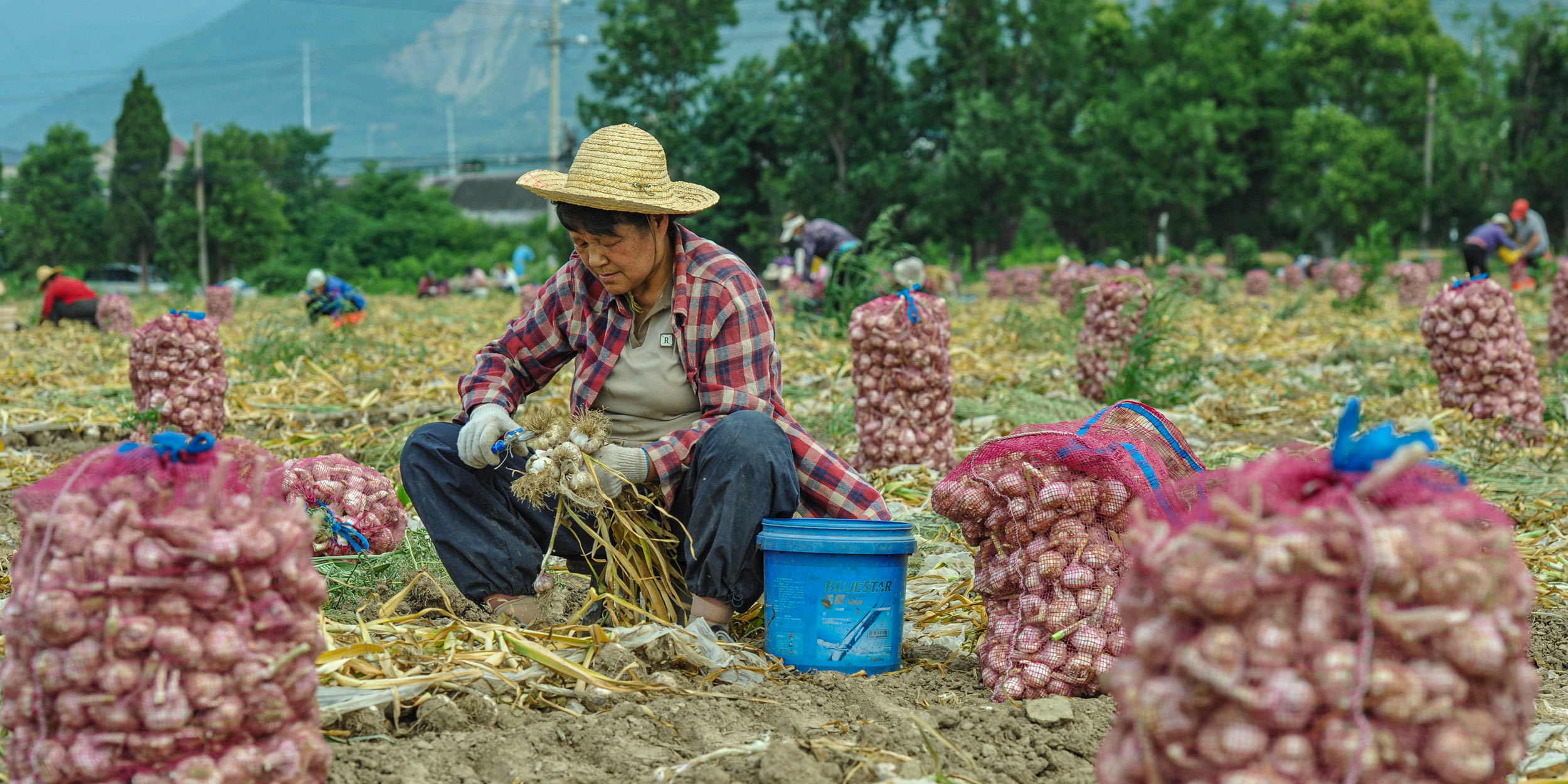
In early summer, the aboveground structures of the garlic plant begin to shrivel, while the belowground bulbs enter their prime harvest period. In northern China, farmers will bind harvested garlic into bunches and lay them out to dry in the sun. The dried skin encasing the bulb acts as a jacket, protecting it from damage, moisture fluctuations, and mold during sorting, storage, and shipping.
Global warming has caused China's rain belt to shift northward, leading to record rainfall in northern China. If the main harvest period is hit by persistent rain, the garlic skin can get damaged, and both soil moisture and air humidity rise. Bulbs may not fully dry, and damaged outer skins can both cause garlic to sprout more leaves and make it more vulnerable to fungal growth. While a moldy bulb at the supermarket can also result from mistakes during storage and transport, a rainy harvest amplifies those risks.
Adaptation and response
The China Meteorological Administration's Bluebook on Climate Change in China, published last year, states that, as warming continues, China is experiencing changes in precipitation patterns and extreme weather risks. This doesn't mean climate change can be cited as the direct cause of every heavy rainfall event or every below-standard bulb of garlic; it means farmers, traders, and meteorological services must plan for more unstable combinations of heat, rain, humidity, drought, and winter warmth.
Given the large areas used to grow garlic, it's not feasible to use greenhouses to shield it from the elements. The real test of adaptation will come from recognizing risks earlier, forecasting with more accuracy, and responding more quickly. Accurate and precise weather reporting is of the utmost importance. According to the China Meteorological Administration, Shandong's garlic-growing Jinxiang County has created a specialized garlic meteorological service team to provide weather support throughout the production cycle.
The bigger picture
The fate of a single bulb of garlic may seem inconsequential — but in reality, it is a signal of something larger. Climate change doesn't just affect the far-off polar ice caps, and it isn't just the stories of climate disasters filling our televisions. It may already be sitting on our dinner tables. These changes will not stop at the garlic bulb, but with each accurate forecast, each planting decision, and each decision to harvest, we are gradually building our ability to respond. Viewed in this way, this single bulb of garlic is a microcosm of the ongoing negotiations between humans and our climate.
Translator: Cynthia Lin.
(Header image: A farmer sorts garlic harvested from a field in Yongji, Shanxi province, May 24, 2026. Liu Baocheng/VCG)