

AI-designed enzyme more efficient than nature's version
A research team at the University of California used artificial intelligence to develop a new enzyme that does not occur in nature. The creation is partially more efficient than the "natural version."
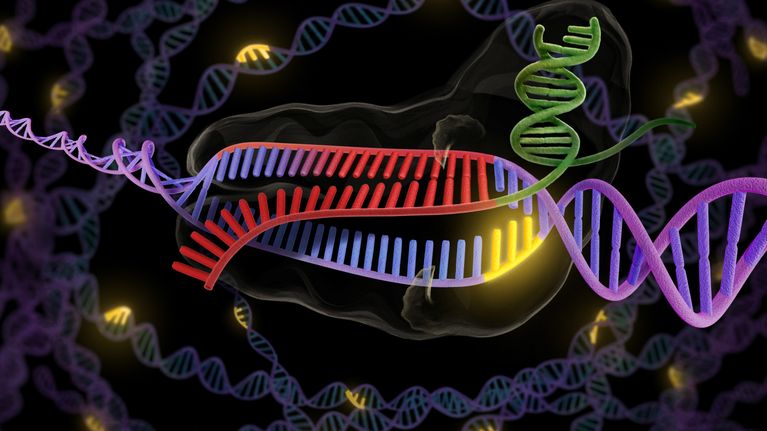
The image shows an illustration of how certain gene scissors work. The enzyme modified by artificial intelligence is called TnpB, which is a simplified enzyme similar to the CRISPR-Cas12 proteins shown in the image. Photo: Jennifer Doudna/UC Berkeley
19 July, 20:59
Artificial intelligence has developed new gene scissors in a recent study from the University of California, Berkeley, according to Science magazine.
Gene scissors can be called, for example, a guide molecule that directs a protein to edit an organism's hereditary material or genome. The protein cuts the DNA strand at the location designated for it.
In the experiment, artificial intelligence designed thousands of new protein versions of TnpB gene scissors based on information provided by researchers. Some of these AI creations differed significantly in structure from natural TnpB proteins, yet retained their functionality despite this.
Some of the artificial intelligence creations modified DNA better than natural gene scissors.
The research demonstrates that artificial intelligence is a suitable tool for developing new proteins that can use RNA as a guide to bind to DNA or RNA. The method opens new possibilities for designing and building proteins for precisely defined tasks, for example in medicine.