
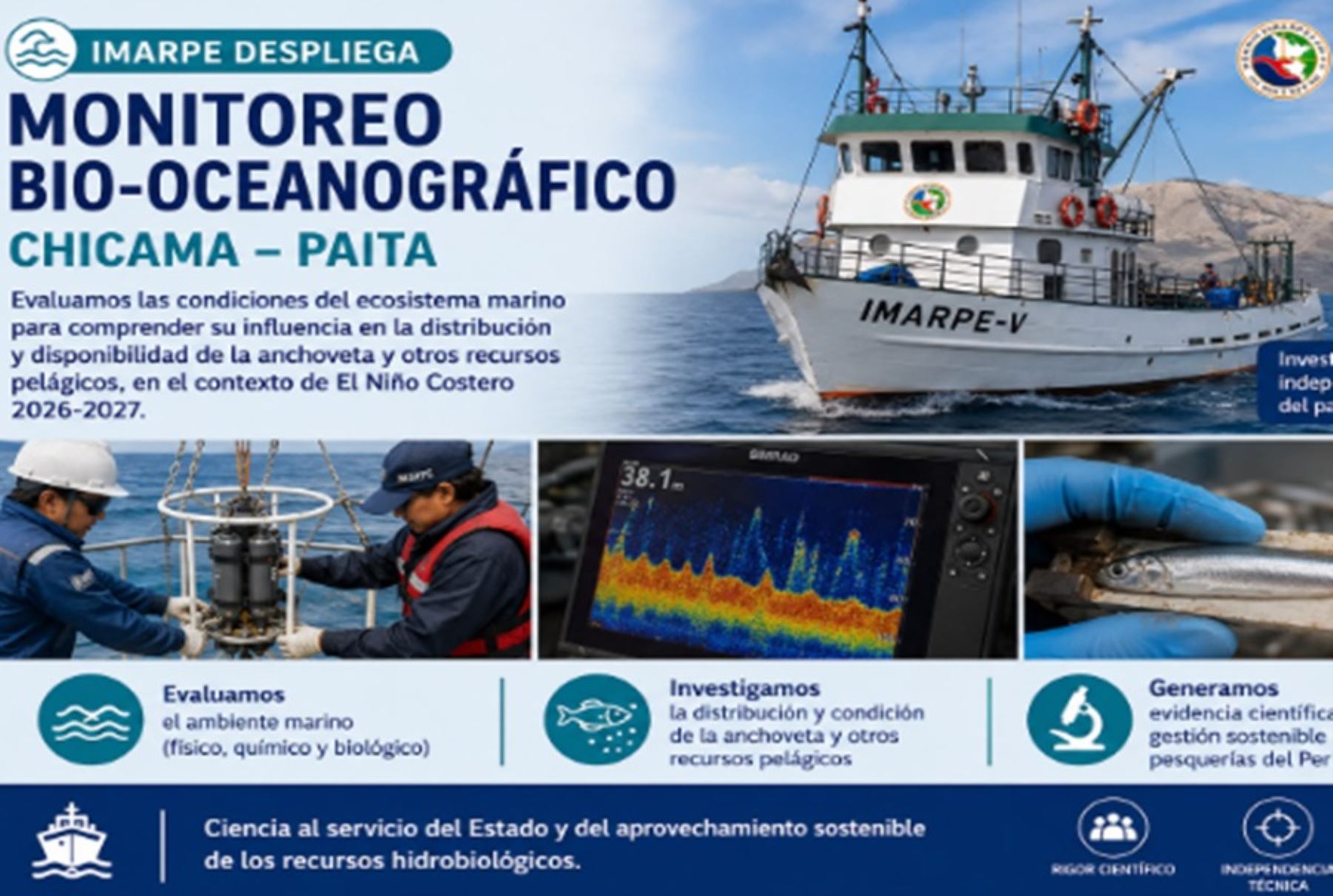
Bio-Oceanographic Monitoring of Peru's Marine Ecosystem During Coastal El Niño 2026–2027
As part of its permanent programme of scientific investigations of Peru's seas, the National Institute of Marine Research (Imarpe), a specialised technical body attached to the Ministry of Production, will conduct Bio-Oceanographic Monitoring Paita–Chicama–Chimbote–Huacho 26-07 from 16 to 29 July 2026 aboard the research fishing vessel Imarpe V.
The objective of this investigation is to assess the environmental conditions of the marine ecosystem associated with the development of Coastal El Niño 2026–2027 and to analyse its influence on the distribution, availability, and biological condition of anchovy (Engraulis ringens), the country's principal fishing resource.
During the investigation, Imarpe specialists will conduct oceanographic, biological, and hydroacoustic observations and measurements, as well as biological sampling and at-sea verification, in order to obtain information on the characteristics of the marine environment and the response of hydrobiological resources to oceanographic variations.
Information will also be collected on physical, chemical, and biological parameters of the ocean, as well as plankton components that form the foundation of the marine food chain, allowing understanding of how ecosystem conditions evolve during the development of Coastal El Niño.
The information obtained will be integrated using scientific methodologies employed by Imarpe to assess the state of marine resources and environmental conditions, generating evidence that contributes to understanding the dynamics of the ecosystem and anchovy populations in one of the country's main fishing areas.
This monitoring takes place in a context of environmental variability associated with Coastal El Niño, whose conditions can modify sea temperature, the distribution of water masses, and the intensity of coastal upwelling, influencing the distribution and availability of various hydrobiological resources.
The results of this investigation will strengthen the scientific basis underpinning Imarpe's assessments of marine resources and will contribute to the sustainable management of fisheries and the responsible use of hydrobiological resources. They will also provide relevant information for monitoring oceanographic conditions that support scientific analyses of the evolution of Coastal El Niño and its effects on marine ecosystems.