
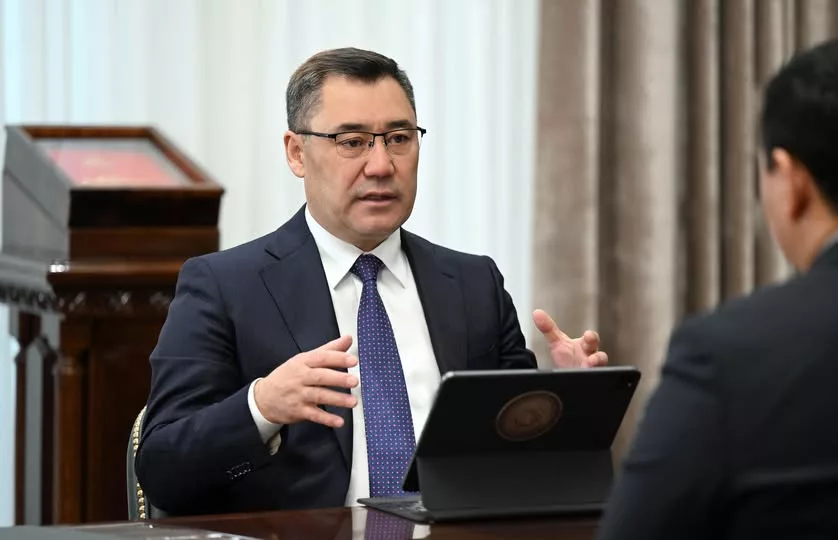
President Sadyr Japarov in a recent interview with the Kabar agency answered questions causing public concern. The head of state stated that Kyrgyzstan's lands will not be sold to foreign citizens, investment projects will be under strict control, and measures of responsibility will be strengthened against foreign citizens violating the law.
— Hello, Sadyr Nurgozhoevich! In recent days, changes to the Land Code have been actively discussed on social media. Information is circulating in society that "foreign investors will be provided with land plots for rent for up to 50 years." Where did this norm come from? Has the practice of providing land plots to foreign investors for long-term lease existed in Kyrgyzstan before, or is this a completely new initiative?
— First of all, it is necessary to understand one important point clearly. Providing land plots to foreign investors for long-term lease is not a new norm that has appeared today. This mechanism has been operating in Kyrgyzstan for many years. The purpose of the current changes is to bring existing norms into compliance with modern requirements, strengthen control over their application, and increase investor responsibility for fulfilling their obligations.
Each of us knows this well. Such investment projects in Bishkek as Vefa Center and Beta Stores were also realized on the basis of this long-term land lease mechanism. And today they do not exist separately, outside the framework of state legislation. On the contrary, thousands of citizens work there, hundreds of entrepreneurs conduct their activities, and tax payments regularly flow into the budget. No one has exported these buildings outside the country. It is impossible to do so.
Most importantly, in accordance with the legislation of the Kyrgyz Republic, foreign citizens and foreign companies cannot acquire a land plot as property. This is a direct requirement of the Land Code. They can only obtain the right to use a land plot for a certain period under lease conditions and with payment of rent. At the same time, the land remains in state ownership.
Therefore, presenting the situation as if a new law has been adopted today and land has now begun to be transferred to foreigners does not correspond to reality. I repeat once more: this is about an investment attraction mechanism that has been applied in Kyrgyzstan for a long time.
Today the state is only improving this mechanism and strengthening investor responsibility. The policy is aimed at eliminating cases where a land plot is leased but nothing is built on it for years, delaying project implementation. Unfortunately, some politicians distort the meaning, trying to cause unfounded anxiety in society. Let them show just one land plot of one hundredth of a hectare that would be in the ownership of a foreign citizen. But this is impossible, since there are no such examples.
— If an investor receives a land plot for long-term lease, can they simply hold it for 49-50 years without taking any action? Or are there mandatory requirements for investment, construction of facilities, and job creation? Does the state have the right to return the land plot if the investor fails to meet the contract terms?
— This question is one of the key ones. The practice of obtaining a land plot and then doing nothing for decades will be ended. For each investment project, a clear implementation schedule and specific obligations will be established. The investment contract will detail what volume of investments must be invested within set deadlines, when construction should begin and when the facility should be put into operation, how many jobs must be created, what the total volume of investments is and what tax revenues the project will provide to the state.
Compliance with these obligations will be under constant control by state bodies and local government authorities. The investor will be able to use the land plot exclusively for the implementation of the project for which it was provided. If a plot is allocated for factory construction, a factory must be built; if for a logistics center, a logistics center will be built. The ability to change the project purpose at will or simply hold a land plot without its development, as happened before, is henceforth excluded.
A good example is an investment project currently being implemented on the territory of the former Ak-Kula hippodrome. The investor was not simply given a land plot. Under the agreement, they transferred almost 6 billion som to the city budget and also undertook obligations at their own expense to build three schools, three kindergartens, roads, and engineering infrastructure. In addition, the total volume of investments in the project is no less than 300 million US dollars.
Today construction work is already underway on this territory, thousands of people are provided with jobs, and the state receives customs payments, tax revenues, and other income. After the project is fully completed, residential complexes and trade and service facilities will be erected there. Thousands of people will be able to live, work, and conduct business activities, ensuring stable tax revenues to the budget. That is, both the state and citizens benefit from the implementation of such investment projects.
Therefore, the key issue is precisely the fulfillment of contract terms. If an investor fails to meet their obligations, does not invest within set deadlines, or does not implement the project, the state has the right to terminate the contract and return the land plot to state ownership in the manner established by law. Moreover, the changes provide for even stricter control over compliance with these requirements.
Let me give an example. In 2024, an investment agreement was concluded under which the investor undertook to build a modern medical complex in Kyrgyzstan. The total volume of declared investments was 2 billion US dollars. However, the investor did not fulfill the conditions provided for in the contract. In connection with this, the cabinet of ministers made a decision to terminate the agreement, and the right to long-term lease of the land plot was immediately terminated. We will never allow decisions that contradict the interests of the state and people of Kyrgyzstan.
— Some express concern that "land plots held in lease by investors will be transferred to banks as collateral, and subsequently the land will pass into the bank's ownership." The question arises: is the land plot itself the subject of a pledge or is it the right of lease? Does such a mechanism create a risk of the state losing its right of ownership to the land?
— For us, a priority is attracting reliable investors with sufficient financial capacity.
Therefore, for each large investment project, a comprehensive preliminary check is conducted of the investor's financial viability, business reputation, and ability to fulfill their obligations. The state will not cooperate with companies that do not have the necessary financial resources or have a high level of risks.
At the same time, a fundamental requirement applies to state lands.
It is not permitted to pledge either the land plot itself, which is in state ownership, or the right to its lease.
In other words, concerns that state land could pass to a bank or third parties are unfounded.
If an investor uses their own funds to build a factory, plant, logistics center, or other real estate facility, they have the right to use facilities belonging to them as property in accordance with legislation. However, state land remains in state ownership and cannot be the subject of a pledge.
The main objective