
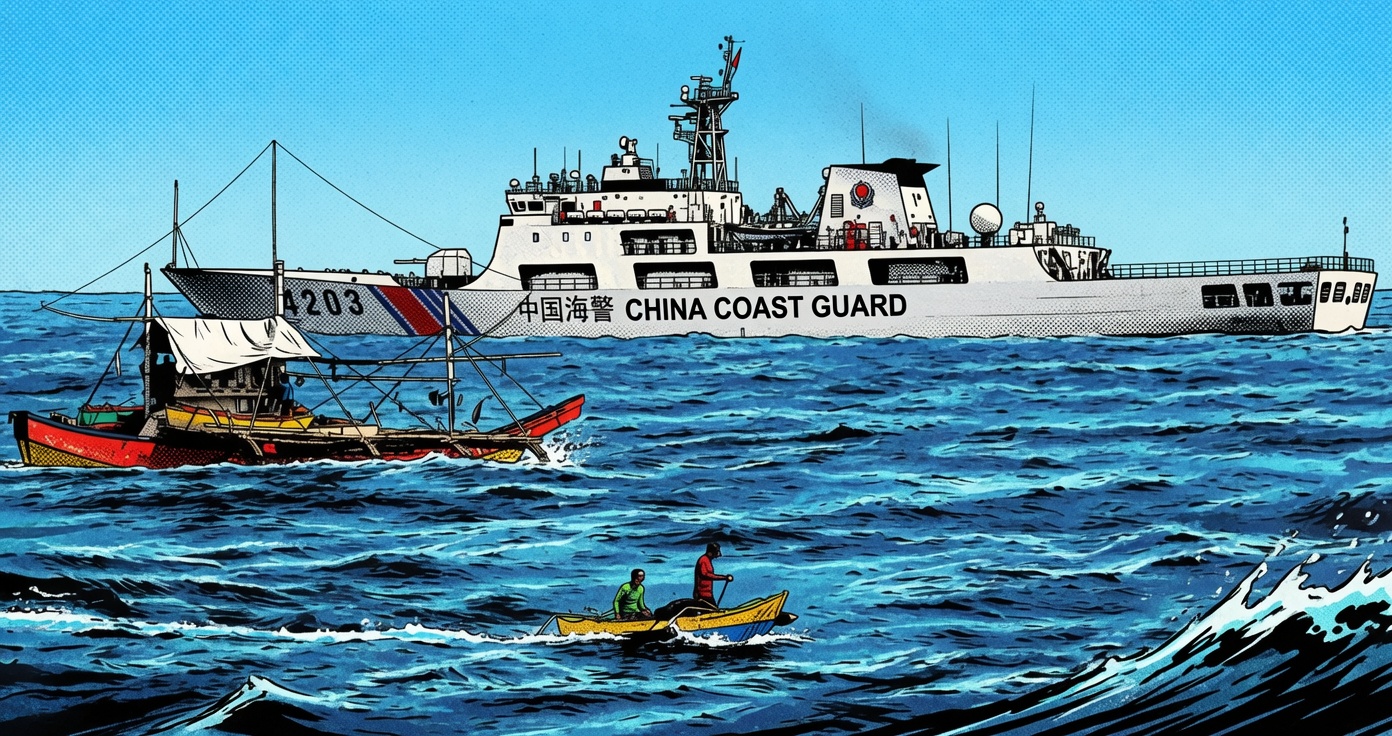
Ten Years After The Hague Arbitration Award, A New Stage in South China Sea Competition
Ten years after the Tribunal for the Law of the Sea dismantled China's maritime claims in the South China Sea, the real novelty is not so much the content of the award — which Beijing continues to reject entirely — but the role that decision is assuming in the strategic architecture of the Indo-Pacific. The joint statement issued by the United States, Australia, Canada, France, Germany, Italy, Japan, Netherlands, New Zealand, United Kingdom and the Philippines does not simply commemorate the tenth anniversary of the 2016 arbitration. In fact, it reaffirms the value of the UN Convention on the Law of the Sea (UNCLOS), recalls the legally binding nature of the sentence and invites China to comply with international law, transforming that ruling into a shared political reference point for an increasingly broad coalition of states.
Beijing's response was swift. The Foreign Ministry reiterated that the award is "illegal, void and without any binding effect", accusing the signatories of interfering in a dispute it considers exclusively bilateral between China and the Philippines. Meanwhile, tension has also shifted to the propaganda arena. China Daily, a newspaper close to the Chinese Communist Party, released an AI-generated video depicting the Philippines as a monkey manipulated by the United States and Japan and pushed to confront China in the South China Sea. Manila called the content "dehumanizing and racist", denouncing it as an example of "despicable propaganda" incompatible with the behavior of a responsible state.
For Matteo Piasentini, China and Indo-Pacific Desk Coordinator at Geopolitica.info and Senior Lecturer at the University of the Philippines Diliman, stopping at the tenth anniversary commemoration would mean missing the deeper significance of the statement. "From a political perspective it is certainly a signal of support for the Marcos administration," he explains, recalling how the Philippine president has built much of his Indo-Pacific strategy on respect for the arbitration and UNCLOS. "But from a strategic perspective the discussion is broader. The reference to the award also serves to legitimize a growing international presence in the South China Sea. Future naval presence is justified by the need to strengthen an international order based on rules."
This is probably the most significant transformation that has matured over the past decade. In 2016, the award represented the culmination of a legal dispute between Manila and Beijing. Today, while continuing to be rejected by Chinese leadership, it is progressively assuming a different function: that of the normative foundation on which a growing number of partners build their political, diplomatic, and increasingly military cooperation. The invocation of UNCLOS serves not only to reaffirm the Philippines' case, but to provide a framework of international legitimacy for the presence of external actors in an area considered crucial for global maritime security.
According to Piasentini, the harshness of the Chinese reaction should also be read in this perspective. More than the content of the statement, Beijing seems to fear the political process it represents. "The Chinese position is not new," he observes. "Since the arbitration, China has always maintained a total rejection because the award is incompatible with its own interpretation of historical rights in the South China Sea." What is changing, rather, is the international context. "The fact that increasingly more states declare themselves stakeholders makes the situation more problematic for Beijing. For China it is much more complex to manage a coordinated response to a coalition of countries than to engage bilaterally with each interlocutor, which is instead the format it has always preferred."
The joint statement breaks precisely this approach. The dispute over the South China Sea is being relocated within a broader discussion on the protection of international maritime order, removing it at least in part from the strictly bilateral dimension on which Beijing has insisted for years. It is not surprising, in this context, that Chinese diplomacy has reacted by convening representatives from some of the countries involved and intensifying its narrative against so-called "external forces", accused of turning Manila into a tool of geopolitical competition led by Washington.
The video distributed by China Daily fits into this climate of growing communicative polarization. Piasentini, however, urges caution in interpreting its political significance. "It is certainly something unprecedented," he observes. "China has always sought to present itself as a moral champion of the Global South and resorting to images of this type represents a novelty. It could be an attempt at distraction on the domestic front or an excess of zeal on the part of some journalist who interpreted the official line in an even more aggressive way. At the moment there are no elements to assert this with certainty." Rather than proof of a change in Chinese strategic posture, the video seems to represent an indicator of the escalation of the narrative clash that now stably accompanies competition in the South China Sea.
For Italy, signing the statement represents a further piece of an increasingly structured presence in the Indo-Pacific. Rome appears for the first time among the signatories of a document of this political weight on the South China Sea, confirming a trajectory already visible through strengthened cooperation with Manila, naval missions in the Indo-Pacific and growing involvement in regional infrastructure initiatives such as the Luzon Economic Corridor.
According to Piasentini, Italy's choice should be read well beyond the symbolic dimension. "Italy is an exporting country, deeply integrated into international trade. The stability of the South China Sea directly impacts its economic interests." But there is also a second level, more political. "Rome has understood that to build a deeper relationship with the Philippines, it is necessary to start from an alignment on principles. Support for arbitration and UNCLOS constitutes the basis on which defense cooperation, industrial relations, investments and infrastructure projects can then develop."
In this perspective, the joint statement also tells the story of Italy's evolving posture in the Indo-Pacific. It does not mark an entry into the territorial dispute between Manila and Beijing, but rather a growing identification with the defense of the maritime order founded on international law. It is a subtle but substantial distinction, which reflects the way Rome is progressively redefining its role in the region.
Ten years after The Hague award, then, the real terrain of competition is no longer solely the validity of a sentence that China continues to reject. It is the capacity of that ruling to transform itself into the common language through which an increasing number of democracies coordinate their presence in the Indo-Pacific. And it is perhaps this evolution, more than the arbitral decision itself, that explains why Beijing continues to contest it with such force not only in its legal content, but especially in its growing strategic weight.