
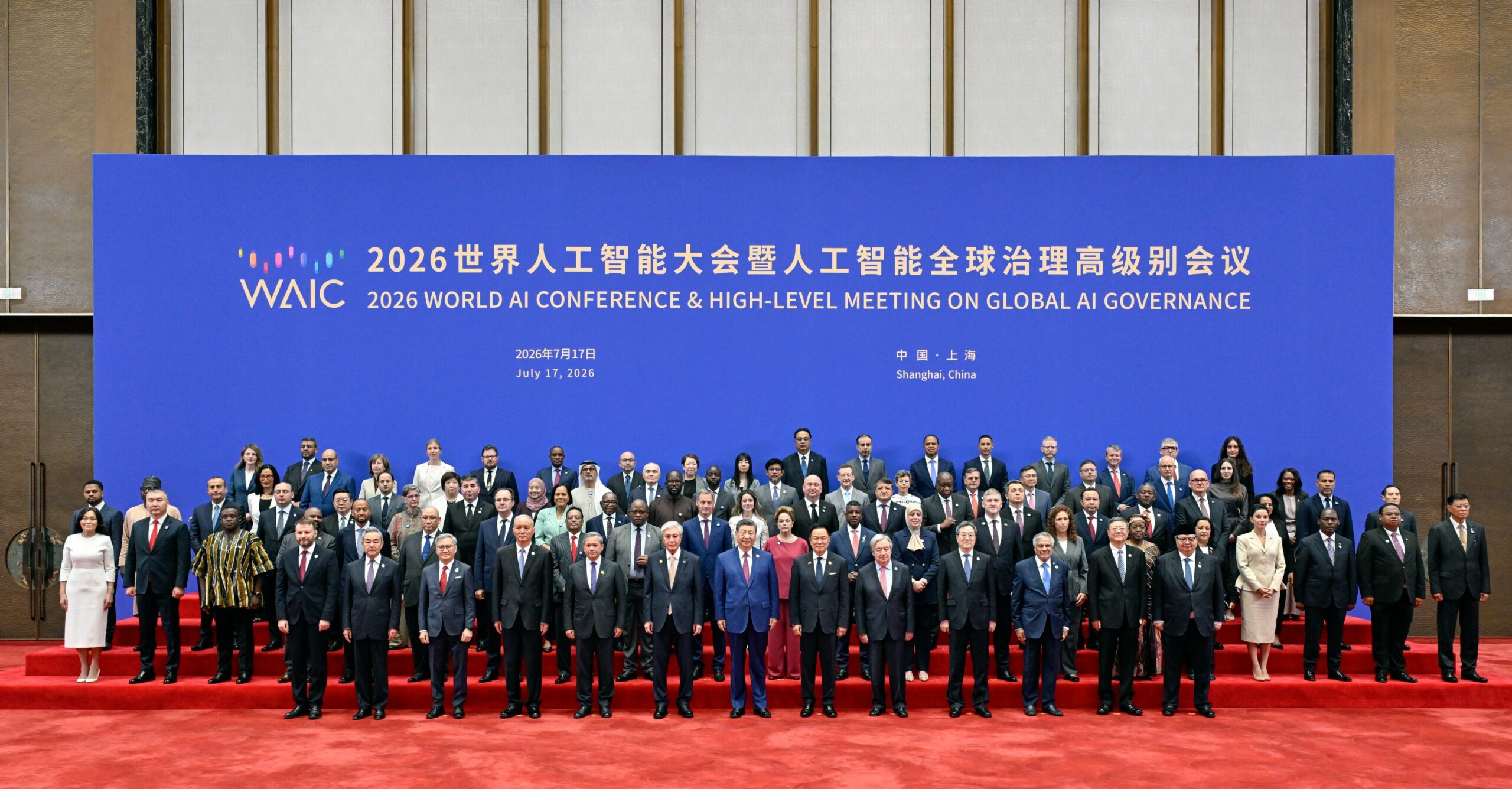
There is no third way in the competition between the United States and China over artificial intelligence. The presence of the director of the Agency for Digital Italy at Xi Jinping's conference contradicts the strategic line that Italy has just signed onto. The risk is creating a rift with Washington deeper than the Sigonella/Iran case — which is why the Agid leadership should resign. An editorial from Formiche signed by Emanuele Rossi
18/07/2026
The director general of the Agency for Digital Italy, Mario Nobile, participated in Shanghai at the World Artificial Intelligence Conference (Waic), the major event promoted by Xi Jinping to consolidate an international coalition in favour of the "with Chinese characteristics" vision of artificial intelligence governance.
Taken in isolation, it might seem like a routine institutional mission. It is not.
Just two weeks earlier, Italy had signed the Joint Statement on AI Opportunity, the political declaration accompanying Pax Silica, the American initiative aimed at building an artificial intelligence ecosystem between the United States and allied countries, founded on common standards, shared technology supply chains, and governance principles compatible with those of democracies. The agreement was signed by ambassador Armando Varricchio, special envoy of Foreign Minister Antonio Tajani for Innovation and New Technologies, who was present at the Pax Silica summit in the US. According to various indications, Rome could formally join the initiative in the coming weeks, when undersecretary of state Jacob Helberg, "the architect of Pax Silica", will be in Italy — an accession that risks being called into question because of that presence in Shanghai.
These are two incompatible images. On one hand, Italy supports an initiative born to strengthen the Western front in technological competition with China. On the other, the head of its digital agency participates in the main international platform through which Beijing seeks to build consensus around its own standards and leadership on artificial intelligence.
It is not a diplomatic contradiction, it is a strategic contradiction. The point is that competition over AI concerns not only the race for the most advanced models or the most powerful chips, but above all who will write the system's rules. Technical standards define interoperability, security, certifications, data flows, supply chains, digital infrastructure and, in prospect, the economic and strategic balance of entire industrial sectors. Whoever helps write them exercises a form of power far more durable than mere technological superiority. This is why Washington and Beijing are investing enormous resources in building international coalitions.
Pax Silica is born precisely with this objective: to create a community of countries that develops a shared architecture for artificial intelligence, reducing strategic dependencies and building a technological system alternative to the Chinese one. The Shanghai conference pursues the opposite objective. Beijing seeks to build international consensus around its own idea of AI governance, presenting itself as the reference point of a technological order alternative to the one promoted by the United States.
The two initiatives are competing, so ambiguity is not tenable. For years, many countries have tried to separate strategic competition from economic relations, maintaining room for manoeuvre between Washington and Beijing. But artificial intelligence now belongs to the narrow group of cutting-edge technologies, alongside semiconductors, quantum computing, and digital infrastructure. On this terrain, the logic of a dual track no longer holds. Whoever contributes to building one ecosystem cannot, at the same time, legitimize the competing one.
While the relationship with the United States on artificial intelligence could become one of the main axes of bilateral cooperation, the presence of the Agid director at Waic feeds an ambiguity that Rome cannot afford. Not because Washington demands it, but because it contradicts the strategic line that the government has maintained with consistency by cancelling membership in the Belt and Road Initiative, holding firm on Chinese police stations, and launching initiatives like Buy Transatlantic.
That presence in Shanghai appears inconsistent with the broader political line of the executive, and for this reason the response cannot be a simple diplomatic clarification, but Rome must formally distance itself from that participation and assess whether the person leading the Agency for Digital Italy can continue to hold the position. What is at stake is Italy's strategic credibility at the moment when it is being decided who will write the rules of artificial intelligence: and in this competition — the most important of the next thirty years — one cannot stand simultaneously with Washington and with Xi.