
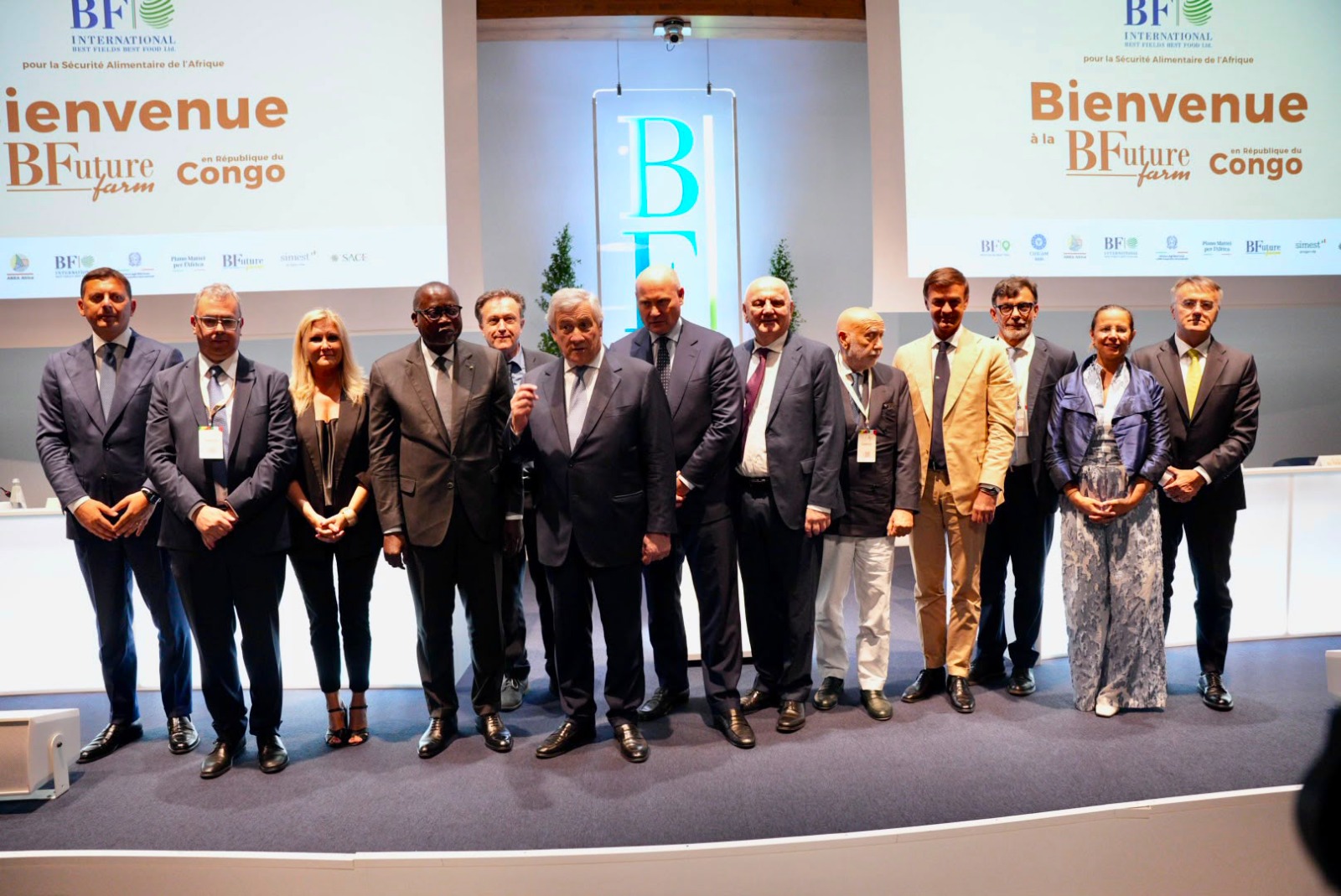
Mattei Plan: BF Spa's Congo Project Becomes Symbol of Italian Cooperation in Africa
BF Spa's project has become one of the symbols of the Mattei Plan: for Foreign Minister Tajani, a model of Italian cooperation in Africa, founded on development and work. Ambassador Okemba describes it as a historic turning point in relations between Rome and Brazzaville, opening the way to new investments and partnerships. The collaboration between public and private sectors is increasingly solid.
16/07/2026
First the project, then the political vision. And finally the system of alliances that makes it possible. It was along these lines that a day organised by BF Spa unfolded in Jolanda di Savoia, in the heart of the Ferrara land reclamation area, to take stock of the first BFuture Farm in the Republic of Congo, one of the flagship projects of the Mattei Plan. The event brought together institutions, businesses, finance, and international cooperation, presenting an image of a model in which agriculture becomes an instrument of foreign policy, economic development, and stabilization of the African continent. The chief executive officer of BF Spa and chief executive officer of BF International, Federico Vecchioni, recalled how the choice to present the results in Jolanda was not coincidental.
The political conclusions ended up providing the key to understanding the entire day. For Deputy Prime Minister and Foreign Minister Antonio Tajani, the BFuture Farm represents one of the most concrete examples of the Mattei Plan.
"Africa is the continent destined to grow, and the future of our world depends on Africa's development," he observed, reiterating that Italian strategy aims to export expertise rather than models of exploitation. "In Congo we are present with our companies to create jobs and prosperity. BF's role is strategic, crucial. This is a model of cooperation."
From this flows the need to promote joint ventures to directly transform raw materials in Africa, strengthening that "growth diplomacy" which also passes through the new export plan, the goal of 700 billion euros in exports, and 620 scholarships for African students.
Vincenzo Gesmundo, president of BF International, brought the industrial dimension further by emphasizing the ethical scope of the initiative. "I am president of BF International for one reason only: I am the custodian of an idea."
A project that, he explained, "beyond its great economic scale" lives especially in its social dimension. "Every hectare we create will be against poverty. Every investment will be for prosperity."
For Gesmundo, the primary sector "can play with its head held high" and growing market interest shows that "finance too can look to agriculture," while BF International's path toward listing represents a further step in this strategy.
A vision shared by the Ambassador of the Republic of Congo to Italy, Henri Okemba, who described the initiative as "the tangible sign of two visions": that of the Congolese president and that of the Mattei Plan promoted by the Italian government. "This day will remain in the history of our countries," he stated, recalling how Brazzaville has launched a new modernization policy based on economic diversification, agriculture, digital technology, and tourism. After the first 10,000 hectares, the Congolese government has already identified two other sites, for a total of 20,000 hectares, aimed at expanding the partnership with BF. "BF puts my country first and creates conditions for new investments. Long live cooperation between Italy and Congo."
Around this axis, the network of System Italy partners consolidated itself. The director of CIHEAM Bari, Biagio Di Terlizzi, emphasized how "strengthening human capital means creating sustainable development," through training programmes aimed at Congolese officials and technicians and investments in educational and health facilities.
The chief executive officer of Simest, Regina Corradini d'Arienzo, recalled that "we have been partners in this story from day one." The choice, she explained, is to "create a fund dedicated to Africa together with local operators," an investment model for the long term fully consistent with the philosophy of the Mattei Plan.
For the general director of Enpaia, Roberto Diacetti, the project "marks a new humanism," because "alongside physical infrastructure it also builds human infrastructure," opening the way to new forms of welfare dedicated to the communities involved.
Antonio Buonfiglio, general director of the Enasarco Foundation, shared the same view: "Pension funds are long-term investors. The Mattei Plan will be remembered if it can produce shared development. Alongside food security there is also social security."
Closing the picture was the vice president of the Emilia-Romagna Region, Vincenzo Colla.
"The integrated public-private system creates quality. If you do not build good relationships you do not do projects. You are doing something for the good of the country and we are at your side," he said, pointing precisely at loyal cooperation between institutions and businesses as one of the distinctive elements of the initiative. A model that, from Jolanda di Savoia to Congo, aims to transform agriculture into one of the main instruments of Italy's international projection.