
HARWICH
The Arctic research vessel RSS Sir David Attenborough departed from Britain today on a mission to Greenland's fjords.
An international research team aims to investigate how severely meltwater from Greenland's glaciers threatens the vital ocean currents of the North Atlantic—and the living conditions of people in Finland.
The researchers carry cutting-edge technology, enabling them to study the issue in greater detail than ever before.
Yle was granted access to the vessel at Harwich Harbour on England's east coast before the British ship's departure.
One objective of the research expedition is to create an early-warning system that detects possible acceleration of melting even faster. Artificial intelligence will assist in monitoring.
Greenland's melting has accelerated fivefold
"It is really important to understand what is happening to Greenland's glaciers. They are melting five times faster than in the 1990s," says Kelly Hogan, a researcher at the British Antarctic Survey.
Hogan leads the research expedition, which is named Giant. Giant stands for Greenland Ice sheet to Atlantic Tipping points.
Hogan explains that freshwater from melting glaciers disrupts the ocean current system of the North Atlantic. This circulation system is part of a broader network of ocean currents that stabilises the world's climate and keeps temperatures mild across Western Europe.
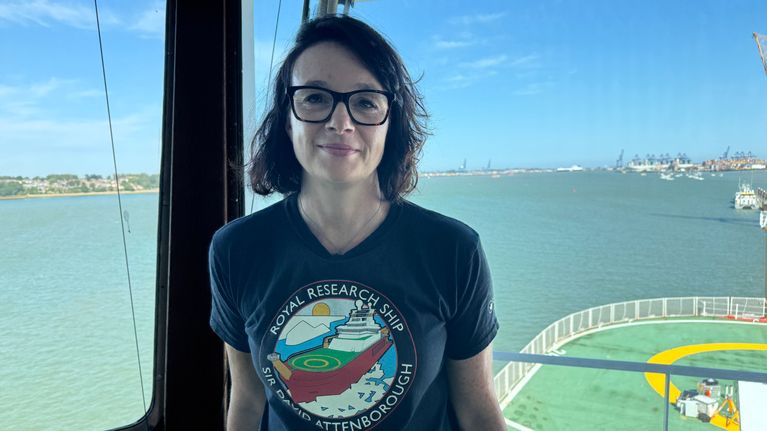
Kelly Hogan has studied polar regions for 20 years. She was photographed on Tuesday aboard the research vessel. Photo: Kirsi Crowley / Yle
"If more ice melts in Greenland, more freshwater flows into the North Atlantic, which could slow the transfer of heat to Europe," Hogan says.
According to her, this could alter rainfall patterns across Britain within a short timeframe—say, over a decade. Winters would also become stormier.
Greenland's glacier melt could trigger irreversible changes to weather and climate across all of Europe.
Hogan warns that this also threatens Europe's food production, which depends on planning for agriculture and fishing.
Hogan notes that if Northern Europe transitions to wind and solar energy, forecasting future climate is essential to predict energy availability.
James Bond-style technology for glacier research
The research vessel is equipped with cutting-edge technology reminiscent of gadgets from James Bond films. Drones, robots, and autonomous submarines enable measurements in locations that are unsafe for humans.
"Working right at the face of a glacier has been dangerous. We have found it very difficult to measure anything there. Now we can do so thanks to our new and excellent technology," Hogan explains.
A small team of researchers will also camp on the glacier to gather additional data on ice behaviour. The scientists simultaneously measure glacier melting, ocean warming, and calving of icebergs.
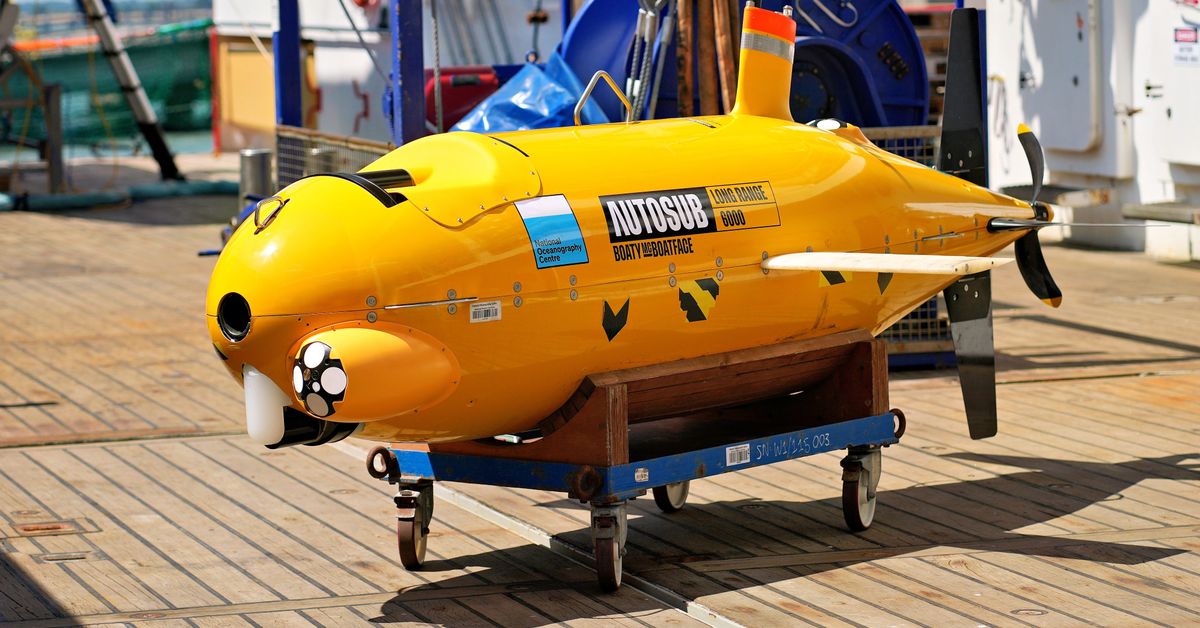
One of the expedition's star instruments is an autonomous submarine named Boaty McBoatface. It can move independently right to the glacier's surface.
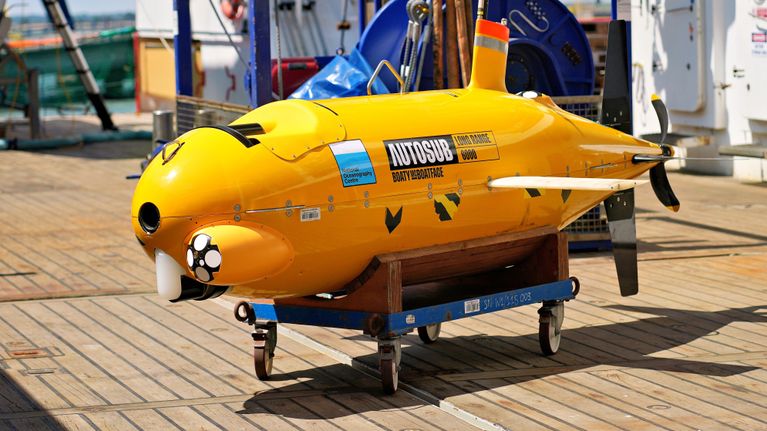
Boaty can study glaciers at depths of thousands of metres. The name Boaty McBoatface was originally proposed humorously as a name for the research vessel, which ultimately became Sir David Attenborough. Photo: Stephen Waller—stephenwaller.c
"Boaty can measure everything from temperature and salinity to small-scale turbulence and mixing," says Dr. Alice Marzocchi from Britain's National Oceanography Centre.
Artificial intelligence and robots improve forecasts
Autonomous vehicles, radar, and AI-supported modelling enable the study of glacier and ocean interaction in ways that were impossible just a few years ago.
One objective of the research expedition is to reduce uncertainty and make forecasts more accurate.
Dr. Paul Holland, one of the Giant project's leaders, says that thinning of Greenland's ice sheet is known. However, there is insufficient knowledge about the impact of ice sheet melting on the ocean.
Currently, forecasts are not very precise, and researchers disagree on the amount of melting.
One of the study's central goals is to identify possible "tipping points"—sudden changes that may be irreversible.
"It means, for example, that if we cool the climate in the future, the ice sheet will not grow back," Holland explains.
He has studied the ice sheet for 25 years.
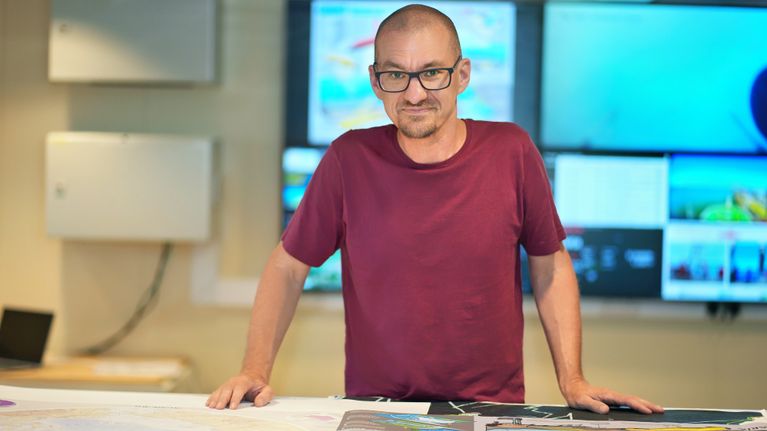
"I have watched glaciers disappear, and it is very sad. I have thought about this a lot and believe we can still do something," Holland says. Photo: Stephen Waller—stephenwaller.c
Holland stresses that the difference between a climate warming by two or three degrees is enormous.
"A planet three degrees warmer is a much worse place to live. The outcome for ice sheets is worse. Every small change we can make to our greenhouse gas emissions matters in preventing the most severe consequences of climate change," Holland says.
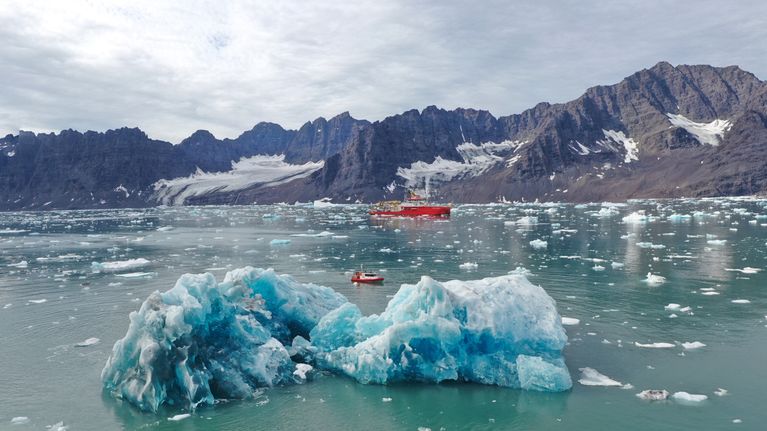
Research vessel RSS Sir David Attenborough on an earlier expedition. Photo: British Antarctic Survey
Personal concern for the future
Kelly Hogan, who has studied polar regions for 20 years, admits she is worried.
"The rate at which ice is disappearing in Greenland just keeps accelerating. I think of my daughter and wonder what will happen in ten or 20 years. It feels like we are in a moment where we can do something, but it won't last forever," she reflects.
If Greenland's ice sheet disappears entirely, it would raise global sea levels by seven metres, Hogan says. This would occur within a few centuries if current rates continue.
"If we think about this in terms of Denmark, Britain, or any coastal city, it is impossible to imagine," Hogan says.
She hopes the research will provide governments with knowledge so they can prepare for change.
"With our results we reduce uncertainty. We convert science into numbers that matter to them and hope they make sensible decisions based on that," Hogan says.