
A Naval Drone and Armed Ground Robot Conduct the First Amphibious Operation Without Human Participation
A sign of how Kyiv is integrating unmanned systems from different domains, aiming to carry out increasingly complex operations.
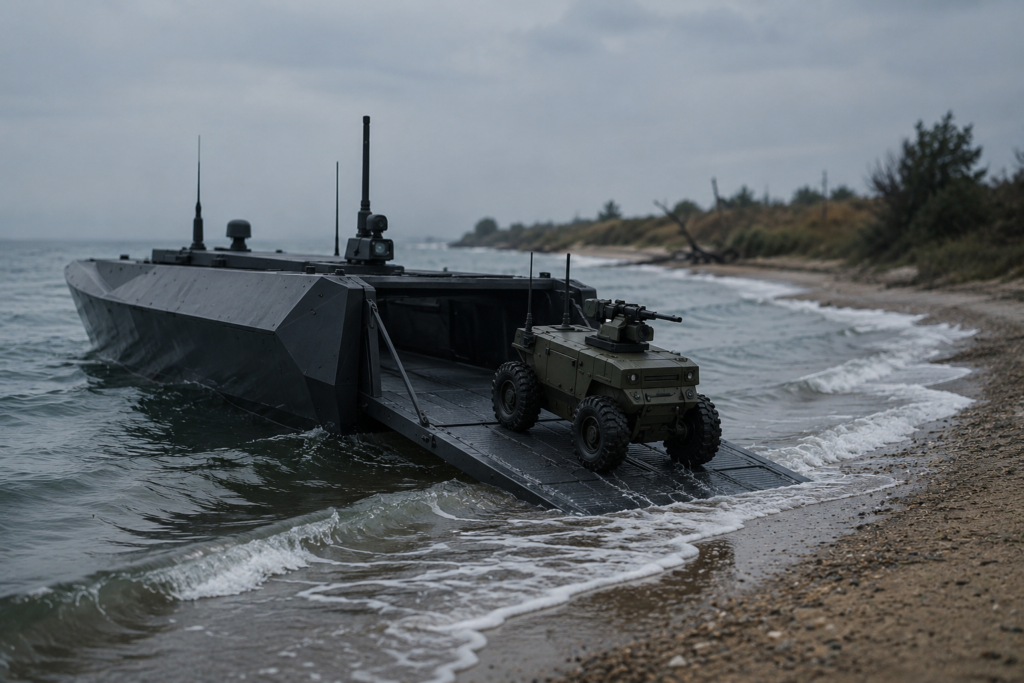
Ukraine may have written a new page in the history of amphibious operations by carrying out a landing operation using only unmanned systems. In recent hours, a video was released that appears to show an action conducted on what seems to be the Kinburn Peninsula, in the southern part of the country currently occupied by Russian forces. The video shows an unmanned surface vessel (USV) that transports a robotic ground vehicle (UGV) to the beach. The UGV appears to be a Rys unit developed by Ukrainian company Roboneers and armed with a 7.62mm PKT machine gun. Once it reaches the shore, the ground vehicle disembarks autonomously, takes position among vegetation, and according to the footage, opens fire with a machine gun toward a position further along the coast. The entire operation is observed and documented by an aerial drone that follows the various phases of the action.
However, numerous uncertainties remain. At present there are no independent confirmations of the outcome of the operation or its actual military objective. It is unclear whether the target was actually occupied by Russian soldiers, whether the robot completed the mission, or whether it was subsequently recovered by a second USV. The precise geolocation of the footage has also not been officially verified. The operation could therefore represent either a genuine tactical raid or a technological demonstration intended to test procedures and concepts meant to be developed in the future.
According to some Ukrainian sources, moreover, supply difficulties would have forced some Russian units to reduce their presence in the area. Information that cannot be independently verified, but that helps explain why Kyiv is intensifying pressure precisely on this sector of the front. The Kinburn Peninsula occupies a strategic position at the entrance to the Dnieper-Bug estuary and controls maritime access to the port of Mykolaiv. For months the area has been subject to Ukrainian attacks against Russian supply lines and continuous drone operations.
Beyond the tactical result, the value of the episode is mainly conceptual. If confirmed, it would be the first amphibious operation in a war context in which transport, landing, combat, and observation are entirely entrusted to unmanned platforms. In recent years the conflict in Ukraine has already transformed the role of aerial and naval drones. Surface drones have placed serious strain on the Russian Black Sea Fleet, while small FPV drones have profoundly changed ground combat. The integration of a robotic ground vehicle into this architecture, however, represents a further step forward.
Naturally, a single robot cannot replace a traditional amphibious operation. It remains to be seen how this approach could be transposed on a larger scale, coordinating multiple USVs, UGVs, and UAVs simultaneously to create a genuine robotic assault force. And indeed that is the most interesting aspect, since even if the raid had limited military impact, it demonstrates that Kyiv is experimenting (successfully) with new forms of integration between unmanned systems belonging to different domains.
As has already happened with naval drones and FPV systems, the importance of these operations may therefore not lie so much in their immediate success as in the ability to anticipate the evolution of the battlefield. If the model proves effective, future amphibious operations could be preceded by, or in part replaced by, waves of unmanned vehicles tasked with clearing the way for conventional forces.