
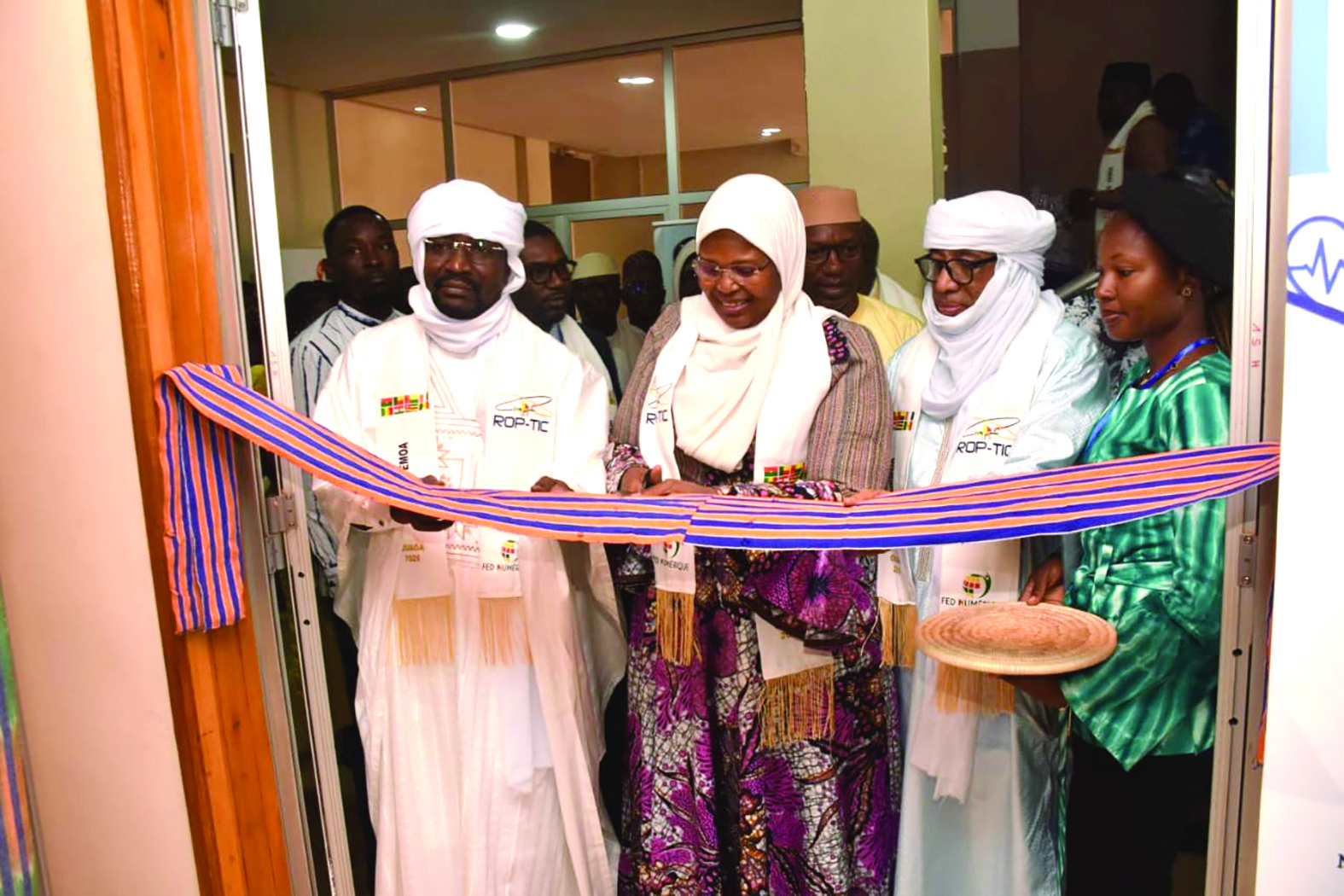
Opening ceremony of the fourth edition of the international digital economy professionals conference of the West African Economic and Monetary Union was held on Tuesday, July 14, 2026, in Ouagadougou.
Following editions in 2023 in Dakar, 2024 in Abidjan, and Lomé in 2025, Ouagadougou is hosting the fourth edition of the International Digital Economy Professionals Conference (SIPEN), a major gathering focused on digital transformation challenges in the West African Economic and Monetary Union (UEMOA) space. This meeting brings together, on July 14 and 15, 2026, in the Burkinabè capital, digital experts, political decision-makers, businesses, and digital actors from the eight member states of the Union.
According to organisers, the goal is to exchange views, reflect on digital challenges, combine their expertise, and create synergy of action to enable the region to benefit from the full potential offered by digital technology. The discussions are centred on the theme: "Rebuilding the digital economy within UEMOA: Artificial intelligence, Fintech and financial inclusion." At the opening of the proceedings, the Minister of Digital Transition, Postal Services and Electronic Communications, Aminata Zerbo, representing Prime Minister Rimtalba Jean Emmanuel Ouédraogo, stressed the importance of artificial intelligence (AI) in the profound transformation of economies.
In her view, AI redefines production methods, modernises public services, revolutionises the health, agriculture, and education sectors while offering new perspectives for financial services. More than a technological innovation, AI now constitutes, in Aminata Zerbo's assessment, a determining factor in competitiveness and sovereignty. AI, she stressed, naturally extends to financial technologies, whose development helps bring financial services closer to populations, facilitate economic exchanges, and support productive activities, including in the most remote areas.
"Progress recorded in the region shows that this dynamic is already underway. Data from BCEAO shows that in 2025, more than 11 billion transactions were carried out, illustrating the scale of digital transformation of financial services in our community space. These results reflect an evolution in our usage patterns and demonstrate the potential of digital as a powerful accelerator of financial inclusion," she explained.
However, the minister responsible for digital transition expressed concern that millions of citizens remain outside formal financial services. For her, this reality underscores that technological progress finds its true justification only when it translates into concrete improvement in people's living conditions. That is why, in her view, SIPEN-UEMOA offers an opportunity to reflect collectively on these issues. Over the two days of work, several presentations are expected, through panels on subjects related to artificial intelligence, fintechs, and financial inclusion.
Aminata Zerbo hoped that the discussions would foster the emergence of solutions designed within the community space, capable of meeting the needs of administrations, businesses, and populations. While welcoming the quality of speakers, the president of the Grouping of Information and Communication Technology Professionals Organisations (ROP-TIC), Antoine Ngom, argued that the choice of theme is significant. He explained that AI is already profoundly transforming global economies, fintechs are revolutionising financial services, and inclusive finance now appears as one of the main levers for reducing economic and social inequalities.
Progress in the community space
Taking the opportunity, the ROP-TIC president presented several indicators illustrating progress recorded in the community space. "In ten years, the financial inclusion rate within UEMOA rose from approximately 10.7 percent to nearly 74 percent. The region now has nearly 249 million electronic money accounts, while mobile money now represents 57 percent of this financial inclusion. These results testify to an encouraging African dynamic," he said. With regard to Burkina Faso's approach to making digital technology a lever for development, Antoine Ngom praised the efforts made by the authorities.
In his view, the country demonstrates daily that strong political will, combined with a dynamic private sector, makes it possible to accelerate digital transformation despite a particularly demanding context. For the UEMOA commissioner, Paul Koffi Koffi, the institution assists states in digitising public services. Addressing the relevance of the theme focused on artificial intelligence, he announced that the commission has decided to prepare and adopt, within a very short timeframe, an AI development strategy. Following the opening ceremony, participants were given a guided tour of the stands.
Oumarou RABO