
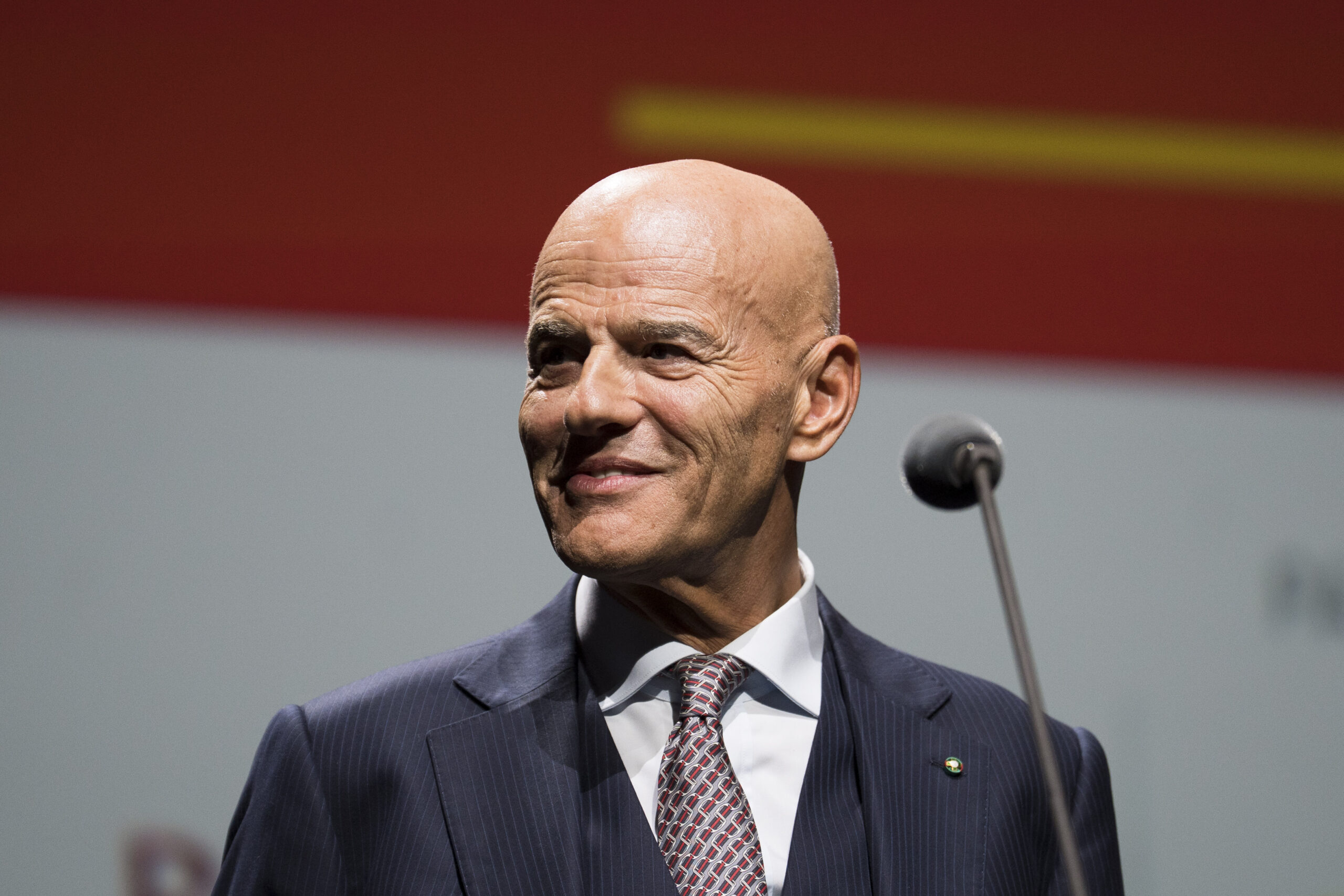
Claudio Descalzi has been saying for weeks that the old architecture of global energy security is finished. Less obvious, but more important, is that Eni has already moved accordingly: from Asian gas to Argentine LNG, from Chilean lithium to satellite companies open to outside capital, the group is transforming its chief executive's geopolitical diagnosis into industrial strategy.
The sequence of Eni deals since the start of 2025 — a stake in Chilean lithium, a new Asian gas major built with Petronas, an entry into the Argentine LNG frontier, a joint venture in trading with Mercuria, a group of satellite companies open to outside capital — is not a scattered list of opportunistic transactions.
Read through the framework that Eni chief executive Claudio Descalzi laid out in his recent interview with Sole 24 Ore, it appears as the deliberate execution of a stated thesis: that the world has entered a permanent regime of supply fragility, and that survival depends on the ability to diversify sources, routes and partners faster than rivals.
A shock that will not reverse
The immediate topical hook is straightforward enough. Since fighting around Iran began in March, transit through the Strait of Hormuz has collapsed by 95 per cent, and daily shipping traffic through the waterway has more than halved again since the start of July.
Descalzi places the cumulative drawdown from global oil stocks, particularly OECD government reserves and maritime cargoes, at 350 million barrels between the start of the bombing campaign in March and the end of May, with the daily depletion rate in May exceeding anything recorded during the pandemic.
He is explicit in saying this is not a transitory shock, but the third in a sequence of five years, after Covid and the war in Ukraine, whose effects on supply, freight rates and insurance costs have compounded rather than cancelled out.
His warning is precise: without a change of course, the market will reach a breaking point in the first quarter of 2027, and Europe — which he argues spent the years after Covid indulging in a narrative that treated the withdrawal of hydrocarbons as structurally assured — is the most exposed actor in the system.
From diagnosis to prescription
The prescription that follows is where the interview stops being commentary and begins to read as strategy. Descalzi invokes an "energy geoeconomics" built on diversification of both sources and geography, on integration along the value chain, and on treating Africa, South America and Southeast Asia as the new decisive terrain, alongside a strengthened relationship with U.S. gas.
It is not merely a personal reading by the company head. The first module of Eni's World Energy Review 2026 provides the same analytical background: in 2025 global energy demand continued to grow, the global energy mix remained substantially stable, oil and gas maintained a central role, while renewables and critical minerals increased their strategic weight. The transition advances, in other words, but does not eliminate the problem of supply security.
Diversification, deal by deal
Eni's recent transactions overlap with that prescription with unusual fidelity.
The SEARAH venture with Petronas, authorised by Jakarta and Kuala Lumpur in May, brings together 19 upstream assets across Indonesia and Malaysia in a jointly owned company producing over 300,000 barrels of oil equivalent per day, with a medium-term target above 500,000 — less an acquisition than the construction of a new regional gas major in the exact Southeast Asian market that Descalzi identifies as underexploited.
The late-June entry into Vaca Muerta, with the acquisition of a 32 per cent stake in three upstream blocks feeding the Argentina LNG project with YPF, extends the same logic to South America, targeting 12 million tonnes of annual LNG capacity.
The joint venture in trading with Mercuria, announced in early July, rebuilds Eni's presence in global commodity flows precisely at the moment those flows have become the contested resource that Descalzi describes.
And the $225 million investment in EnergyX's Black Giant project in Chile, which secures a quarter of future lithium carbonate production, pushes Eni into the supply chains of the critical minerals that underpin the transition away from oil that it says it cannot abandon in the short term.
A different way to pay for it
A parallel pattern is visible in how Eni is financing all this. Rather than carrying capital-intensive assets on its own balance sheet, it is building autonomous "satellite" companies and inviting outside investors to enter them: KKR's stake in Enilive, now at 30 per cent with an implied valuation of 11.75 billion euros; Global Infrastructure Partners' co-control of the new CCUS holding that comprises British, Dutch and Italian carbon storage assets; and Plenitude's acquisitions of Acea Energia and Umbria Energy, which allowed the retail and renewables arm to reach its target of 11 million customers three years ahead of the original 2028 deadline.
Plenitude has also built on the international side, absorbing a renewable asset portfolio from French developer Neoen during 2025, and in February the European Commission approved a joint venture with Société Générale's Vulturno Investments to acquire and manage solar, wind and battery storage projects — a model for pairing Eni's origination with a bank's balance sheet rather than its own.
The sale of a 10 per cent stake in the Baleine project to SOCAR, Azerbaijan's state oil company, meanwhile, shows the same portfolio discipline applied in reverse — what Eni calls dual exploration, recycling capital out of mature assets to finance the next frontier.
Entering the fuels of transition
The same satellite logic extends into the Asian biofuels supply chain.
A joint venture with South Korean LG is advancing a biorefinery expected to begin operations in 2027, with capacity to process around 400,000 tonnes per year — a deal that combines Enilive's push to internationalise, the group's growing biofuels business and an industrial partnership with one of the few Asian conglomerates able to match Eni's scale in refining and chemicals.
It reinforces the point made by SEARAH: Eni's Asian strategy is not confined to upstream gas, but also reaches the fuels of the energy transition.
The final point
What stands out is the sequence. Eni was buying positions in Indonesian gas, Argentine LNG and Chilean lithium before Hormuz became the dominant story on trading desks, suggesting a strategy already in motion rather than one improvised for the cameras.
Descalzi naturally has an interest in framing his company's transactions as foresight rather than ordinary portfolio reshuffling, and price volatility favours this frame. But a European major that spent two years simultaneously diversifying suppliers, geographies and financial partners is better positioned than most.