
Hungary's Parliamentary Terms Also Shortened. The Reform Could Serve as a Model for Future Governments, Europe Correspondent Anna Karismo writes.
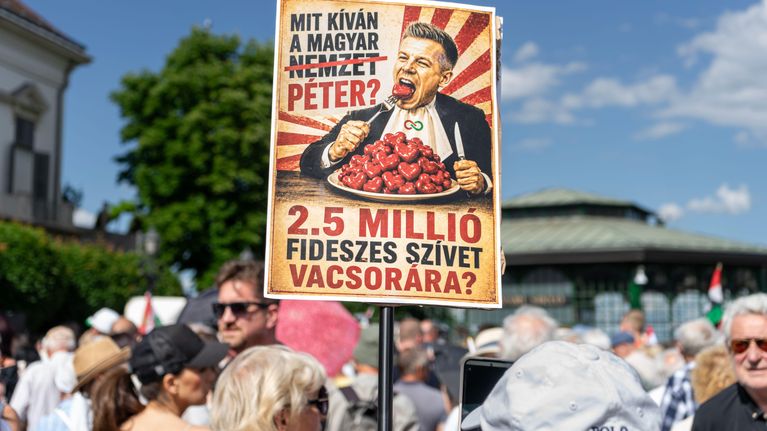
"What does Hungary's Péter want?" asked a sign at a June protest by the opposition Fidesz party against the new prime minister. "2.5 million Fidesz hearts for dinner?" Image: All Over Press

13.7. 19:30
BERLIN Hungary's parliament voted on Monday on a constitutional amendment that would end the term of incumbent President Tamás Sulyok immediately.
The outcome was expected, because Prime Minister Péter Magyar's Tisza party, which achieved a historic election victory in spring, holds a two-thirds supermajority in parliament.
At first glance, the decision appears entirely logical. Sulyok is an ally of former authoritarian and nepotistic Prime Minister Viktor Orbán. A majority of Hungarians believe his removal is not only justified but also a necessary step to repair Hungary's democracy.
But the decision carries risks as well.
Clearing Obstacles
The Tisza party won the spring election with a promise to dismantle the power system built by Orbán. Pro-European, centre-right Magyar secured a crushing election victory in April's parliamentary elections.
Orbán's Fidesz party appointed Sulyok to the presidency shortly before the elections. Orbán also placed other allies in long-term positions, which hampers the new government's work.
Therefore, this "mine-clearing" is a logical first step in the new government's work. Magyar has accused the unpopular President Sulyok and other senior officials of being puppet stooges of his predecessor.
– It would be a betrayal of the Hungarian nation if we did not amend this constitution, Magyar said in parliament before the vote, according to Reuters.
Monday's law also limits parliamentary representatives' terms to a maximum of 12 years in the future. This means many Fidesz party representatives from the Orbán era will see their careers end at the next elections in 2030.
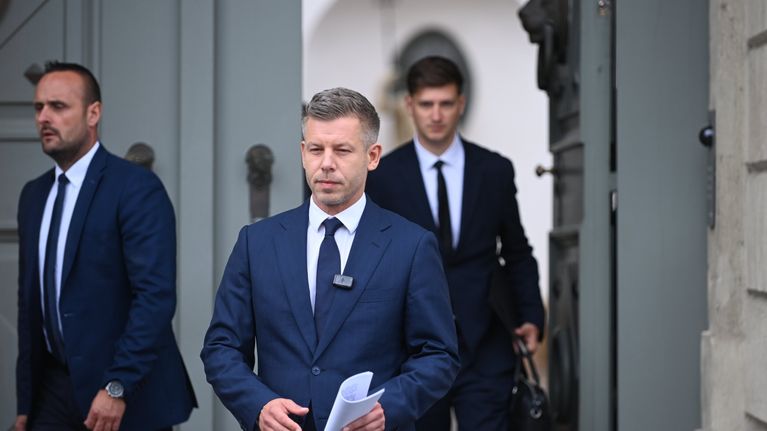
Péter Magyar (pictured) has repeatedly tried to negotiate with President Sulyok before the constitutional tussle and urged him to resign voluntarily. Sulyok, however, refused sharply to step aside. Image: All Over Press
Changing the Rules?
The flip side is that the constitutional amendment sets a dangerous precedent.
Removing a head of state by amending the constitution bypasses normal legal process and creates rules that future governments can exploit for political purges.
Human rights organisations fear that hastily dismantling Orbán's apparatus could damage Hungary's institutions in the long term.
Amnesty International has stressed that the proposal threatens to undermine the separation of powers. According to Human Rights Watch, removing the president by legislation recalls the Fidesz era itself. Hungary's Helsinki Committee has also expressed deep concern.
The Helsinki Committee is one of Hungary's oldest and most respected civil society organisations. Its name traces its roots to the 1975 Helsinki Final Act, which formed the basis for the international Helsinki movement to monitor the implementation of human rights.
Prime Minister Magyar must now convince domestic critics and European partners that the legal changes strengthen democratic governance rather than simply replacing one domineering political system with another.
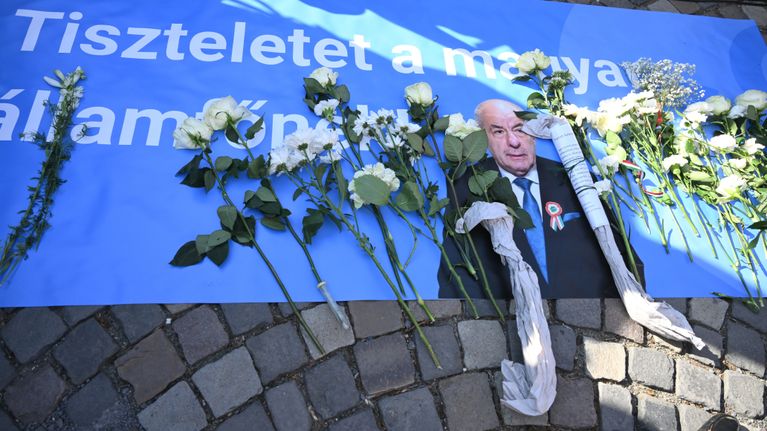
Flowers were laid over an image of Hungarian President Tamás Sulyok at a June protest opposing Prime Minister Péter Magyar's planned purge of the state administration. Image: EPA
The constitutional amendment and the president's removal have also stirred strong opposition in Hungary.
The Fidesz party held a demonstration last week arguing that Magyar's proposed constitutional addition is authoritarian – the very criticism previously levelled at Orbán.
Leading Fidesz politicians criticise the Tisza party for using its new supermajority in exactly the same ways and harsh methods that Tisza previously accused Orbán of using.
However, Magyar's term limits also prevent his own government from entrenching power for decades in the manner of Orbán.
Hungary's state television published a statement on screen last week in which it apologised for having lied to viewers for many years.
What Next?
If Sulyok refuses to sign the law within five days, the government will initiate proceedings against him in parliament.
Parliament will elect a temporary president to replace Sulyok for at most five years, or until the new constitution enters into force.
Sulyok has appealed to the Venice Commission, which falls under the Council of Europe, to assess the legality of the process.
The Pace Has Changed
Under Magyar's tenure, Hungary has already announced it is aiming for euro membership, joined the European Public Prosecutor's Office, and received a ten-billion-euro pot from the EU's recovery instrument created after the pandemic. State media reform is underway.
The government has enacted a new "oligarch tax" targeting large companies and businessmen who became wealthy through state procurement during the Orbán era. These funds finance the government's health care and education reforms.
Magyar has also made smaller systemic changes.
Minsters and state secretaries in the new government can no longer use official state cars or drivers for daily commutes within Budapest. Magyar is distancing himself from Orbán's wasteful politics and put dozens of state-owned luxury official cars directly up for public auction.
After the election victory, Magyar announced that the posturing, luxury lifestyles of decision-makers, and the era of corruption under Orbán are over. The new government, among other things, rejected the traditional formal shoes and switched to wearing white athletic sneakers at official meetings.