
Burkina Faso Presents Third National Report on Sustainable Development Goals Implementation
Burkina Faso presented its third voluntary national report on the implementation of the Sustainable Development Goals (SDGs) for the 2016–2025 period on July 10, 2026, in New York, at the high-level political forum on sustainable development. The report synthesizes a decade of socioeconomic progress by a country that has chosen economic sovereignty and development amid unprecedented adversities.
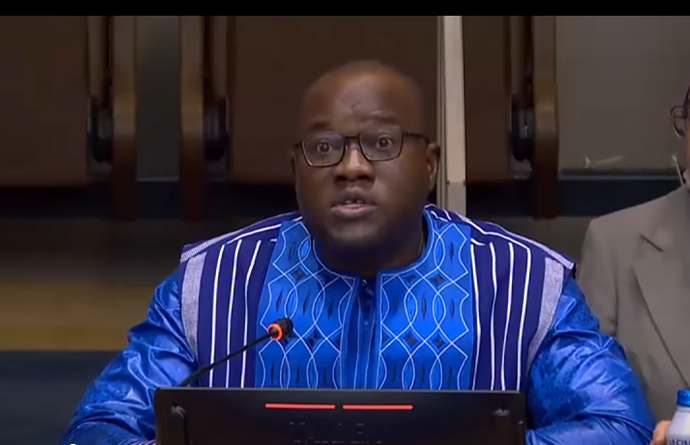
"Ten years of progress, but also of trials. Ten years during which Burkina had to learn to pursue its development amid adversity, to transform crises into challenges, to rise up and to rely more on its own strength." This is the situation of a decade of evolution for the country of upright men, summarized in its third voluntary national report on the implementation of the Sustainable Development Goals (SDGs), presented by Minister of Economy and Finance Aboubakar Nacanabo on July 10, 2026, in New York, at the high-level political forum on sustainable development, organized by the United Nations Economic and Social Council.
Supported by indicators of economic and social performance, he demonstrated that despite terrorist attacks, effects of climate change, COVID-19, supply chain disruptions, geopolitical tensions, and declining external financing, Burkina Faso endures. Moreover, it advances toward progress and the well-being of its people. "Few countries would have gone through so many trials without seeing their development ambitions deeply shaken," Minister Nacanabo emphasized.
As evidence of its strong resilience capacity, Burkina Faso recorded average growth of 4.8% over the 2016–2025 decade, with cereal production reaching 7.15 million tonnes, or 126% of national needs coverage. These performances in agriculture result from a political will materialized through structural investments in that sector, he noted. To this are added advances in basic social sectors. In health, for example, indicators show continuous improvement, as illustrated by a 30% reduction in malaria incidence between 2024 and 2025.
In education, thanks to efforts to reclaim national territory, marked by a gradual improvement in the security situation, 1,473 schools were opened between 2024 and 2025, following the return of populations to their localities. "Behind this figure are thousands of children returning to school. These are communities coming back to life. It is the state returning and hope being reborn," the minister emphasized. In social protection, Burkina Faso now has 1.84 million vulnerable people registered in unified social schemes, with 20% enrolled in universal health insurance. Committed to the path of financial sovereignty for better control of its own development, Burkina Faso has more than doubled its own resources over the decade. These reached 3,309.7 billion CFA francs in 2025.
Burkina Faso's Progress on the SDGs
In his presentation of the 3rd voluntary national report proper, Aboubakar Nacanabo highlighted the achievements his country has made in implementing the five SDGs selected for the 2026 assessment. Indeed, at the level of SDG 6, the rate of access to drinking water stood at 78.9% in 2025, compared to 72.4% in 2016. Regarding sanitation, the rate rose from 19.8% to 28.8%. The community approach to total sanitation, public investments in boreholes, the drinking water supply system, and integrated water resource management explain this progress in both sectors.
Regarding SDG 7, convinced that there can be no industrialization or economic transformation without energy, and no true economic sovereignty without energy sovereignty, the country has firmly committed to ensuring populations access to sufficient, reliable, secure, and sustainable energy. This political will, accompanied by substantial investments, has allowed the national electrification rate to rise from 20.07% in 2016 to 34.2% in 2024 and has doubled the share of renewable energy in national production, which increased from 14.3% to 29.7%, thanks to investments in solar power plants.
Concerning SDG 9, dedicated to industry, innovation, and infrastructure, Minister Nacanabo noted that the contribution of the industrial sector to gross domestic product (GDP) rose from 24.4% to 32.9%, while the mining sector's share in GDP in 2025 stands at 19.3%. The massive expansion of fiber optics, which has increased sixfold since 2016, has allowed mobile internet penetration to rise to 83%. At the level of SDG 1, through city construction responding to the aspirations of populations, the presidential program Burkina Faso "Ndeenw Ka Soow" aimed at building 50,000 homes contributes to its realization. Burkina's ambition is to build more inclusive, resilient, and better-planned cities.
With regard to establishing partnerships for development, the seat of SDG 17, the approach of the country of upright men focuses on three complementary levers: strengthening mobilization of internal resources, developing innovative national financing mechanisms, notably popular shareholding, consolidating international partnerships, and mobilizing contributions from the diaspora. As an illustration, in terms of participatory financing, the Agency for the Promotion of Community Entrepreneurship (APEC) mobilized and invested more than 18 billion CFA francs over 2023–2025 in structural industrial projects.
A Call for a Different World
Without forgetting that Burkinabè people have financed security and territorial reclamation to the tune of 500 billion CFA francs between 2023–2025 through Patriotic Support Funds (FSP). At the same time, transfers from the Burkinabè diaspora are estimated at approximately 350 billion CFA francs in 2025. For the minister, the government's vision is to mobilize its own forces first to better build partnerships with others, because true partnership is built neither in dependence nor in submission, but in responsibility, trust, and mutual respect. And all these achievements, he continued, reinforce our conviction that even in adversity, development is possible when political will, national mobilization, and confidence in our own capacities converge. The adoption of its new national development plan, Relance 2026–2030, is part of the same momentum.
Beyond presenting Burkina's advances over 2016–2025, Minister Nacanabo addressed four key messages from his country to the international community, deriving from its ambitions and convictions, "forged by trial and carried by hope." They concern the courage of Burkinabè people who, in the face of diverse adversities, refuse to bow and submit to others' dictates—resilience, which has become a collective strength in the face of harsh trials; hope based on Burkinabè faith in sustainable development and in peoples' capacity to transform their destiny despite crises, uncertainties, and world divisions.
It is, above all, a message of sovereignty—none other than the commitment of the Burkinabè people to make their development choices anchored in national priorities, its realities, and deepest aspirations.