
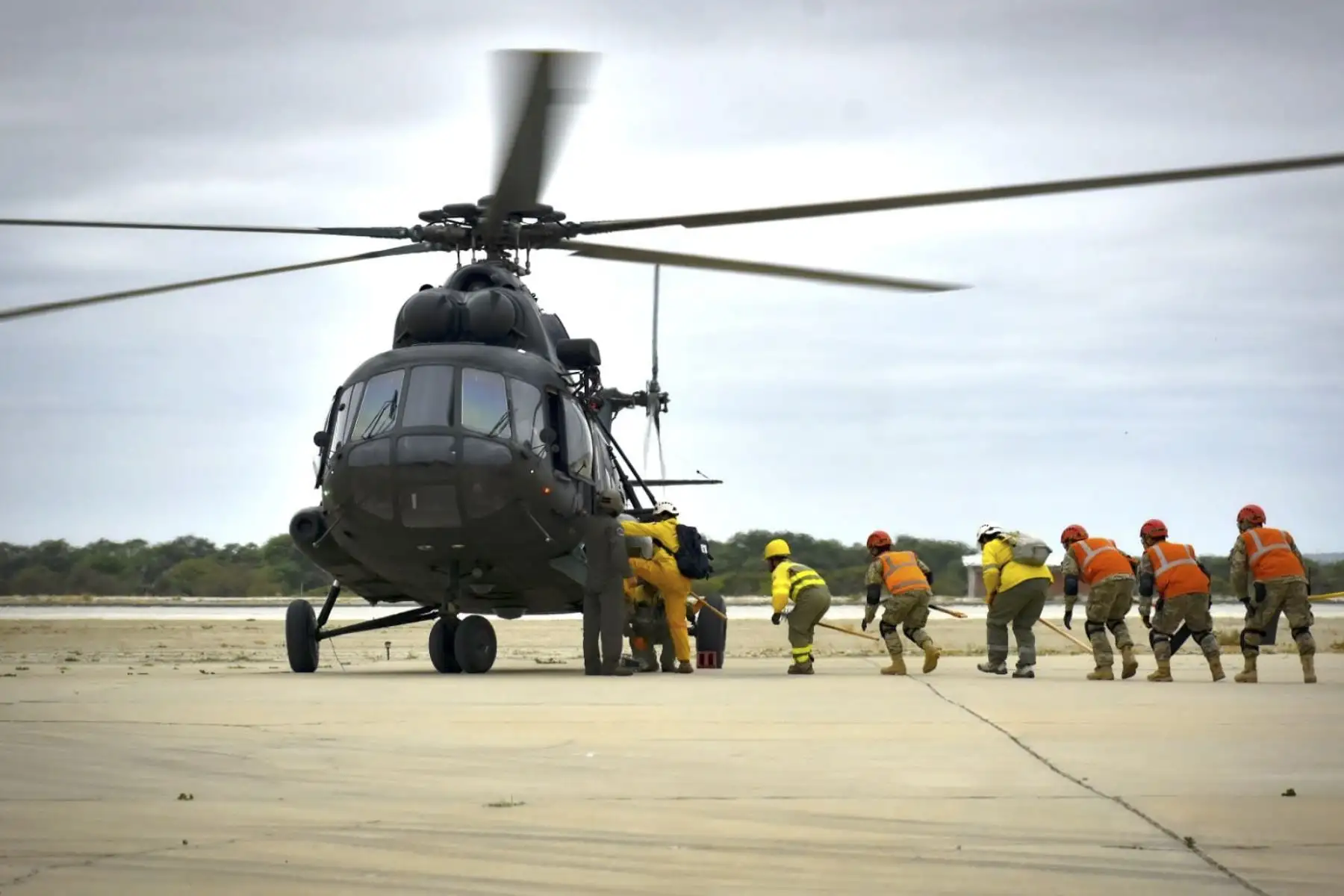
Peru's Air Force Leads Multisectoral Wildfire Response Exercise
The Peruvian Air Force (FAP) led the multisectoral exercise "PAAMARI II - Piura 2026" at the facilities of Air Wing No. 1, aimed at strengthening response capacity against forest fires and possible effects of the El Niño phenomenon.
The institution planned, conducted, and coordinated operations, integrating entities from the National System for Disaster Risk Management to optimize coordinated emergency response.
The exercise brought together specialized personnel from the FAP, the National Service of State-Protected Natural Areas (Sernanp), the General Volunteer Fire Department of Peru, the National Civil Defense Institute (Indeci), and other institutions, who participated in joint training aimed at strengthening inter-institutional coordination and interoperability in high-complexity scenarios.
During the exercise, various FAP operational capabilities were tested, including the use of the C-27J Spartan aircraft equipped with the Guardian System, which enabled aerial deployment of biodegradable boxes filled with water for initial forest fire response.
MI-17 and Bell 212 helicopters equipped with the Bambi Bucket system also participated, with capacity to transport and discharge large volumes of water over affected areas.
The exercise also included the intervention of specialized forest fire brigades and the execution of Search and Rescue (SAR) maneuvers, integrating air and ground assets under FAP command.
Interoperability Among Institutions
One of the main objectives of PAAMARI II was to validate the application of the Incident Command System in a large-scale forest fire scenario.
To achieve this, the interoperability of participating institutions was tested, the coordinated deployment of air and ground assets, efficient resource management, and decision-making under a Unified Command structure, strengthening the State's response capacity to such emergencies.
As part of preparation for the "PAAMARI II - Piura 2026" exercise, the Peruvian Air Force conducted the Helicopter Aerial Crew course for Sernanp personnel from Lambayeque, Piura, and Tumbes, as well as representatives of participating institutions.
The training was carried out aboard an FAP MI-17 helicopter and trained participants in support functions for forest fire suppression, including the use of the Bambi Bucket system, which allows transport and discharge of large volumes of water over affected areas.
With the development of the PAAMARI II - Piura 2026 exercise, the FAP consolidated its leadership in the preparation and conduct of disaster response operations, strengthening interoperability among participating institutions and reaffirming its commitment to maintaining its operational capabilities in service of protecting the population and the country's natural heritage.