
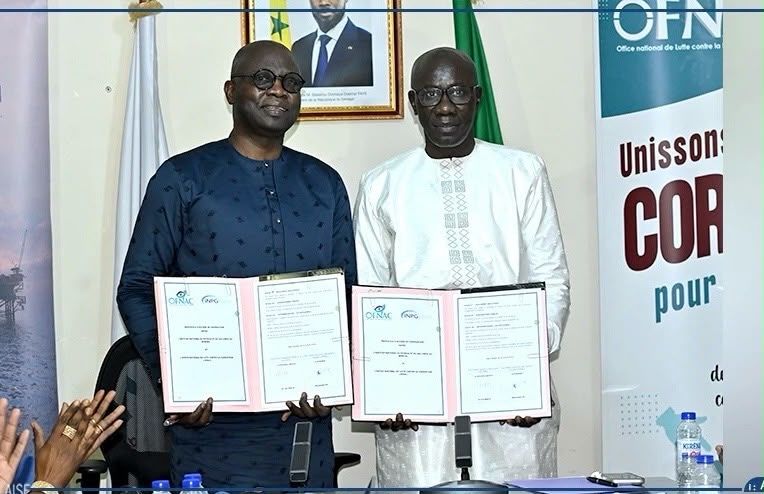
Senegal's Anti-Corruption Office and National Gas and Petroleum Institute Sign Cooperation Agreement
The National Office for the Fight Against Fraud and Corruption (OFNAC) and the National Institute of Gas and Petroleum (INPG) signed a cooperation agreement on Friday aimed at promoting transparency, integrity, and good governance in the oil, gas, and energy sectors. The partnership also seeks to prevent and combat corruption and related practices in hydrocarbon-related activities.
For OFNAC president Moustapha Ka, this signature goes beyond a simple administrative formality. According to him, Senegal has entered a new phase of its economic history with the development of its oil and gas resources. While this dynamic opens up significant growth prospects, it also requires exemplary governance.
"The exploitation of natural resources can be a powerful engine of development, provided it is based on transparency, accountability, ethics, and citizen oversight," he stressed. He recalled that this sector, while creating value, strengthening public finances, and supporting investment, remains exposed to risks such as conflicts of interest, contractual opacity, favoritism, undue capture of revenues, non-compliance with regulatory rules, and weaknesses in control mechanisms.
Facing these challenges, OFNAC and INPG have decided to establish an Anti-Corruption Academy. This structure is intended to be a reference space dedicated to training, research, knowledge production, and experience-sharing in the prevention of integrity-related risks, particularly in sensitive sectors.
The Academy's main missions will be to train students and agents from the public and private sectors, strengthen the capacity of extractive sector actors, produce knowledge and educational tools, and raise public awareness of the issues surrounding the fight against corruption.
For his part, INPG director Dr. Fall Mbaye reaffirmed his institution's commitment to supporting this project. The INPG will place appropriate facilities at the Academy's disposal according to mutually agreed terms, facilitate access to educational infrastructure—particularly training rooms, equipment, and digital platforms—and integrate the Academy's activities into its academic environment.