
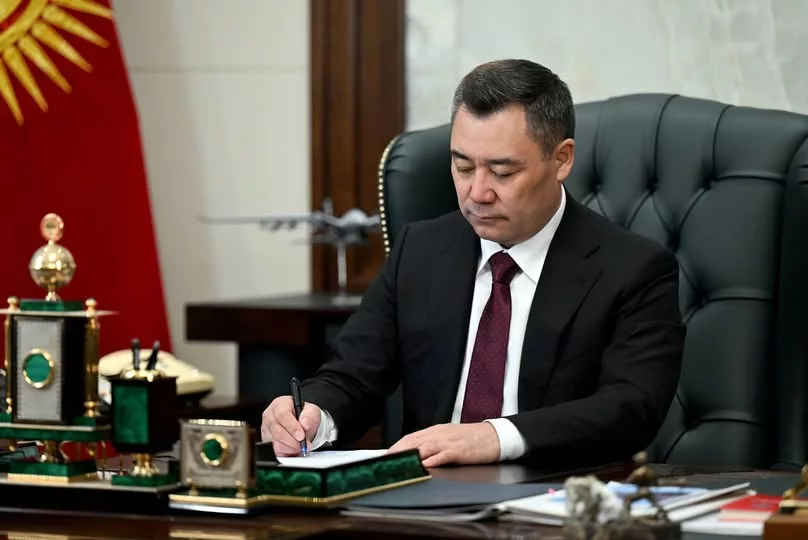
President of Kyrgyzstan Signs New Referendum Law
President Sadyr Japarov of Kyrgyzstan has signed a revised version of the Constitutional Law on Referendums.
Under the law signed on July 8, referendums may be held on draft constitutions of the Kyrgyz Republic, laws including amendments to the Constitution, and other matters of state significance.
A referendum question must be formulated in such a way as to exclude the possibility of multiple interpretations and permit only a single unambiguous answer.
Questions that cannot be submitted to referendum:
- War and peace;
- Early termination or extension of the president's or deputies of Jogorku Kenesh's term of office;
- Appointment of early elections for president or Jogorku Kenesh deputies, or postponement of such elections;
- Introduction, modification, or repeal of taxes and fees, or exemption from payment;
- Tariffs;
- Changes to the secular character of the state, unitarity, or territorial integrity of the Kyrgyz Republic;
- Administrative-territorial structure and borders of the Kyrgyz Republic;
- Introduction of martial law or emergency situations;
- Adoption or modification of the republican budget;
- Matters related to election, appointment, and removal of officials in representative and executive state bodies;
- Amnesties and pardons.
Referendums cannot be conducted during martial law or a state of emergency declared across all of Kyrgyzstan or in certain areas.
A repeat referendum using the same or similarly worded question cannot be held within one year of official publication of the previous referendum's results.
Decision to hold a referendum:
- The President may call a referendum on adoption of the Constitution on his own initiative, at the initiative of no fewer than 300,000 voters, or at the initiative of two-thirds of all Jogorku Kenesh deputies.
- The President may decide to hold a referendum on amendments and additions to the first, second, and fifth sections of the Constitution on his own initiative, at the initiative of no fewer than 300,000 voters, or at the initiative of two-thirds of all Jogorku Kenesh deputies.
- The President may decide to hold a referendum on other matters of state significance on his own initiative, at the initiative of no fewer than 300,000 voters, or at the initiative of a majority of all Jogorku Kenesh deputies.
- Between designation of a referendum and official publication of its results, the parties mentioned above cannot propose initiating a new referendum.
A referendum is called by presidential decree. The decree sets the referendum date and the wording of the question or questions to be put to referendum; the referendum date may be set for any non-working day no later than four months from the date the decree takes effect.
Remote and electronic voting may be used in referendums. The decision to conduct remote or electronic voting is made when the referendum is called.
A decision taken in a referendum is binding, requires no additional approval, and applies across all of Kyrgyzstan.
The law takes effect after ten days from its official publication—July 21. The Central Election Commission has been tasked with bringing its regulatory legal acts into compliance with the law.