
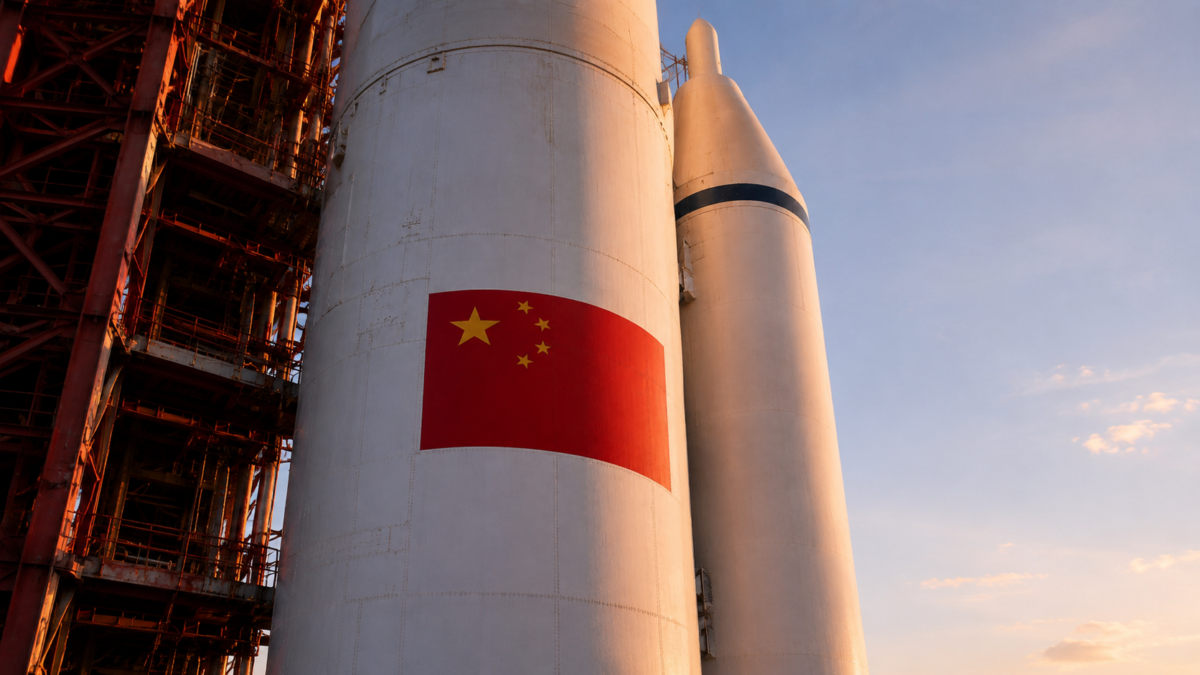
With the recovery of the first stage of the Long March 10B, China has become the second country in the world to demonstrate orbital reusability capability and is now aiming to harness it to support its mega-satellite constellations and future lunar missions. A result that reopens the comparison with the United States and that, once again, highlights Europe's lag.
10/07/2026
At 12:15 on Friday in Beijing (6:15 Italian time), a Long March 10B rocket launched from the commercial launch site at Wenchang on Hainan Island, and about eleven minutes later, the China Aerospace Science and Technology Corporation (CASC) confirmed that the first stage, after separating from the second stage and releasing the satellite on its trajectory, returned in a controlled vertical descent and was recovered by being caught in a net mounted on a floating platform at sea. This is the first time China has succeeded in recovering the first stage of a launcher after an orbital flight, a milestone that no other actor except SpaceX has yet managed to replicate on these terms.
A second place that is worth a revolution
It is worth clarifying the situation. In the field of reusable launchers, SpaceX retains the absolute lead, regularly recovering Falcon 9 boosters since December 2015, and more recently Blue Origin as well, with the New Glenn rocket. The Chinese achievement therefore represents the third case of orbital first-stage recovery in the history of spaceflight, but the first accomplished by a country other than the United States. China thus becomes the second country in the world to achieve this, ahead of actors such as Europe, Russia, Japan, and India. For Beijing, in any case, this is truly a historic first. In recent months, similar recovery attempts had already been made, both with the state-owned Long March 12A rocket and with Zhuque-3, owned by private company Landspace. Both of these attempts, however, resulted in failure. The same goes for testing the first version of the Long March 10A, which took place in February. This time, the entire sequence, from the separation of the first stage through to recovery on the platform, proceeded without issues.
The difference with SpaceX
On a technical level, the solution chosen by Beijing is slightly different from that of SpaceX. The Falcon 9 lands autonomously on its own legs, on a ground platform or on a barge at sea. The Long March 10B, by contrast, did not touch down on its own "legs," but instead hooked onto a net mounted on a recovery ship, the Linghang Zhe. This is the first documented recovery achieved using this method, which has the advantage of "sparing" the first stage the additional weight of landing legs, thereby increasing payload margin. The launcher, approximately 70 meters tall and 5 meters in diameter, was developed by the China Academy of Launch Vehicle Technology through its commercial subsidiary Chinarocket. This version shares the first stage, powered by seven kerosene and liquid oxygen engines, with the Long March 10A variant, which will be used to launch the crewed Mengzhou capsule, while the second stage, powered by liquid methane, is designed primarily for commercial satellite launches. In the reusable configuration, the vector can carry up to 16 tonnes of cargo to low Earth orbit, compared to almost 23 tonnes for the Falcon 9. CASC has already announced that the stage just recovered will undergo inspections and overhauls to be launched again by the end of the year. At that point, if all goes well, we can say that China has officially entered the ranks of actors with reusable launch capability.
Beijing and Washington race, what about the others?
Why such urgency? The answer lies in the numbers of China's space program and competition with the US. Beijing is simultaneously building two mega-satellite constellations for global connectivity, Guowang and Qianfan, which alone will require hundreds of launches over the next decade and, without reusable boosters, the cost and cadence necessary to place tens of thousands of satellites in orbit would be scarcely sustainable even for the Dragon's economy. There is also the lunar program, which aims to bring the first taikonauts to the Moon by 2030. Meanwhile, everyone else is struggling. Europe above all. The old continent has neither a reusable launcher nor, at present, structured programs in the pipeline to acquire one. There is the European launcher challenge issued by the ESA, but even in that case the selection requirements do not explicitly mention reusable launchers, preferring a vaguer mention of "sustainable solutions." Yet there is now no doubt whatsoever that reusable vectors represent the future (but perhaps already the present) of the global space industry.