
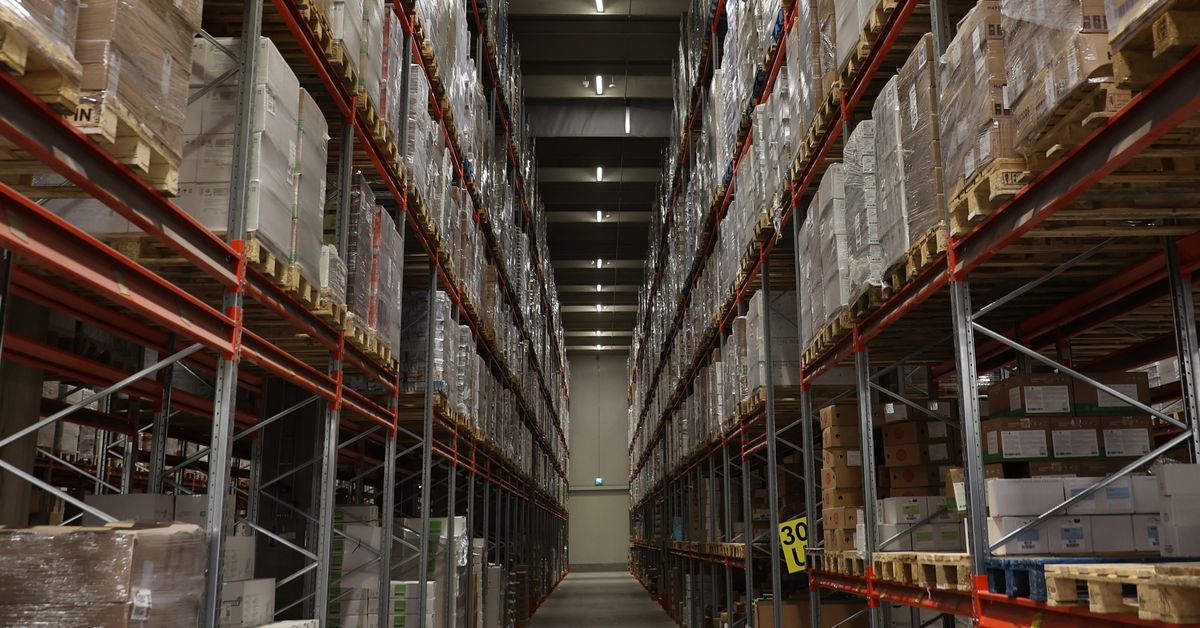
Freezing cold halls are Helsinki-Vantaa airport's newest heat source
Frigid storage halls hum next to Helsinki-Vantaa airport. These frozen food warehouses are Vantaa's newest sources of heat.
When frozen food storage facilities are refrigerated, the fundamental process involves transferring thermal energy away.
Previously, some of the heat from these operations went to KWH Freeze, the company running the frozen storage warehouses, for its own use, while the rest was blown into the air. Now the waste heat is fed through the district heating network to warm homes in Vantaa.
The heat volume is 42 gigawatt-hours per year, equivalent to the average annual consumption of 2,300 single-family homes.
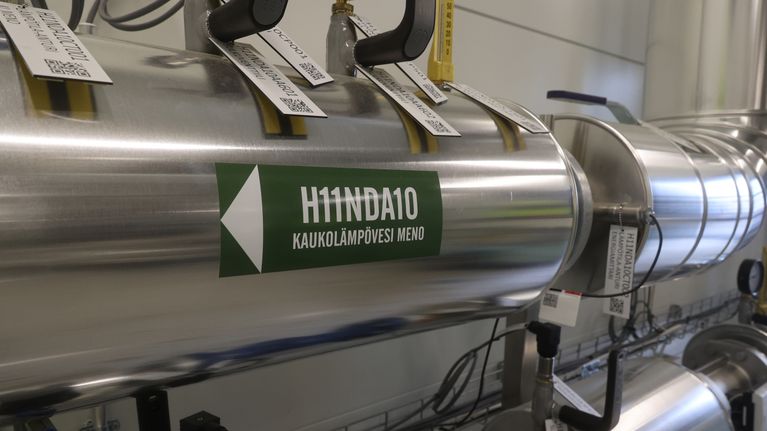
Current forecasts suggest that more than half the time, waste heat from the frozen storage warehouse justifies conversion into district heating. When producing district heating is cheaper by other means, waste heat continues to be released into the air. Photo: Matti Myller / Yle
"Exploiting waste heat in district heating is genuinely sensible. This is very low-emission and cost-effective technology," says Sanna Syri, professor of energy technology and economics at Aalto University.
According to Syri, Finland is doing well at capturing various forms of waste heat. It has grown significantly over the past decade.
The reason is the rising price of fuels and emission allowances, coupled with falling electricity costs for heat pumps.
Heat pumps are necessary because they can raise the temperature of waste energy to whatever level the district heating network requires.
Despite the new investment, Vantaa Energia is not really a pioneer in waste heat recovery.
Before this, the company received waste heat from only one small data centre, even though frozen products have been stored on this site for decades.
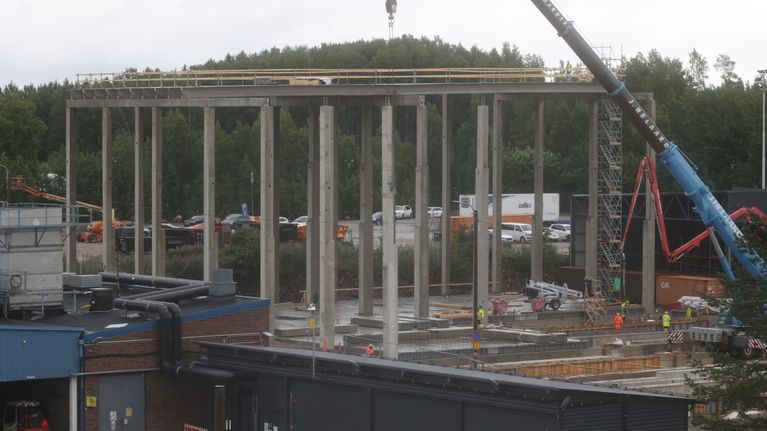
KWH Freeze's Vantaa frozen storage facility, established in 1973, now consists of three sections making it Finland's largest. A fourth warehouse is under construction and will also be connected to Vantaa's district heating network. Photo: Matti Myller / Yle
Syri points out that different cities have very different starting positions.
Helsinki has long exploited waste heat from wastewater in the capital region. Vantaa, on the other hand, has a large waste incineration plant, which has not been hit as hard by rising fuel prices.
Although Syri praises Finland for waste heat recovery, there is room for improvement beyond Vantaa.
When investigated in 2020, over 90 percent of waste heat that was "technically reasonably recoverable" was lost to the environment.
Market prices set the pace, confirms Matti Wallin, energy services director at Vantaa Energia. Fundamentally, the company produces district heating from whatever source is cheapest.
Now the calculations showed the time was right to exploit this waste heat.
Frozen storage waste heat will henceforth cover just over two percent of Vantaa's annual district heating demand.
This is just the beginning. The goal is for waste heat to account for 20 percent by 2035.
"We have quite a lot of negotiations ongoing with various sites where waste heat is generated as part of industrial processes," Wallin says.
Data centres produce more heat—and more risk
The advantage of frozen storage waste heat is that the facility already exists and is undeniably necessary for society. But it is not very large.
Much larger heat quantities are generated in data centres, which are being built and planned intensively across Finland.
For example, Fortum will soon derive 40 percent of Espoo, Kauniainen and Kirkkonummi's district heating from two Microsoft data centres.
Data centres require new land area as well as electricity production and transmission capacity.
Microsoft is building a large data centre in Vihti in addition to the Espoo and Kirkkonummi facilities. Images: Microsoft / Olla Architects
Opinions on data centres' necessity vary: some run critical services, while others power trivial videos or artificial intelligence experiments.
According to Wallin, Vantaa's goal of heating 20 percent with waste heat does not require "excessively large" new data centre projects.
Vantaa Energia estimates that roughly half the waste heat target can be sourced from facilities that already exist today.
"Our strategy is more about gathering waste heat from multiple sources so we can spread that risk," Wallin says.
Aalto University's Sanna Syri also acknowledges the risks of large data centres.
For example, Kouvola has good electrical connections for data centres left over from declining forest industry, and waste heat could become available in larger quantities than the city needs.
But it is not a shortcut to success, because district heating companies have an obligation to keep the city warm in all circumstances.
"If a data centre breaks down or suddenly decides Finland was not a good country after all and moves operations elsewhere, the district heating company must always have a backup plan ready," Syri says.
When Russia invaded Ukraine, Mäntsälä was anxious about district heating, most of which came from a data centre operated by Russian Yandex.
Waste heat exploitation is in energy sector hands—at least in Vantaa
Although some of Vantaa residents' heating now depends on the business of the frozen storage facility, the new arrangement barely affects KWH Freeze's operations.
The refrigeration equipment is the same as before, and little money changes hands, says CEO Mika Halvorsen.
The company made only a small investment in equipment, and it will be gradually paid back over coming years through payments from Vantaa Energia.
Vantaa Energia bore the cost of the expensive heat pumps and thus the financial risk.
"Their business is heat and our business is cold," says KWH Freeze CEO Halvorsen.
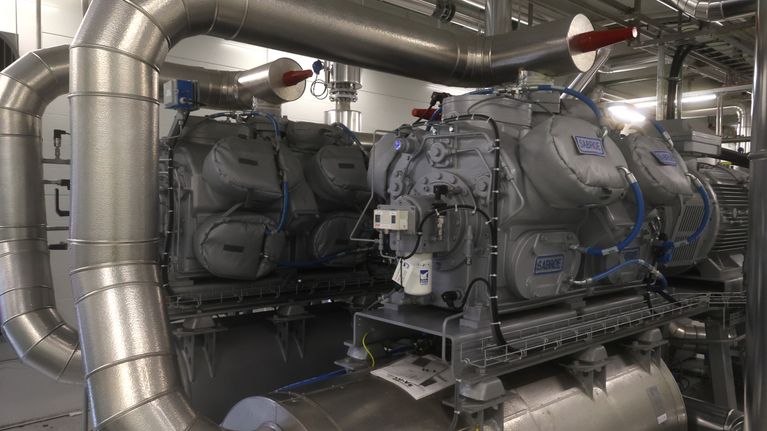
According to Vantaa Energia, the heat pumps' coefficient of performance is 3–4, meaning they produce 3–4 times as much heat as the electricity they consume. Photo: Matti Myller / Yle
One major factor behind rising fuel prices is Russia's invasion of Ukraine. If the war ever ends, fuel prices could change again.
Vantaa Energia's Wallin nevertheless believes the waste heat investment will not lose its foundation.
According to him, there will be pressure from society to reduce all combustion that is not otherwise necessary. That pressure will first focus on fossil fuels and eventually on biomass as well.
"All trends point in the direction that waste heat should not be wasted, and investments like these will become increasingly common."