
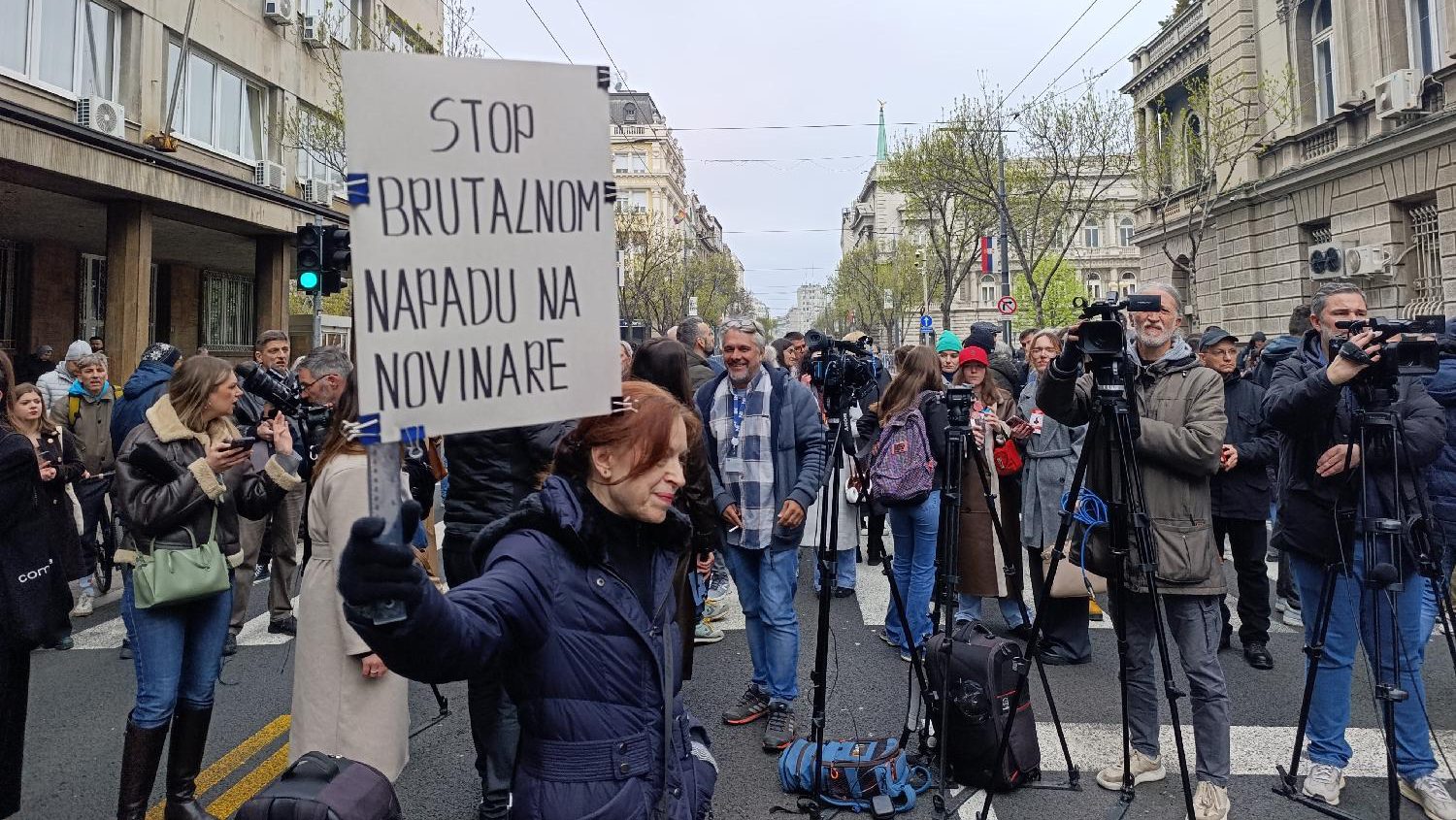
Culture of violence, impunity, and inadequate responses from state institutions, combined with increasingly frequent public attacks by state officials, have created an environment in which threats and attacks on journalists, lawyers, and all critics of the government become normal. According to those interviewed by Danas, the ultimate goal of such pressure is intimidation.
Threats stating that recipients were marked with a "black hand" were sent on the same day to FDU professor Ana Martinoli, BIRN executive editor Gordana Andrić, BIRN journalist Jelena Veljković, and NUNS lawyer Rade Đurić.
On July 5, Martinoli received a message at her official email address signed "zoran cvijanovic" stating: "The black hand has marked you, friend," while threats were also sent to BIRN journalists and Đurić from the Instagram account "zoka2807," which uses the same name.
NUNS warns that this is a person who continues unimpeded in sending threats to journalists, professors, lawyers, activists, and other publicly engaged citizens. The organization notes that similar threats from the same account or from a person using the same identity were previously sent to professors Smiljana Milinkov and Aleksandra Krstić, as well as journalist Vojin Radovanović.
Marlinoli told N1 that the person who sent her the threatening message has sent similar threats to others and, as far as is known, has still not been prosecuted.
Marinoli wrote an article about this case for the weekly magazine Radar, and says this was important to her not for personal reasons, but for others who have recently been receiving threatening messages.
"I have to say it was very important to me to write the article for Radar, not only because of the email I received, but because of almost 20 reports—that is, 20 different people who reported the same or similar threats to their security over the past six to nine months. Similar messages were received from the same address by my colleagues from the Faculty of Political Science, from the Faculty of Philosophy, from faculties in Kragujevac and Novi Sad, as well as numerous journalists and activists," Martinoli said.
As she added, she believes "that everything that happens in pro-regime media—hate speech, targeting, insults—as well as statements from high-ranking state officials, creates an atmosphere in which you get the feeling not only that it is permitted to threaten people, but that it is desirable."
"An atmosphere where self-censorship increases, where it will matter to you whether you will speak up at your workplace, in your environment. All of this serves to create a general social atmosphere in which everyone will start to worry about whether to say something," Martinoli said.
Asked whether the email caused this reaction in her, she said it did create discomfort.
"For me and my family, but also for people in my immediate circle. Although the email did not surprise me much, what did surprise me was that at the moment I announced that I had received such a message, a broad community of journalists, activists, and professors came forward. And then we realized we were dealing with one and the same address, to which no one had reacted. And that troubles me more than that single email," Martinoli concluded.
Rade Đurić, a lawyer with the Independent Association of Journalists of Serbia, told Danas that a culture of violence and violent narrative prevails in Serbia, which, combined with impunity and lack of accountability, leads to a situation where violent behavior, death threats, and targeting are seen as completely normal.
"The biggest problem is that such a pattern of behavior comes from representatives of the authorities. They treat journalists roughly and irresponsibly, and members of the police have already shown they are ready for both physical and verbally very crude treatment. This pattern is then adopted by others. We have reached a situation where values and culture, as social phenomena, have created an environment in which attacks on journalists are increasingly perceived as something permitted," Đurić said.
As Đurić adds, there is no real support from the prosecutor's office and police in protecting journalists, and the real goal is to intimidate journalists so they can no longer perform their job of presenting the truth.
"These institutions, which should independently do their job, unfortunately do not. The prosecutor's office presents itself in a very negative light, and people have even started to mock it, because you can see that they actually cannot, even when they want to, protect journalists. A particular problem for us today is the police, which not only denies this, but openly places itself in the service of a particular side, particular interests, and against journalists," Đurić explains.
The threat sent to lawyer Rade Đurić from the Instagram account "zoka2807," which reads: "Read, the black hand has marked you, be careful, friend," he assesses as a term relating to violence, attack, endangering security, death, and murder.
"Not only I, but my journalist colleagues truly believe our security is endangered. We rank this threat of being marked with a 'black hand' in the same category as the most direct threats, those in which rape, murder, mutilation, persecution, attack, and the like are mentioned," he says.
NUNS filed a criminal complaint with the High-Tech Crime Prosecutor's Office over these threats, and as Đurić notes, they responded very quickly and the case was opened. The prosecution has instructed the police's high-tech crime unit to identify the person who sent such a message.
"For the Prosecutor's Office to proceed, it is necessary to establish the identity of the person who made the threat, so that a conversation can be held with that person or further measures taken. In this case, the identity of the perpetrator is still unknown. The Prosecutor's Office is responding, but it needs greater support from the police, which again raises the question of the relationship between the two institutions and the effectiveness of police action," Đurić noted.
He added that when it comes to representatives of the authorities, "it is incredibly easy to find potential perpetrators or people committing these acts, but when it comes to journalists, it always stalls."
"I think it is clear where the problem actually lies and how it can be solved," Đurić concludes.
In June 2026, the Independent Association of Journalists of Serbia (NUNS) recorded a total of 21 cases involving journalists and media workers. Ten attacks, seven death threats and endangerment of journalists' physical security, and four cases of other threats were documented.
BIRN director Dragana Žarković Obradović emphasized that the standard response they receive from the prosecutor's office is that the Interior Ministry does not cooperate, but that, as she notes, it is not their responsibility to ensure that cooperation.
"Every threat and attack on political opponents and government critics undoubtedly has political and ideological grounds. It remains to be determined whether this is a coordinated attack, and I expect the answer to that question from the Prosecutor's Office," Žarković Obradović concludes.
Beyond attacks on journalists, numerous attacks on lawyers have also been recorded in the previous period. Lawyer Danko Cvejić was beaten and sustained severe bodily injuries. The Bar Association of Serbia noted that the attack occurred on Saturday, while Cvejić was with his minor children, assessing that this incident calls into question the state's ability to guarantee lawyers basic personal security and equal protection under the law.
Dušan Bratić, president of the Bar Association of Serbia, told Danas that the causes of such attacks are, on one hand, ineffective work by police, prosecutors, and courts, and on the other, the social environment that has been created in our society, unfortunately, over many years.
"To these causes we must add the contribution of certain media outlets that actually incite violence as a way of resolving conflicts, first among people and then in societal conflicts," Bratić emphasizes.
He adds that for now there is not enough data on whether these attacks on lawyers and their property were organized or are cases that are not interconnected.
"If there are even indicators of elements of coordination, direction to achieve certain goals, we will certainly as the Bar Association review this, draw certain conclusions, and then assess whether and what further actions are necessary," Bratić said.