
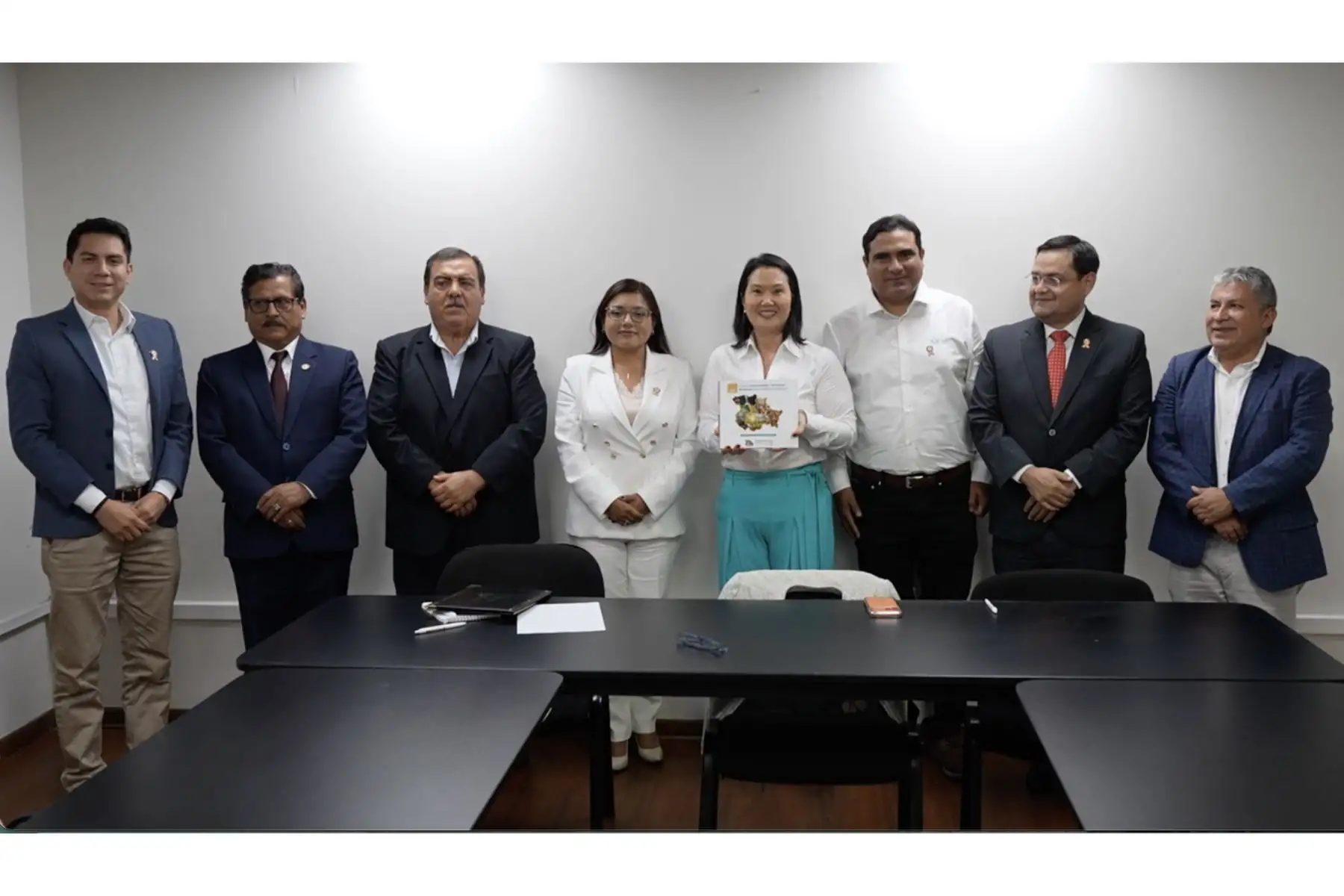
As part of her dialogue round with various political sectors in the country, president-elect Keiko Fujimori met today with the board of directors of the National Assembly of Regional Governors (ANGR) to coordinate actions on prevention efforts against the El Niño phenomenon and to learn about the progress of public works.
Following the meeting at the president-elect's office, the ANGR representatives, headed by Luis Neyra, regional governor of Piura, welcomed the incoming head of state's willingness to meet to address urgent issues such as the response to the El Niño phenomenon.
"I believe that this message she has had with the members of the Board of Directors of the National Assembly of Regional Governments has been quite hopeful, since she has committed to working hand in hand to move our country forward," said the ANGR president.
Luis Neyra noted that they have committed to working jointly, with all the machinery that regional governments have and private sector participation, to face the imminent rains through mitigation work against the El Niño phenomenon.
He also noted that the meeting addressed the issue of reconstruction and permanent works in regions such as Piura, for which a budget is required. "We must also be concerned about permanent works and our president-elect understands this, and that is important," he said.
Resources for riverbank defenses
Meanwhile, Jorge Pérez, Regional Governor of Lambayeque and ANGR vice president, expressed that they have told the incoming head of state the position of regional governors regarding the supplementary credit project being debated in Congress.
"We ask Congress to reflect and that this money serves fundamentally for priority works of riverbank defenses, for the difficulties that our coastal regions will face, but also those regions that will suffer from frost and cold spells," he said.
He also clarified that regional governments will make available all their machinery deployed throughout the entire country, so that, together with the teams of the ministries and the Armed Forces, they can complement each other to face any emergency.
He also expressed that regional governors hope that starting July 28, an "investment shock" will be implemented at the level of infrastructure the country requires.
Macroregions
Meanwhile, Gilia Gutiérrez, Regional Governor of Moquegua, greeted President Keiko Fujimori on behalf of the ANGR and noted that as a representative of the southern macroregion she has raised to the incoming leader the importance of addressing the country's problems by macroregions.
In that regard, she noted that she has laid out to Keiko Fujimori the urgent problems of the southern part of the country that have gone unaddressed for decades, such as closing gaps in health and education.
"The president has committed to meeting with the governors of the southern part of the country to address problems such as the El Niño phenomenon, but in much of the south we will rather suffer from water scarcity, frost, and therefore it is our responsibility to work on prevention," she said.
She also stated that in the south there are social conflicts due to river contamination, as well as border problems existing in regions such as Cusco, Tacna, and Moquegua.
"There is a broad agenda; there is the commitment of the president to work in the field as we women do. And to work hand in hand for the good of the country, because if the government that enters today does well, the regions do well and Peru does well," she said.
Finally, Antonio Pulgar, Regional Governor of Huánuco, stated that another problem facing regions is illegal mining, which must also be addressed.